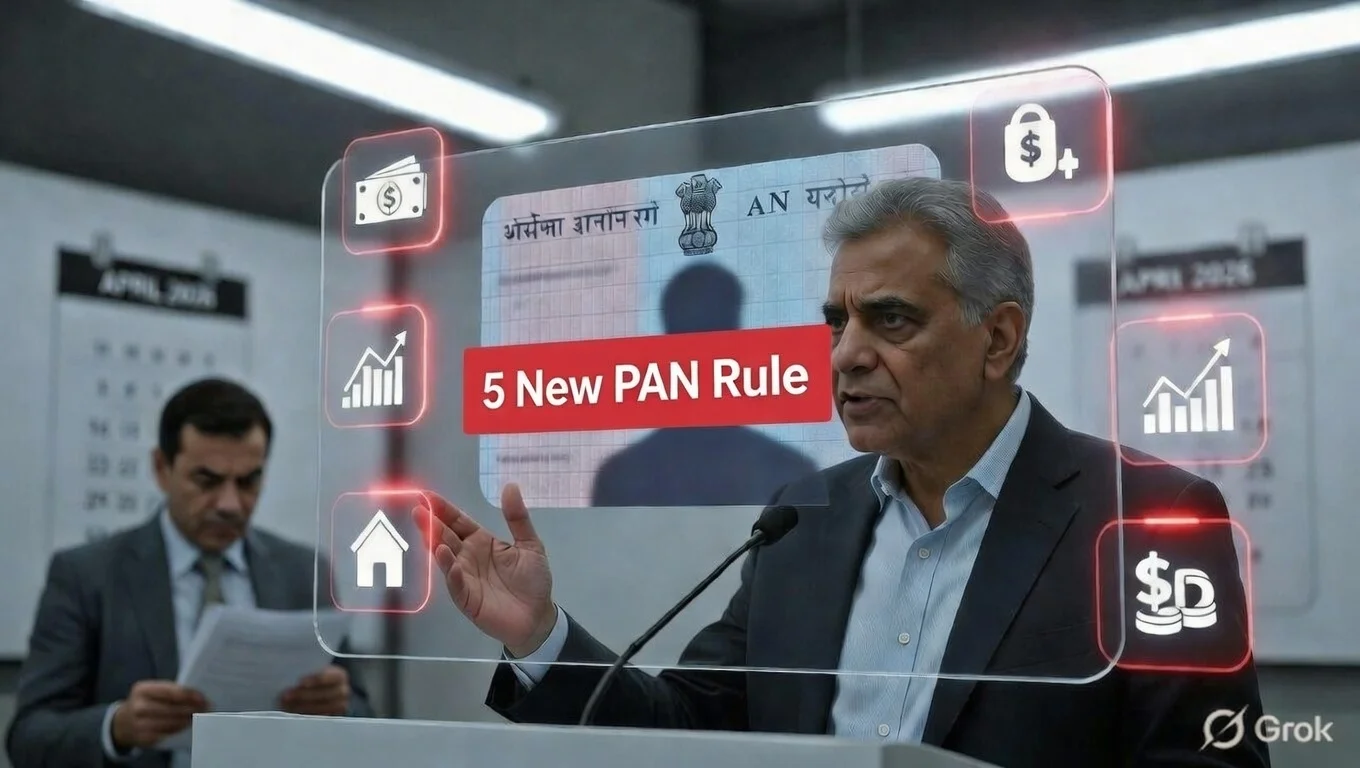
New proposed income tax regulations in India suggest major changes to how residents can use a PAN (permanent account number) card in a financial transaction. The suggested regulations involve attempting to streamline smaller transaction compliance, while losing regulations on larger transaction compliance. Financial institutions will use these to help prevent tax evasion. These revisions will focus on tax evasion. These changes will affect real estate, the insurance sector, salaried employees, small business owners, and a large number of taxpayers.
As of now, employees are being interrupted and annoyed by the constant need to use a PAN card on every small transaction. The proposed changes will address the constant need to use a PAN card in small transactions while allowing larger transactions that need to be tracked to remain in place. This guide will address “What are the 5 major transactions changing the 2026 PAN changes?" and tips on how to use a PAN card.
1. Cash Transaction Limit 2026: Daily To Annual Aggregate £10 Lakh
The most taxpayer-friendly/simplest change to the Draft Income Tax Rules 2026 is the change to the cash transaction limit 2026. The previous rules made it so that banks and post offices required the quoting of a PAN for cash deposits made of over ₹50,000 in a single day. This created a hassle for small business owners, farmers, and families with legitimate cash flows.
The NEW PAN CARD Rules 2026 are moving from daily limits to an annual aggregate limit. PAN will become necessary only when total cash deposits ORwithdrawals across one or more accounts in one financial year (April to March) are equal to or greater than ₹10 lakh. This creates a new restriction for non-PAN holders.
This means:
- A small trader will now be able to make monthly cash deposits of ₹80,000 without being asked to provide a PAN.
- Banks and other financial institutions will simply request that a PAN be provided when the total annual deposits exceed ₹10 lakh.
- The same conditions apply to cash withdrawals; no more daily limits, just the annual total.
The adjustment under the cash transaction limit of 2026 will cut down paperwork for middle-class families and micro-enterprises. It is also in line with the government’s goal of easing the burden of compliance while targeting patterns that typically indicate unreported income. Analysts anticipate these changes will foster the use of digital payments while not disadvantaging bona fide cash users in rural and semi-urban locations.
Pro Tip: Use a bank statement and apps such as BHIM or Google Pay to track your cash transactions throughout the year. If you get close to the ₹10 lakh limit, cash withdrawals may need to be digital to avoid having a PAN request at the end of the month.

2. Property PAN Threshold ₹20 Lakh: Huge Relief for Affordable Housing and Smaller Transactions
The revised property PAN threshold of ₹20 lakh will be a game-changer for real estate buyers and sellers. Currently, for any purchase or sale of movable property (house, flat, plot, or land) worth ₹10 lakh, PAN needs to be provided. The Draft Income Tax Rules 2026 have increased this limit to ₹20 lakh, making this one of the most anticipated proposals in the PAN card new rules 2026.
The new regulation also mentions property gift transactions as well as joint development agreements (JDAs), which were previously considered ambiguous. For transactions valued over ₹20 lakh, both parties must provide their PAN for registration.
Real-life impact:
- Is there no requirement for PAN quoting at the registrar's office for purchasing an ₹18 lakh 1 BHK flat and a small piece of land in a Tier 2 or Tier 3 city?
- In the case of luxury and commercial real estate that goes for ₹20 lakh or more, the owners must still provide a PAN, which ensures that the high-end real estate market is still controlled.
- This is less of a compliance burden for first-time home buyers and buyers in smaller towns, as property prices are considered.
The change in the property PAN regulation to ₹20 lakh is anticipated to encourage transactions in affordable housing and ease documentation for middle-income families. All other KYC requirements, such as Aadhaar, proof of residence, and reporting of capital gains, will remain the same. Real estate registries will be reporting all transactions that are over the established limit to the Income Tax Department as a part of the Statement of Financial Transactions (SFT).
Expert Insight: Real estate consultants believe that this alteration will be especially beneficial for non-metro regions where average property prices are between ₹10-25 lakh. Even for deals of smaller amounts, you should always have a registered agreement for your own protection.
3. Purchase of Motor Vehicles: PAN Necessary Only for ₹5 Lakh (Two-Wheeler Included)
Great news for buyers of vehicles! The PAN card new rules 2026 bring in a value-based threshold for the purchase of motor vehicles in the Draft Income Tax Rules 2026.
- Previous Rule: For the purchase of any four-wheeler (cars, SUVs), a PAN was needed, while for two-wheelers, it was typically exempted.
- Current Rule: A PAN will now be needed if the purchase price is greater than ₹5 lakh. This does include high-end bikes and scooters, but not tractors or other agricultural vehicles.
With prices between 4.8 and 5.5 lakh, owners of vehicles will be influenced, as owners of premium motorcycles will lose that privilege. Those purchasing a ₹4.8 lakh sedan will bypass this requirement, while those purchasing a ₹5.5 lakh bike will be subject to it. Dealers have to report the sale to the tax department and will quote a PAN at the time of sale.
Significance
- Those buying budget cars (Maruti Swift, Hyundai i20 base models, or entry-level EVs) will be able to bypass the PAN requirement.
- Those buying premium two-wheelers (Royal Enfield and Harley Davidson models) over ₹5 lakh will be required to present a PAN.- The alterations smooth out friction at dealerships and reflect the government’s ease-of-doing-business strategy.
Showrooms are already preparing for the April 2026 rollout. If you intend to purchase a vehicle at that time, be sure to check the on-road pricing carefully, as the RTO charges and insurance are included, which are part of the ₹5 lakh barrier.

4. Hotel, Restaurant & Banquet Hall Payments: Cash Limit Raised to ₹1 Lakh
The fourth significant update in the PAN card new rules 2026 will benefit travellers and event organisers. The limits for cash transactions in hotels, restaurants, banquet halls, and convention centres have been increased.
- Previous Rule: A PAN was required for a single cash transaction greater than ₹50,000.
- Current Rule: A PAN is only required for cash transactions at the time of billing if it’s ₹1 lakh or more.
If you are planning a wedding reception that costs ₹75,000 or an off-site corporate event with a bill of ₹90,000, under the new rules, you can pay in cash without having to quote a PAN. This creates more space for genuine cash transactions in the hospitality sector.
The shift shows that payment methods are changing, with most consumers using cards, UPI, or net banking for larger transactions. As for hotels and restaurants, they’ll continue to report high-value transactions digitally, meaning customers will have to provide their PAN less frequently.
Note: If an event is likely to exceed ₹1 lakh, it may be worth considering some form of payment splitting or using a digital payment method to avoid having to report a transaction. This is only applicable to cash payments, as debit/credit cards and online payments have differing reporting criteria.
5. Insurance Policies: PAN Needed When Onboarding Every Account-Based Relationship
The last change associated with the Draft Income Tax Rules 2026 tightens insurance sector compliance. Until now, a PAN was only required when the annual premium was above ₹50,000.
But now, with the new 2026 PAN card rules, insurers will need to capture the PAN up front as soon as they establish what is called an “account-based relationship.” This means that, even if a basic term plan or a health policy has an annual premium of ₹20,000, the PAN will be required.
Important Impact:
- New policy buyers (life, health, ULIP, or endowment) will have to provide their PAN when they submit the proposal.
- If the PAN is not already linked, existing policyholders will have to update their details.
- The change improves the tracking of insurance-linked high net worth investments.
This may feel like added paperwork at this time; however, in the long run, it reduces disputes when it comes to claims or maturity payouts and, therefore, paperwork. Insurance companies will have to do PAN verification via Aadhaar e-KYC, and will have to do it smoothly.
Preparing for PAN Card Rules 2026 Starting from April 2026
All future verifications will be made easier by linking your PAN and Aadhaar cards.
- Keep all your records. Bank applications, Excel documents, and cash flow tracking applications will help you maintain your records.
- Talk to a tax consultant to make your life easier, especially if you’re involved in high-value insurance, real estate, or automobiles.
- Finalised rules will be issued to stakeholders after the deadline of 22 February 2026. To stay up to date, check the Income Tax India website frequently.
- UPI, net banking, and cards will continue to have fewer restrictions. Technology will keep your life simple.

Final Thoughts
The PAN card new rules 2026 and the Draft Income Tax Rules 2026 will help you ease the burden on your day-to-day life. The cash transaction limit 2026, property PAN limit raised to ₹20 lakh, and relaxed vehicle, hospitality, and insurance rules will all make it easier for the common man, while the government continues to secure its tax base.
Here is how these five massive changes impact home and car purchases, bill payments, cash deposits, and insurance/banking services. Changes include the new PAN card rules, and with each alteration, we move closer to simplifying the burden on taxpayers' systems. Considering the new rules, prepare yourself by organising your documents, updating your records, and shifting to digital payments.

DISCLAIMER: This blog is NOT any buy or sell recommendation. No investment or trading advice is given. The content is purely for educational and information purposes only. Always consult your eligible financial advisor for investment-related decisions.









 72.jpg)