
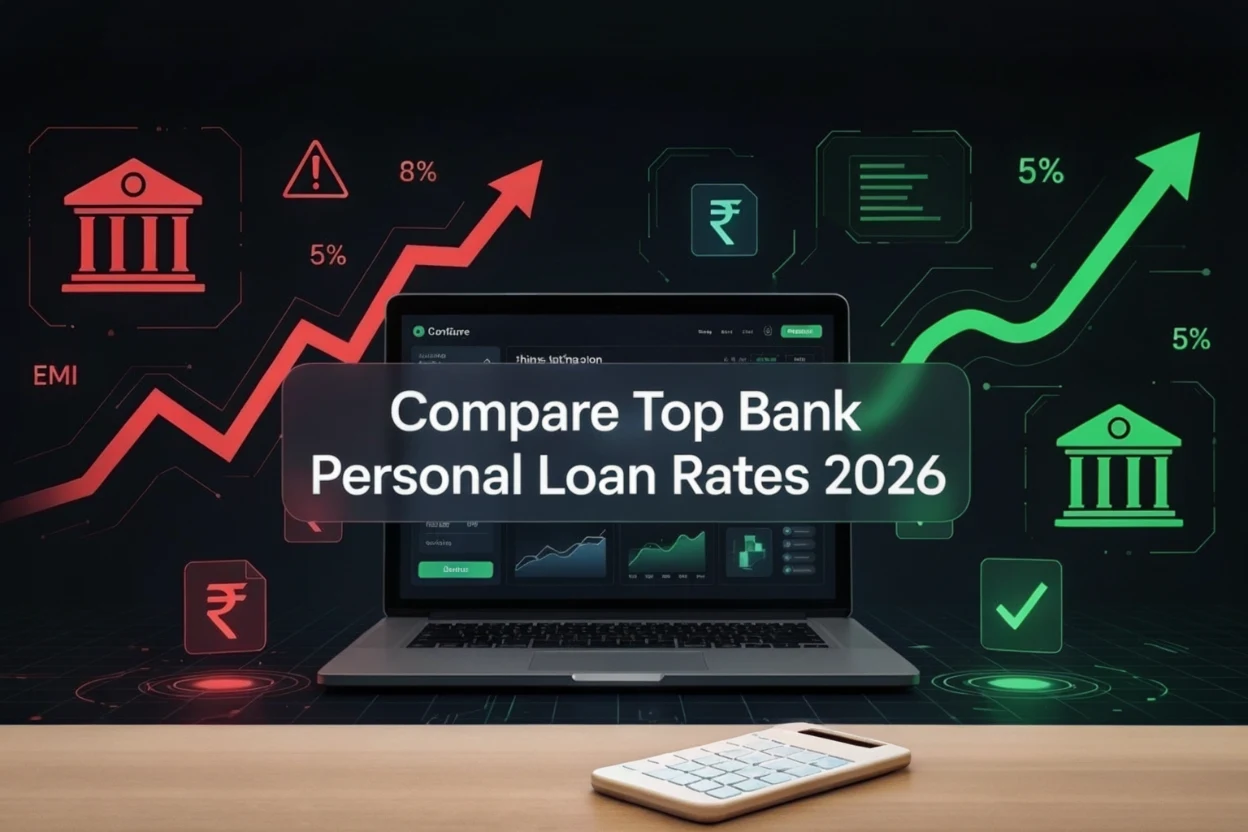
Have you thought about borrowing to fund your wedding, remodel your home, pay for medical expenses, or even fund your business? The personal loan interest rates in March 2026 range from 8.75% to 24% p.a. This means that picking an appropriate lender can lead to a huge difference in your EMIs and total interest. If you are a salaried professional or self-employed, smart personal loan comparison in India has become a necessity.
The lowest initial rates in March 2026 are being offered by public sector banks like the Union Bank of India and the Bank of Maharashtra, and on the other side of the spectrum, private sector giants like HDFC and ICICI Bank Digital Banking are competing for the lowest rates. Subsequently, there also appear to be other considerations that must be taken into account. Bank loan rates in India can vary significantly based on your credit score, disposable income, and the amount of the loan you are requesting.
If you are referred to the personal loan charges (processing fees, prepayment penalties, charges for late payments, etc.), you may be paying much more than you anticipated.
Using this guide, you can get an up-to-date comparison of the leading banks, better insight into the personal loan charges, and we’ll discuss 5 things to watch out for before applying to any loan. Sign up now and let’s get right to work!

Personal Loan Rates March 2026: Leading Providers Compared
Rates are steadier through the March 2026 horizon due to the RBI’s recent policy shifts, but as always, they remain highly customised to the individual borrower. This means your rate depends on your CIBIL score (750+ gets you the best rates), your monthly salary, existing debts and which category your employer falls under.
As of 20 March 2026, here’s a consolidated table through the leading aggregators (BankBazaar, Paisabazaar, and individual banks) to clear personal loan comparison in India
|
Bank / Lender |
Interest Rate (p.a.) |
Processing Fee |
Max Loan Amount |
Tenure |
|
Union Bank of India |
8.75% – 12.55% |
Up to 1% (max ₹7,500) |
₹50 lakh |
1–7 years |
|
Bank of Maharashtra |
8.75% – 13.55% |
Up to 1% (max ₹10,000) |
₹20 lakh |
1–7 years |
|
Canara Bank |
9.70% – 15.15% |
0.5% (₹1,000 – ₹5,000) |
₹20 lakh |
1–6 years |
|
HDFC Bank |
9.99% onwards (up to 24%) |
Up to ₹6,500 + GST |
₹40 lakh |
1–5 years |
|
ICICI Bank |
9.99% onwards (up to 16.50%) |
Up to 2% |
₹25 lakh |
1–6 years |
|
Axis Bank |
9.50% – 21.55% |
Up to 2% |
₹15 lakh |
1–5 years |
|
State Bank of India (SBI) |
10.00% – 15.00% |
Up to 1.5% (₹1,000 – ₹15,000) |
₹35 lakh |
1–6 years |
|
Kotak Mahindra Bank |
9.98% – 18.99% |
Up to 5% |
₹25 lakh |
1–5 years |
|
IDFC FIRST Bank |
9.99% onwards |
Up to 1.50% |
₹1 crore |
6 months–5 yrs |
|
Bajaj Finserv (NBFC) |
10% – 30% |
Up to 3.93% |
₹35 lakh |
1–7 years |
Important insights on bank assurance rates in India
State-run banks (Union Bank, Bank of Maharashtra) offer the best starting rates for salaried individuals with good credit scores. Private banks have an edge with a quicker disbursement (even in 10 seconds) but have a larger processing fee and rate band. Bajaj, an NBFC, finances a larger sum but at a higher interest rate.
Always verify on the lender’s site or aggregator before you apply, as rates may change and are based on your profile.
Personal Loan Costs: Hidden Charges to Watch Out For
Your borrowing costs may increase by 2-5% if you do not consider the additional costs associated with personal loans. Here is what to look for:
- Processing Fees: One-time charge (0.5%-5% of loan amount or a flat fee of ₹6,500). For example, while HDFC has a cap of ₹6,500, Kotak can charge you as much as 5%.
- GST on processing fees: 18% is added for this; do not forget to consider this.
- Prepayment/ Foreclosure fees: Some banks charge you 2-4% if you repay the loan before it is due (unless the loan has a floating rate, then some PSB banks will not charge you this).
- Late payment fees: You will incur a charge of ₹500-1,500 + there is still a chance of you incurring a charge for a penalty of interest (18-36 % per annum).
- Bounce Charges: If you miss an EMI payment, you will incur a charge of ₹500-700.
- Stamp Duty and Documentation: In some states, you will have to pay a fee of ₹500-2,000.
An example of a chargeable fee is a processing fee of 3% on a loan with a 10.5% interest rate. This loan will cost more than a loan with an 11% interest rate and no processing fee.

Personal Loan Tips: Things to do Before Applying
Use the tips related to loan eligibility to avoid making mistakes that will cost you. Don’t jump on the first offer that you get.
1. Confirm Your Loan Eligibility First (Loan Eligibility Tips)
Before comparing loan rates, first check what your loan eligibility is. Most banks require:
- Age: 21-60 years (salaried) or 21-65 (self-employed)
- Minimum monthly salary of ₹15,000 to ₹25,000 (varies by city).
- Employment: minimum 1 year of experience + 6 months in current job.
- CIBIL score: 750+ to get the best (if your score is below 700, the rates increase by 2-4%).
- Debt-to-income ratio: Ensure your EMI + existing loans = below 40% to 50% of your salary.
Loan eligibility tips: Get your CIBIL report for free. Pay off old dues, and make sure to use your credit card no more than 30%. Avoid having multiple credit checks in 30 days. Employees of the government and MNCs also get better rates. If you are self-employed, you should have 2-3 years of ITR.
2. How To Do A Proper Personal Loan Comparison India
The first bank to pre-approve you should not be your end goal. You can use an aggregator to compare 15+ lenders in just 60 seconds.
When comparing lenders, focus on the following:
- The starting rate versus your personalized rate.
- How much interest will you have to pay over the loan duration?
- How fast the loan will be disbursed (HDFC/ICICI = instant, PSBs = 2-3 days)
A 1% decrease in the interest rate is a savings of over ₹25,000 on a loan of ₹5 lakhs over 5 years.
3. Understand the Details of Personal Loan Costs
As previously detailed, processing fees and other hidden fees can affect the costs of your loan. Be sure to ask for a loan schedule, which will break down your EMIs, interest, and any fees you will be charged. Also, be sure to ask for the processing fee to be waived. Many banks will waive this fee for current customers or those who have a higher credit score.
4. Selecting the Appropriate Tenure & What the Real EMI Will Be
A longer tenure will lead to a lower EMI, but will result in a higher overall interest to be paid.
For example, let’s take a loan for ₹5 lakh at 10.5% interest:-
- If the tenure is 3 years, then the EMI will be ₹16,200 and the total interest will be ₹84,000.
- If the tenure is 5 years, then the EMI will be ₹10,800 and the total interest will be ₹1,48,000.
Make sure to use the EMI calculator provided by the bank. In order to have some extra cash at the end of every month, make sure the EMI will be less than 40% of your take-home pay.
5. Examine Rules of Prepayment, What Insurance is Needed, & What Paperwork is Required
Be sure to ask the following questions:
- Will the loan be free to close if only 12 months have passed?
- Does the loan require you to take out insurance? (This adds 1% to 2% to the overall cost of the loan)
- What paperwork do you need? (Usually includes your PAN, Aadhaar, 3 salary slips, Form-16, and bank statements)
Providing all of the required documents in the beginning will greatly improve your chances of your loan being approved without a long waiting period.
Steps to Getting the Best Personal Loan March 2026
1. Obtain your CIBIL score via a free report.
2. Check the websites that aggregate data on personal loan comparison India.
3. Select 3–4 lenders with the most favorable effective rate.
4. Approvals on applications are usually done online in a matter of minutes.
5. Evaluate the most recent offer letter to check the rate and other fees.
6. Digitally sign documents and receive the loan amount within 2–48 hours.

Conclusion
Managing credit that is supposed to be beneficial can easily become a headache if not done properly. Although personal loan interest rates in March 2026 are likely to be better than in previous years, the credit can easily become a trap. For your own sake, set a budget on the loan based on the 50-30-20 rule. You should contact a financial planner if the loan is expected to be greater than ₹10 lakh.
Do you want to keep your money? As easy as starting a personal loan comparison in India is as easy as securing the best bank loan rates in India available based on your profile. With just a few minutes of your time, you could save tens of thousands of rupees.
Your money is important. Use it wisely.
(Source: Livemint)

DISCLAIMER: This blog is NOT any buy or sell recommendation. No investment or trading advice is given. The content is purely for educational and information purposes only. Always consult your eligible financial advisor for investment-related decisions.










.jpeg)
.jpeg)
.jpeg)


