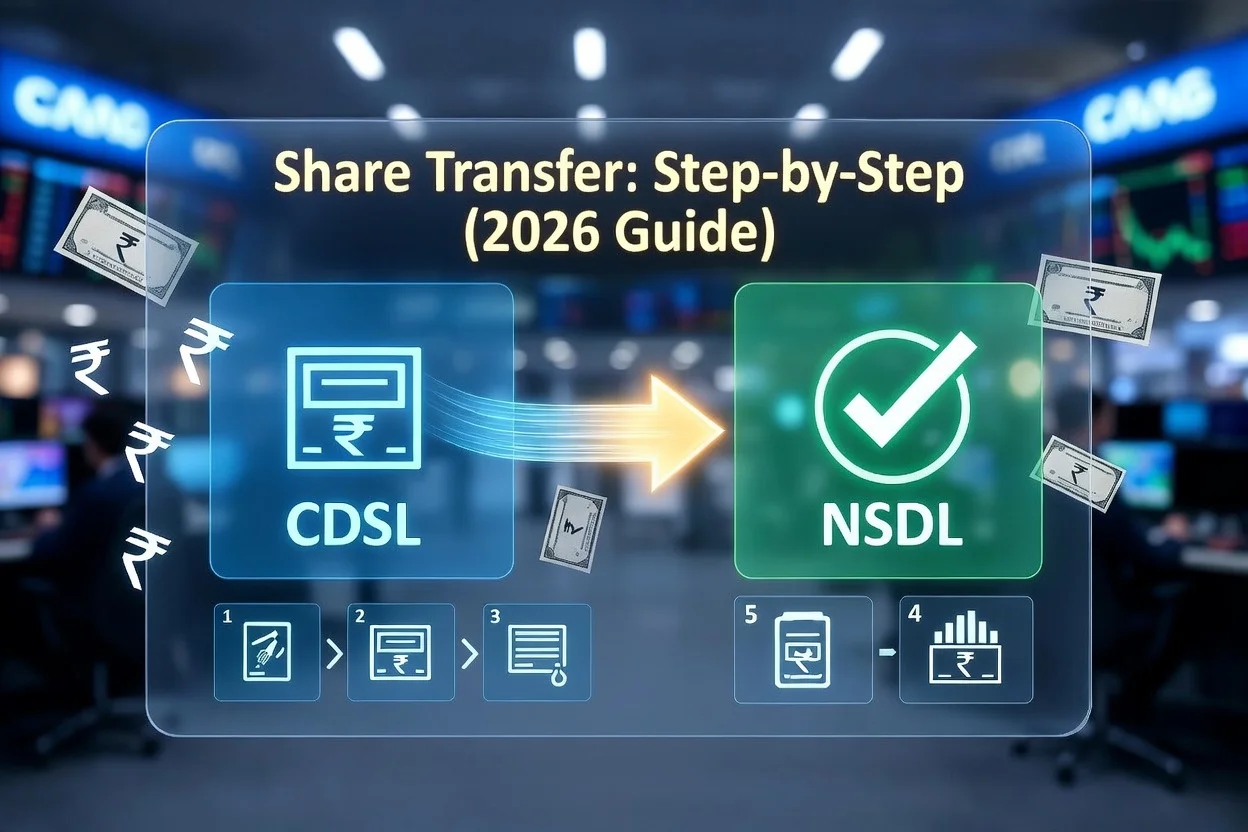
Moving your investment portfolio doesn't have to feel like moving houses. If you have made the decision to change brokers or just want to consolidate your holdings, the CDSL to NSDL share transfer process is the next step you need to take.
By 2026, the Indian digital depository system is set to be more efficient, but still, many investors have trouble understanding terms like ISIN, DIS, or Inter-Depository transfers. If you are transferring from a CDSL-registered broker (such as Zerodha or Angel One) to an NSDL-registered broker (such as ICICI Direct or HDFC Securities), then this guide is for you.
What does a CDSL to NSDL transfer mean?
Before we get into the how, let us understand the what.
CDSL (Central Depository Services India Limited): Often linked to newer discount brokers.
NSDL (National Securities Depository Limited): Often linked to older bank-based brokers.
Inter-Depository Transfer: If you are transferring shares from one depository to another, for example, from CDSL to NSDL, that process is called an inter-depository transfer.

Methods: How to Transfer Shares from One Demat to Another
When it comes to the demat share transfer process, there are two main approaches you can take: the old school traditional offline method, and, the present-day modern online approach.
[A]. The Offline Method (Using DIS)
For one-time transfers of large amounts of shares, this method is the most dependable. It requires a physical Delivery Instruction Slip (DIS), which is essentially a "chequebook" for your shares.
Step-By-Step Offline Process:
1. Request a DIS Booklet. If you do not have an unfilled DIS booklet, you may contact your current broker (the broker you are moving shares from) and request one.
2. Filling the Slip: You need to fill in the following details:
- ISIN (International Securities Identification Number): A unique 12-digit number assigned to each stock (example, INE002A01018 is for Reliance).
- Target Client ID: The 16-digit Demat ID associated with your new NSDL account.
- Mode of Transfer: Very Important – Tick the box for "Inter-Depository" C(meaning you are moving from CDSL to NSDL).
3. Off-Market Share Transfer: Since this transfer is happening outside of the stock exchange, you are required to select an off-market share transfer and provide a "Reason for Transfer" (example, “Transfer to own account”).
4. Submit & Relax: All you need to do is submit the signed slip to your current broker. The transfer is processed, and the shares will be in your new NSDL account within 3 to 5 business days.
[B]. The Online Method (Using CDSL Easiest)
If you would like to avoid traditional methods entirely, you can use Easiest (Electronic Access to Securities Information and Execution of Secured Transactions) offered by CDSL.
Easy Steps for Online Method:
1. Easiest Registration: Go to CDSL's website (https://www.cdslindia.com/) and Easiest registration by entering your BO ID (beneficiary owner id).
2. Put Your New NSDL Demat Account as Trusted Account: Your broker takes about 1 day to approve this.
3. Initiate Set-Up Transfer:
Go to Transactions .
Under Inter-Depository, choose your NSDL account in the dropdown.
4. Pick Securities: Select and enter the number of shares of the ISINs you wish to transfer.
5. Move to Authenticate: Input your 8-digit PIN (not your TPIN) or use the registered mobile number's OTP.
Note: Ensure your mobile number and email are current to both accounts. Since 2026, SEBI has enforced dual-factor authentication for any inter-deposit movements due to added security measures.
Fees for Share Transfers in 2026
Although you generally do not have to pay to open a Demat account, there are fees charged for transferring shares from a Demat account.
|
Transfer Type |
Estimated Cost (Per ISIN) |
|
Intra-Depository (CDSL to CDSL) |
₹13.50 + GST |
|
Inter-Depository (CDSL to NSDL) |
₹25.00 – ₹30.00 + GST |
Online Transfers Fees are generally the same as for offline transactions, but some brokers have lower fees for their online transactions.
Note: These fees are charged by the "Source" broker, while the "Target" broker (NSDL) typically does not charge to receive the shares.
Important Checklist Before You Start
Before you begin, to avoid delays in your demat share transfer process, make sure to review the following:
Name Matching: All names and PANs have to be the same on both CDSL and NSDL accounts. Otherwise the transfer request will be denied.
Lock-in Periods: You cannot transfer shares that are in locked-in periods (this includes pre-IPO shares and ELSS mutual funds) until that period is over.
Negative balance: Your current broker's ledger must not be negative, and there cannot be overdue annual maintenance charge (AMC) or brokerage owed. Otherwise, they will prevent the transfer.
ISIN Accuracy: Make sure to check the 12 digit ISIN again. Even one incorrect digit can cause the shares to be sent to the wrong "place," or result in the transaction not going through.
Tax Implications of Off-Market Transfers
Is an off-market share transfer taxable?
Transfer to Self: No tax liability exists when moving shares between your own two accounts. It is not viewed as a "sale."
Gifting to Others: Share transfer to a family member as a gift is tax exempt from the sender. However, if the value is greater than ₹50,000 and the recipient is not a "relative" as per the Income Tax Act, he/she may incur tax.

Conclusion
The CDSL to NSDL share transfer process is highly efficient and evolved in 2026. The online "Easiest" option is certainly good for tech-savvy investors, but the offline DIS option also remains a great option for anyone moving their life savings at once.
This guide allows you to focus on growing your wealth while ensuring your off-market share transfer is done smoothly. Would you like me to assist you in locating ISIN codes related to your stocks or aid you in estimating transfer charges based on your broker's fees?

DISCLAIMER: This blog is NOT any buy or sell recommendation. No investment or trading advice is given. The content is purely for educational and information purposes only. Always consult your eligible financial advisor for investment-related decisions.