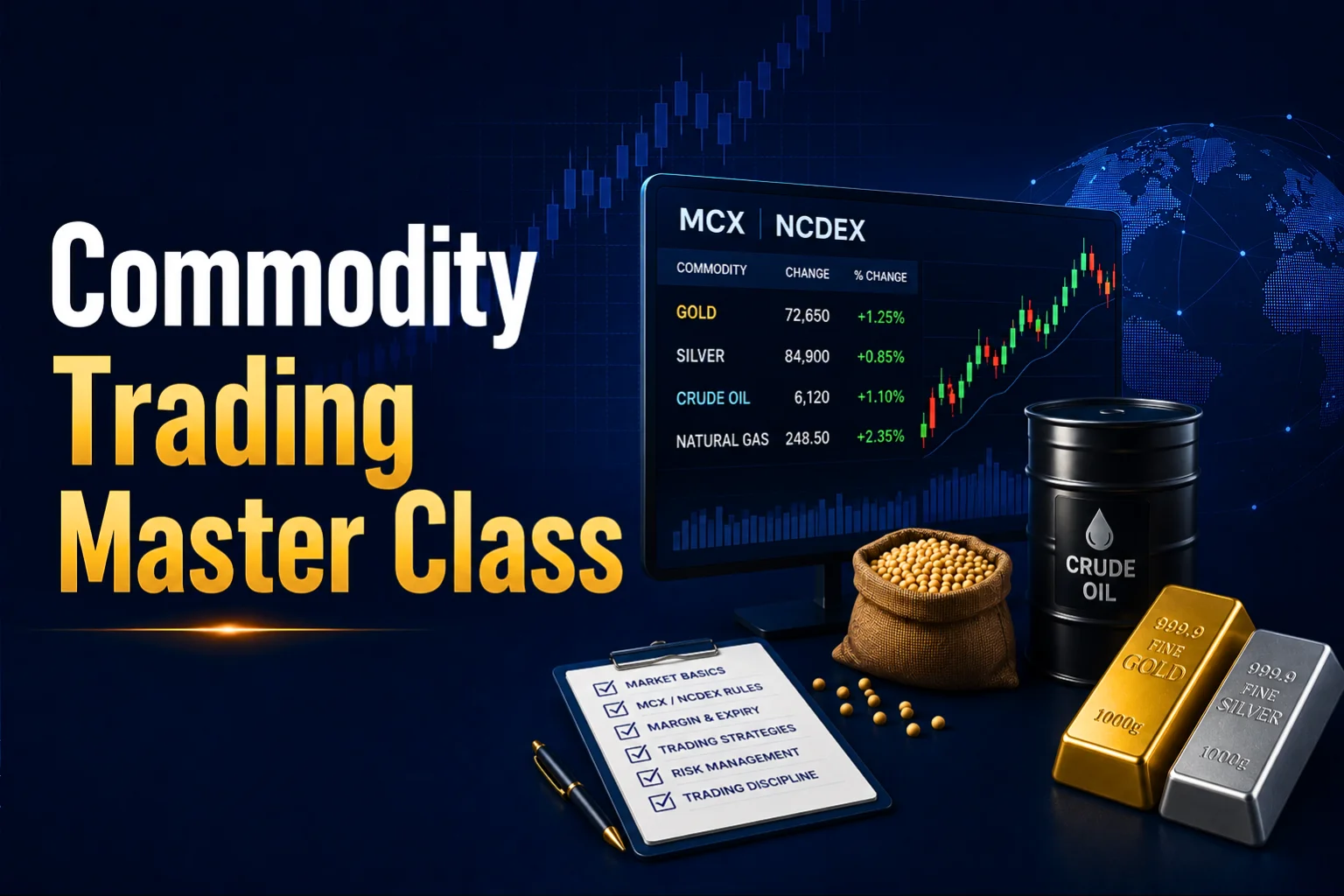
A structured Commodity Trading Master Class or Commodity Trading Course can help beginners understand market mechanics, risk management, and commonly used Commodity Trading Strategies. This type of Commodity Trading Training supports those who want to learn commodity trading step-by-step with realistic expectations.
Leveraged commodity derivatives can magnify both gains and losses, especially when traders use inadequate position sizing or do not fully understand margin and expiry rules.
The following is a hypothetical example created for educational purposes.
Imagine Raj, a 28-year-old software engineer from Pune. Like many Indians, he read stories of price swings in gold and crude oil and thought commodity trading could build extra income. He opened an account on MCX, put in some savings, and jumped into gold futures after seeing a quick upward move.
Within weeks, an unexpected news event reversed the price, and his position hit a margin call. Raj lost a significant part of his capital and felt lost. His story is common—many new traders face challenges in commodities, especially in the beginning.
If you’re a beginner staring at charts, hearing terms like “lot size,” “margin,” or “rollover,” and wondering where to start, this guide is for you. We’ll walk through the realities of commodity trading in India in simple, beginner-friendly language.

Why Many New Traders Face Challenges in Commodities
Commodity prices reflect real-world supply and demand for physical goods such as gold, silver, crude oil, natural gas, wheat, and guar seed. Factors like monsoon rains, global geopolitics, inventory reports, and currency movements create volatility. Leverage in futures trading can magnify both gains and losses.
Common difficulties include trading without clear rules, poor risk management, and reacting emotionally to price swings. A good Commodity Trading Course or Commodity Trading Master Class helps build awareness of these issues.
Understanding the Indian Commodity Market
In India, the main platforms are MCX (Multi-Commodity Exchange) and NCDEX (National Commodity & Derivatives Exchange). These are regulated by SEBI (Securities and Exchange Board of India).
You primarily trade futures contracts (agreements to buy or sell at a future date) and options, rather than physical commodities in most cases. The settlement method varies by contract. Depending on the commodity and contract specification, expiry may involve cash settlement, devolvement into futures, or physical delivery. Traders must verify the latest settlement and delivery terms before taking a position near expiry.
MCX trading timings vary by commodity category and daylight-saving period. Some internationally linked contracts may trade until 11:30 PM or 11:55 PM, while selected agricultural contracts may close earlier. Always check the latest MCX trading hours circular.
Important concepts for beginners:
- Lot size / Contract size: Minimum quantity you must trade (e.g., standard Crude Oil lot on MCX is 100 barrels).
- Margin: A fraction of the contract value you need to deposit (leverage effect). Initial margin and maintenance margin apply.
- Expiry and Rollover: Contracts expire on specific dates. Traders often roll over to the next month.
- Charges: Brokerage, Commodity Transaction Tax (CTT, where applicable), exchange transaction charges, GST, SEBI turnover charges, stamp duty, and delivery/storage/handling charges where applicable.
- Liquidity and delivery risk: Popular contracts have better liquidity. Avoid illiquid ones as a beginner.
A quality Commodity Trading Master Class explains these with actual MCX contract examples.
What a Quality Commodity Trading Master Class Covers
A well-structured Master Class goes beyond scattered tips. It typically includes:
- Market basics and Indian regulations.
- Reading price charts and understanding fundamentals.
- Risk and money management.
- Practical strategy application on demo accounts.
The focus is on building skills gradually.

Commonly Used Commodity Trading Strategies
Here are some widely discussed approaches. These are not guaranteed to make money—every strategy has limitations, drawdowns, and performs differently under various conditions. Always backtest and practice on paper/demo first. No strategy guarantees profits.
1. Trend Following
- Market condition: Clear uptrend or downtrend.
- Instrument & Timeframe: Often used on daily charts for gold or crude oil.
- Sample Entry: Price closes above 50-day moving average with rising volume.
- Stop & Target: Stop below the recent swing low; target 1:2 risk-reward ratio.
- Considerations: Works better in trending markets; suffers during sideways moves. Watch transaction costs and false signals.
2. Breakout Trading
- Market condition: Price consolidating near support/resistance.
- Entry: Close above resistance on higher volume.
- Stop placement: Below breakout level.
- Risks: False breakouts are common near news. Slippage possible in volatile contracts like natural gas.
3. Range / Mean-Reversion Trading
- Market condition: Sideways price action.
- Entry: Near support with confirmation.
- Exit: Target opposite side of range.
- Limitations: Breaks down when a new trend starts. Needs patience.
Combine with fundamentals (e.g., inventory data for oil). Some traders use a predefined maximum risk per trade (such as 0.5% or 1% of capital), depending on their strategy, volatility, and personal risk tolerance.
Key Learning Considerations for Popular Commodities
|
Commodity |
Main Drivers |
Volatility Level |
Key Learning Considerations |
Typical Contract Example (MCX) |
|
Gold |
Inflation, USD, geopolitics |
Medium |
Good liquidity; study trends and delivery rules |
Standard contract commonly quoted in 1 kg units; check current delivery and settlement specification |
|
Crude Oil |
Global supply, OPEC, demand |
High |
News-sensitive; practice margin management |
100 barrels |
|
Natural Gas |
Weather, storage |
Very High |
High volatility; requires experience |
Seasonal patterns important |
|
Wheat |
Monsoon, global harvests |
Medium-High |
Fundamental analysis is useful; watch expiry |
Agri contract specifics |
|
Silver |
Industrial use, gold correlation |
High |
Understand leverage impact |
Check variants |
(Data compiled from general MCX contract information. Always verify the latest specifications on official exchange websites.)
Sample Position Sizing Idea: Risk amount = (Entry price – Stop price) × Lot size × Number of lots. Keep this small relative to your total capital.
Beginner Readiness Checklist
- Understand margin and leverage risks
- Complete a meaningful sample of documented demo trades (following your rules, tracking drawdowns, and including costs)
- Defined risk approach per trade
- Knowledge of MCX/NCDEX rules
- Emotional discipline plan (e.g., no trading after losses).
Challenges and How Education Helps
- Margin calls due to leverage
- Emotional decisions after losing trades
- Ignoring costs (brokerage + slippage)
- Trading illiquid contracts.
Commodity Trading Training helps through real examples, simulations, and Indian market case studies.
Getting Started Responsibly
Start with education, then consider a small account only with money you can afford to lose. Use broker demo platforms and practice consistently.
Publication Date: June 2026 (review periodically as rules change).

Conclusion
Commodity trading in India offers opportunities to understand markets, but it requires serious preparation. A structured Commodity Trading Master Class or Commodity Trading Course can help you learn the foundations responsibly. Focus on continuous learning, discipline, and realistic goals.
(Sources: MCX India, Zerodha, ICICI Direct, NSC Clearing)

DISCLAIMER: This blog is NOT any buy or sell recommendation. No investment or trading advice is given. The content is only for educational purposes. Always discuss with your SEBI-registered financial advisor for investment-related decisions.

.webp)