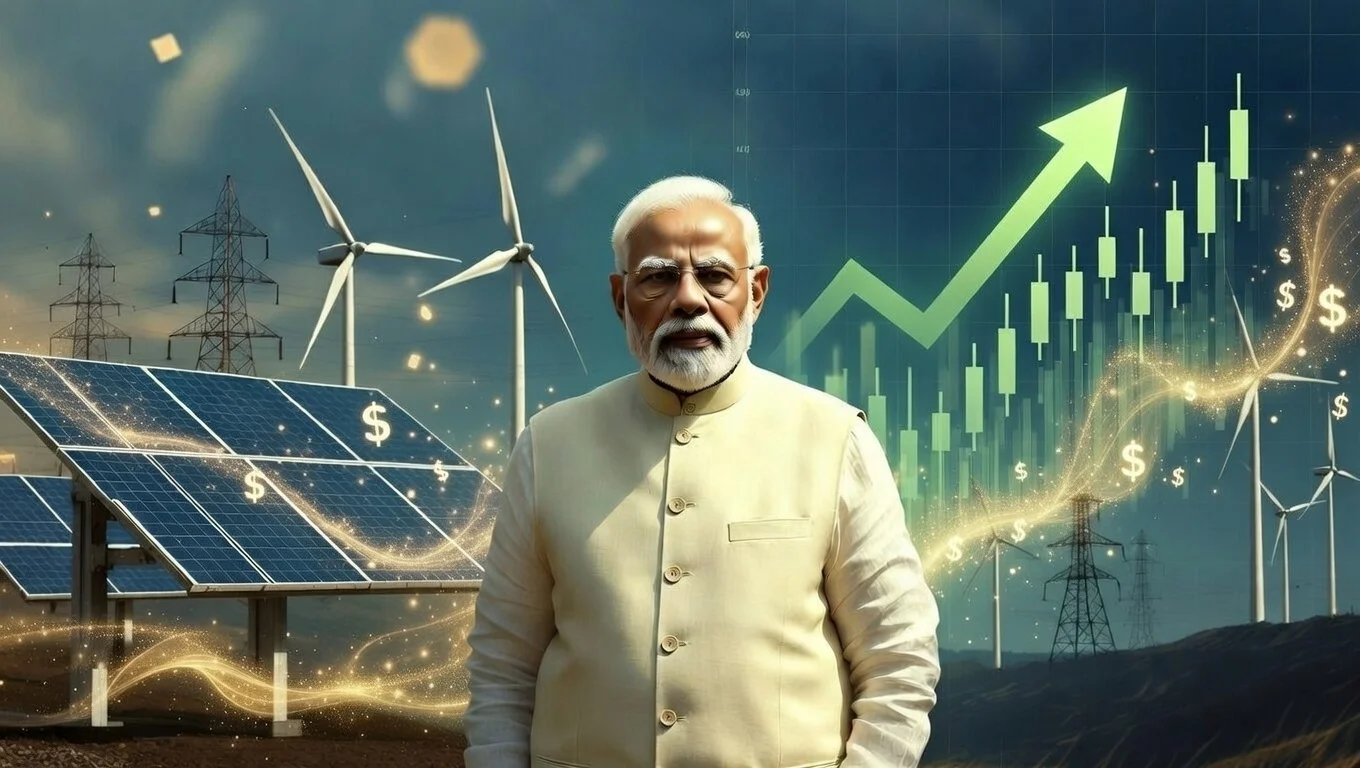
Why This One Line from Modi Matters More Than Budget Announcements
When Prime Minister Narendra Modi casually mentioned “$500 billion in investment opportunities in India’s energy sector”, markets didn’t hear a headline — they heard a structural signal. This wasn’t a budget promise, a PSU reform pitch, or a one-year capex roadmap. It was a long-cycle message aimed at global capital, energy majors, and institutional investors watching India’s demand story unfold.
Unlike budget allocations that change every year, this statement reflects a multi-decade reset of India’s energy strategy — from import dependence to energy self-sufficiency, from fragmented assets to integrated energy ecosystems. The focus is no longer just on oil and gas production, but on refining, LNG infrastructure, petrochemicals, pipelines, and energy exports.
For investors, this one line matters because it reframes energy stocks as growth assets, not legacy plays. When policy intent aligns with rising consumption and global capital, the stock market usually reacts — not immediately, but decisively over time. This is how new investment cycles are born.

In recent years, global investors have been invited to the Indian energy sector. Most recently, India’s Prime Minister, Narendra Modi, during his speech in Goa at the India Energy Week 2026, spoke of the potential to create 500 billion dollars of investments into the India energy sector in the next couple of years.
For investors, this potential is creating interest in energy stocks, as this is likely to be a volume-driven stock market trading opportunity. In the India energy sector, further development of oil and gas refining, additional construction of Liquefied Natural Gas (LNG) facilities, and self-sufficiency in energy are likely to promote the development of productive capacity in all of the energy subsectors.
India has now assumed the role of the 3rd largest consumer of energy and 3rd largest importer of crude oil. Modi’s recent speech in Goa, India, is now placing great importance on the development of self-sufficiency in energy as opposed to just energy security.
India's Energy Future According to PM Modi
Indian PM Modi addressed delegates virtually at the India Energy Week on Jan 27, 2026, and said that the energy sector is at the centre of India's development aspirations. Modi said, "Our energy sector is at the centre of our aspirations. It holds $500 billion in investment opportunities," supporting the new self-reliance roadmap in energy production and the energy sector infrastructure.
(Source included: Reuters)
This PM Modi statement, of course, is built on previous reforms for the hydrocarbons space. The government liberalised the exploration of hydrocarbons, with less of the exploration zone closed for exploration, and has offered more than 170 exploration blocks. The Andaman and Nicobar Islands basin is a new hydrocarbon basin. Modi continues to call for added domestic production, where the country is more than 88% dependent on oil imports, and India is now one of the largest consumers of energy worldwide.
Key targets shared include the following:
- Attaining $100 billion of investment in the oil and gas sector by the close of the decade.
- 1 million square kilometres of exploration.
- Increased refining capacity to more than 300 million tonnes per annum (mtpa) to make India the top oil refining country in the world from the current 260 mtpa.
These objectives outline steps to address growing domestic needs while providing competitive energy exports to more than 150 countries.
Understanding the Investment Potential of $500 Billion
The $500 billion investments are not an arbitrary number and are anchored in specific sectors of the energy value chain in India. Global players are invited to engage in upstream, midstream, and downstream value chain activities, as requested by PM Modi.
In upstream oil and gas exploration, the focus is on increasing domestic production by acquiring new exploration blocks and forming technology partnerships. The government is looking to streamline this process to make it more transparent and responsive to the needs of the investors.
Of the downstream activities, refining is still by far the most important. And as one of the world’s few major economies with increasing demand for petroleum, India is expanding not only its refining capacity to make low-cost fuels and petrochemicals but is also in a position to meet its export needs. Thus, this expansion fulfils domestic demand and also positions the country as a net exporter.
In the value chain of LNG, India also finds increasing opportunities. Between 6 and 15 percent is the targeted increase of natural gas in the country’s primary energy mix. Investments in critically underdeveloped portions of the value chain, such as LNG regasification terminals, city gas distribution systems, and domestic pipelines, are a pressing need. A notable highlight is the promotion of ‘Make in India’ for LNG carrier ships as part of a 70,000-crore shipbuilding grand.
These self-contained ecosystems lower the risks involved with imports while increasing the competitiveness of exports.
Why Energy Stocks Stand to Gain the Most
The Energy sector is likely to become the focus of most investments, especially considering the level of Refining, Petrochemicals, and LNG cross-value chain integration of Reliance and downstream players like BPCL and IOC. Thin value chain players like ONGC are likely to be left behind.
The suite of Refining and LNG infrastructure expansions are likely to positively impact revenues, margins, and market cap of Reliance, BPCL, and IOC. Petrochemicals are likely to drive IOC and BPCL's revenues and margins, considering India's manufacturing sector establishes itself.
These recent announcements strengthen the outlook on investments and the energy sector overall. These also should drive fresh bottoms-up investments into energy-focused mutual funds and ETFs, thereby increasing the popularity of energy funds. These suggest that rising energy demand is also coming with more lucrative investment opportunities.

Infrastructure Enablers (Quiet Compounding)
While headline attention remains on large refiners and integrated energy giants, the real compounding story of India’s energy transformation lies in infrastructure enablers. LNG terminals, gas pipelines, and city gas distribution companies form the backbone of India’s ambition to increase natural gas usage to 15% of its energy mix.
India’s LNG ecosystem is still under-penetrated, creating long runways for growth in regasification capacity, pipeline connectivity, and last-mile gas distribution. As LNG imports rise and domestic gas allocation improves, these companies benefit from volume visibility, regulated returns, and long-term contracts, making them relatively insulated from crude price volatility.
Unlike refining businesses that are sensitive to global margins, infrastructure players grow steadily with policy support, urbanisation, and industrial gas demand. For long-term investors, these stocks may not deliver sharp rallies, but they offer predictable cash flows and quiet wealth creation as India’s energy consumption deepens.
Pure Upstream Plays (Higher Risk Zone)
Despite aggressive capex announcements and increased exploration blocks, pure upstream companies like ONGC and Oil India remain structurally disadvantaged in this cycle. The primary reason is simple: upstream earnings are price-dependent, not volume-driven.
Even as domestic exploration expands, upstream producers continue to face:
- High dependence on global crude prices
- Government-imposed pricing mechanisms
- Long gestation periods for new discoveries
In contrast to integrated players, upstream companies lack downstream levers such as refining, petrochemicals, or marketing margins to cushion earnings during periods of oil price volatility. Capital expenditure may rise, but return on capital remains uncertain, especially when discoveries take years to monetise.
For investors, upstream energy stocks represent tactical exposure rather than structural growth stories. Unless supported by sustained high crude prices, these companies are likely to underperform integrated and infrastructure-led energy plays in the medium to long term.
Impact on Stock Market and Investors
The energy sector is expected to capture the positive sentiment from the $500 billion investment announced in the US. The expected impact will slowly reflect in the stock market and will lead to an immediate energy stock market rally. US oil prices will support energy stock prices.
Investors will need to be aware of the delays in the execution of the investment. In the case of delays in the development of the sector due to regulatory roadblocks, the prices of the commodities may have a negative impact on the expected moderate positive outcomes. In spite of these potential outcomes, the sheer size of the opportunity in the Energy Sector of India for 2026 and beyond and the Government of India’s track record of implementing reforms is tremendous.
Keep closing your eyes and envision the multiple turning points India is positioned for in the coming years.

Conclusion
For energy stock investors, multiple turning points are expected to be on the horizon due to the consistent and predictable growth trajectory of the nation. Investing in these stocks will differentiate your portfolio and moderate expected outcomes. The uncontrolled growth of the market, the Energy Sector, and India will lead to euphoria.

DISCLAIMER: This blog is NOT any buy or sell recommendation. No investment or trading advice is given. The content is purely for educational and information purposes only. Always consult your eligible financial advisor for investment-related decisions.