Have you ever noticed that Bitcoin is trading at one price on Binance and at a slightly different price on Coinbase or an Indian crypto exchange? The reason is simple: Bitcoin does not have one fixed global price. Every cryptocurrency exchange operates as an independent marketplace where buyers and sellers decide prices based on demand, supply, liquidity, trading volume, and order-book activity.
Differences in currency conversion, trading fees, market depth, and regional demand can also affect the final price. This is why the Bitcoin price difference between exchanges is completely normal. Understanding these factors can help beginners make better buying decisions, compare exchanges, and identify potential Bitcoin arbitrage trading opportunities.
What Is the Bitcoin Price Difference Between Exchanges?
Bitcoin is a decentralised cryptocurrency. Unlike traditional stocks that may have a primary exchange or official reference market, Bitcoin trades across multiple cryptocurrency exchanges worldwide.
Platforms such as Binance, Coinbase, Kraken, and Indian crypto exchanges connect buyers and sellers. Each platform has its own order book, trading activity, liquidity, and user base.
For example, imagine Bitcoin is trading at:
|
Crypto Exchange |
Illustrative Bitcoin Price |
|
Exchange A |
$90,000 |
|
Exchange B |
$90,100 |
|
Exchange C |
$89,950 |
(Note: These prices are hypothetical examples, not live Bitcoin prices.)
Although all three platforms are trading the same Bitcoin asset, their prices are slightly different. This is called a cryptocurrency price difference or crypto exchange price difference.
The difference may be small during normal market conditions, but it can become larger during periods of high volatility, low liquidity, or sudden changes in buying and selling activity.

Why Bitcoin Price Varies on Different Exchanges: 7 Major Reasons
There is no single reason behind Bitcoin price differences. Several market-related factors work together to create price variations.
1. Different Supply and Demand on Every Exchange
The first and most important reason is supply and demand. Every crypto exchange has a different group of buyers and sellers. On one platform, more people may be interested in buying Bitcoin, while on another platform, more traders may be willing to sell.
When buying pressure increases, buyers compete to purchase Bitcoin at higher prices. This can push the exchange's Bitcoin price upward.
Similarly, when selling pressure increases, sellers may accept lower prices to exit their positions. This is how Bitcoin supply and demand influence prices across different trading platforms.
Example:
Exchange A has more buyers than sellers.
Exchange B has more sellers than buyers.
Bitcoin may trade at a higher price on Exchange A and a lower price on Exchange B.
This explains why Bitcoin prices are different even though the underlying cryptocurrency is the same.
2. Liquidity Is Different Across Crypto Exchanges
Another major reason is liquidity. In simple terms, liquidity means how easily you can buy or sell Bitcoin without significantly changing its market price.
A high-liquidity exchange generally has more active buyers and sellers, allowing larger orders to execute with less price impact.
A low-liquidity exchange may have fewer buyers and sellers. Even a relatively small order can move its Bitcoin price.
This is what beginners should understand about Bitcoin liquidity:
|
Factor |
High-Liquidity Exchange |
Low-Liquidity Exchange |
|
Buyers and Sellers |
More |
Fewer |
|
Trading Activity |
Higher |
Lower |
|
Price Impact |
Usually Lower |
Usually Higher |
|
Order Execution |
Generally Smoother |
May Be Difficult |
|
Price Stability |
Relatively Better |
Can Fluctuate More |
The European Securities and Markets Authority (ESMA) has also examined Bitcoin market liquidity across exchanges. Its research highlights differences in order-book depth and bid-ask spreads between trading platforms.
Therefore, when comparing Bitcoin prices, always consider liquidity instead of looking only at the displayed price.
3. Bitcoin Trading Volume Is Different on Every Platform
Trading volume represents the total amount of Bitcoin traded during a particular period, commonly measured over 24 hours. An exchange with higher genuine trading activity generally has more active market participants and more frequent transactions.
For example:
|
Factor |
Exchange A |
Exchange B |
|
Illustrative 24-Hour BTC Volume |
10,000 BTC |
500 BTC |
|
Market Participation |
Higher |
Lower |
|
Order Book Activity |
More Active |
Less Active |
|
Potential Price Impact |
Lower |
Higher |
These figures are hypothetical and are only meant to explain the concept.
When large buying or selling orders enter an exchange with relatively low trading volume, the price can move more sharply. This is one reason why Bitcoin prices may temporarily differ between exchanges.
4. Order Books Determine Exchange-Specific Prices
Understanding the Bitcoin order book is essential if you want to know how crypto exchanges determine prices. A crypto order book is a live list of buy and sell orders placed by traders.
It generally contains two important elements:
Bids: Prices at which buyers are willing to purchase Bitcoin.
Asks: Prices at which sellers are willing to sell Bitcoin.
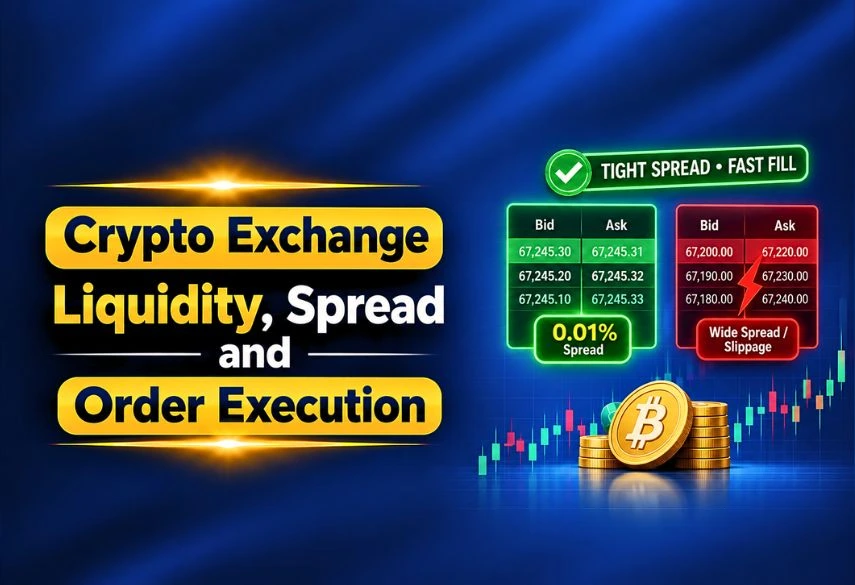
The difference between these two prices is called the bid-ask spread. If a buyer places a market order, it can match with the lowest available sell order. If the order is large, it may consume multiple sell orders at different prices.
This can change the average execution price. Coinbase also explains how bids, asks, and order-book depth influence trade execution.
5. Bid-Ask Spread and Trading Fees Affect the Final Price
Many beginners compare Bitcoin prices on two exchanges but forget to consider the spread and trading fees. The bid-ask spread is the difference between the highest buying price and the lowest selling price. A wider spread generally means a higher implicit trading cost.
Example of Bitcoin spread:
If you purchase Bitcoin at $90,000 and immediately sell it at $89,950, you would face a $50 price difference per BTC, before considering other fees.
Some platforms also include a spread in their instant-buy or conversion quotes.
For example, Coinbase explains that its quoted prices can include a spread and that fees may vary depending on the transaction and market conditions. Therefore, the lowest displayed Bitcoin price does not always mean the cheapest purchase.
6. Regional Demand and Currency Conversion
Bitcoin is traded globally, but every country has its own currency, financial infrastructure, regulations, and market participants.
For example, Bitcoin can be traded in:
- USD (US Dollar)
- EUR (Euro)
- INR (Indian Rupee)
- USDT (Tether)
- GBP (British Pound)
The BTC/USD price and BTC/INR price are not directly comparable without considering the USD-INR exchange rate.
Suppose Bitcoin trades at $90,000 globally and the illustrative USD-INR exchange rate is ₹90. However, an Indian exchange may show a different BTC INR price because of local buying and selling pressure, currency conversion costs, liquidity, and exchange-specific charges.
This is an important reason behind the Bitcoin price difference in India. The Bitcoin price Binance vs Indian exchanges comparison may therefore show a difference even when both platforms are trading the same underlying asset.
7. Market Volatility and Different Price Updates
Bitcoin trades 24 hours a day, seven days a week. Unlike traditional stock exchanges, cryptocurrency markets do not have a common daily opening and closing time.
When important economic news, regulatory announcements, institutional buying, or global market developments occur, Bitcoin prices can change very quickly. Different exchanges receive and process market orders independently.
As a result, their displayed prices may not update at precisely the same moment. During highly volatile conditions, even a few seconds can make a difference.
This is why a Bitcoin price comparison should always use prices captured at approximately the same time.
Bitcoin Price on Binance vs Coinbase: Why Is There a Difference?
Binance and Coinbase are two major cryptocurrency trading platforms, but they operate independent marketplaces.
Binance
Its BTC trading price depends on the specific trading pair, order-book activity, liquidity, and buyers and sellers on the platform.
Coinbase
Its BTC price is determined by its own trading activity, order book, market depth, and applicable transaction pricing. For example, Binance may show Bitcoin at $90,000 while Coinbase shows it at $90,080.
This does not mean Bitcoin has two different values. It means the two marketplaces currently have different trading prices. The difference may disappear quickly as traders react to price variations.
Important: Always compare the same trading pair, such as BTC/USDT with BTC/USDT or BTC/USD with BTC/USD. Comparing different pairs without adjusting for currency conversion can create misleading results.
Bitcoin Price Difference in India: Binance vs WazirX vs CoinDCX
Indian investors may notice that Bitcoin prices on Indian exchanges are different from prices displayed on international platforms. For example, the Bitcoin price on WazirX vs CoinDCX may not always match the price shown on Binance or Coinbase.
There are several reasons behind this difference:
INR conversion: International Bitcoin prices are generally quoted in USD or USDT, while Indian platforms may display BTC/INR.
Local demand: Buying and selling activity in India can differ from international markets.
Liquidity: Different exchanges have different order-book depth and trading volumes.
Trading charges: Exchange fees and spreads affect the actual purchase cost.
Currency premium: The effective conversion rate used to calculate the INR price may differ.
Example: How BTC INR Price Is Calculated
Suppose the following hypothetical market conditions exist:
|
Particulars |
Value |
|
Bitcoin Global Price |
$90,000 |
|
USD-INR Exchange Rate |
₹90 |
|
Theoretical BTC Price in INR |
₹81,00,000 |
|
Illustrative Indian Exchange Price |
₹81,50,000 |
The Indian exchange is showing a premium of approximately 0.62% over the theoretical converted price. This premium may arise from local demand, liquidity, conversion costs, and other market factors. Therefore, investors should not assume that the BTC INR price today will always match the direct USD-to-INR conversion.
What Is Bitcoin Arbitrage Trading? Can Traders Make Money From Price Differences?
Now comes an interesting part. If Bitcoin is trading at a lower price on one exchange and a higher price on another, can traders benefit from this difference?
Yes. This trading approach is known as Bitcoin arbitrage trading. Bitcoin arbitrage involves buying Bitcoin on an exchange where its price is relatively lower and selling it on another exchange where its price is relatively higher.
How to Compare Bitcoin Prices Across Different Exchanges
If you are a beginner, you do not need complicated trading software to understand cryptocurrency price differences.
Follow these simple steps:
Step 1: Check the same Bitcoin trading pair.
Compare BTC/USDT with BTC/USDT or BTC/INR with BTC/INR.
Step 2: Check prices at the same time.
Bitcoin trades 24/7, so comparing prices at different timestamps can produce incorrect conclusions.
Step 3: Check the order book.
Look at the highest bid, lowest ask, and available market depth.
Step 4: Compare trading fees.
The displayed Bitcoin price is not necessarily the final purchase price.
Step 5: Check liquidity and trading volume.
A platform with better liquidity may offer a more efficient trade even if its displayed price is slightly higher.
Step 6: Calculate the actual execution cost.
Include the spread, fees, currency conversion, and applicable withdrawal charges.
Which Is the Best Crypto Exchange to Buy Bitcoin?
There is no universally best crypto exchange to buy Bitcoin. The right platform depends on your requirements, location, trading experience, security preferences, and transaction costs. Consider these factors before choosing an exchange:
|
Selection Factor |
What to Check |
|
Security |
Security Practices and Account Protection |
|
Liquidity |
BTC Order-Book Depth |
|
Trading Fees |
Maker and Taker Charges |
|
Spread |
Difference Between Bid and Ask |
|
Trading Pairs |
BTC/INR, BTC/USDT, BTC/USD |
|
Withdrawals |
Available Withdrawal Options and Charges |
|
Regulatory Compliance |
Applicable Local Registration and Requirements |
Never select an exchange only because it displays the cheapest Bitcoin price. Check the platform's credibility, withdrawal facilities, and actual execution costs.
How Bitcoin Prices Are Calculated on Global Cryptocurrency Websites
You may also notice that Bitcoin prices displayed on CoinGecko and CoinMarketCap are slightly different from prices shown on individual exchanges.
Why does this happen?
Because these websites generally aggregate market data from multiple exchanges rather than simply copying the price from one trading platform. For example, CoinGecko calculates a volume-weighted average price using data from multiple cryptocurrency exchanges.
This means exchanges with higher trading volume can have a greater influence on the aggregated price.
Similarly, CoinMarketCap uses a volume-weighted average of market-pair prices and applies filters to exclude certain outliers and unreliable data.
|
Platform |
Price Display Approach |
|
Individual Crypto Exchange |
Based on Its Own Market and Trading Activity |
|
CoinGecko |
Aggregated Volume-Weighted Market Price |
|
CoinMarketCap |
Volume-Weighted Average of Eligible Market Pairs |
This is why the Bitcoin market price explained by an aggregator may not exactly match the live trading price on Binance, Coinbase, or an Indian exchange.

Conclusion
Bitcoin does not have one fixed global trading price. Its value is discovered independently across cryptocurrency exchanges through buyers, sellers, liquidity, trading volume, and order-book activity.
The Bitcoin price difference between exchanges is a normal feature of decentralised cryptocurrency markets. Sometimes these differences create arbitrage opportunities, but they also involve fees, execution risks, and regulatory considerations.
For beginners, the most important lesson is simple: Don't just compare Bitcoin prices. Compare the actual cost of buying and selling Bitcoin. Understanding these factors will help you make more informed decisions in the cryptocurrency market.
(Sources: support.coinmarketcap.com, support.coingecko.com, incometaxindia.gov.in, fiuindia.gov.in)

DISCLAIMER: This blog is NOT any buy or sell recommendation. No investment or trading advice is given. The content is only for educational purposes. Always discuss with your SEBI-registered financial advisor for investment-related decisions.
Follow this WhatsApp Channel for the latest updates directly on WhatsApp.