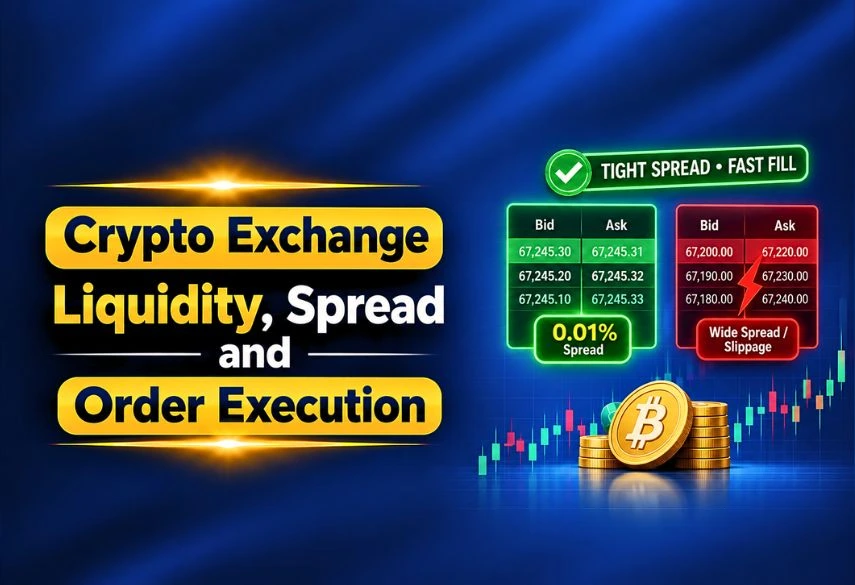
The most effective way to choose the right crypto exchange is to compare three core factors for the exact trading pairs systematically and order sizes you use: crypto exchange liquidity (how easily you can buy or sell without moving the price much), the bid-ask spread (the gap between the highest buy price and lowest sell price), and order execution quality (how close your actual fill price is to the price you expected).
Start by opening the live order book on several platforms, measure the percentage spread, check depth near the mid-price, and estimate slippage for your typical trade size. This practical approach consistently identifies low-spread, high-liquidity venues and helps you avoid hidden costs that erode profits.
Many new traders select a cryptocurrency exchange based only on advertised fees, brand recognition, or the number of coins listed. While those factors matter, they often overlook the real cost drivers of crypto trading: liquidity, spread, and execution. Understanding these elements is essential if you want to trade efficiently, whether you are a beginner making small buys or an active trader handling larger positions on a Bitcoin trading platform or altcoin pairs.
Why Liquidity, Spread and Execution Decide Your Real Trading Cost
Every time you place an order on a crypto trading platform, three things determine the final price you pay or receive:
1. Liquidity - The amount of buying and selling interest available at prices close to the current market.
2. Bid-Ask Spread - The difference between what buyers are willing to pay and what sellers are asking.
3. Order Execution - How the exchange’s matching engine fills your order and whether the final average price differs from your expectation (this difference is called slippage).
High crypto trading volume on an exchange does not automatically mean good conditions for your specific pair. Volume measures past activity. Liquidity, spread, and depth measure what is available right now for your next trade. Focusing on these three factors gives you a clearer picture than ranking lists based only on total volume.
Understanding Crypto Exchange Liquidity in Simple Terms
Crypto exchange liquidity refers to how easily and quickly you can enter or exit a position without causing a significant price change. In a highly liquid market, large orders can be filled near the current price. In a low-liquidity market, even moderate orders can push the price against you.
Liquidity comes mainly from active market makers, institutional traders, and retail participants who place resting limit orders. Major pairs such as BTC/USDT and ETH/USDT usually enjoy the deepest liquidity across leading platforms. Smaller altcoins often show much thinner books.
How to check crypto exchange liquidity yourself:
-
Open the trading pair and look at the order book.
-
Focus on the volume sitting within 0.1% to 1% of the mid-price on both the bid and ask sides.
-
Compare the same pair on two or three exchanges at the same time.
-
Note whether depth remains stable or disappears quickly when price moves.
Third-party research frequently ranks major centralized exchanges on order-book depth and slippage. Rankings can vary depending on the exact measurement band used (for example, 0.01%, 0.03%, or 1%), the time of day, and whether the data covers spot or futures markets.
What Is the Bid-Ask Spread and Why It Matters
The bid-ask spread (also called the crypto bid-ask spread) is the gap between the highest price a buyer is willing to pay (best bid) and the lowest price a seller is willing to accept (best ask). It represents the immediate cost of crossing the market with a market order.
Simple calculation:
Spread = Best Ask - Best Bid
Percentage Spread = (Spread ÷ Mid-Price) × 100
Example:
Best Bid = $79,990
Best Ask = $80,010
Mid-Price = $80,000
Spread = $20 or 0.025%
On highly liquid Bitcoin pairs during active hours, spreads on top exchanges can be extremely tight - often well under 0.01%. On less popular altcoins, spreads of 0.5% to several percent are common. Tighter spreads usually signal stronger competition among market makers and healthier crypto trading liquidity.
When comparing platforms, always look at the percentage spread rather than the absolute dollar amount. This allows fair comparison across coins with very different prices. Low-spread crypto exchanges reduce the cost of every round-trip trade and are especially valuable for frequent traders.
Crypto Market Depth and the Order Book Explained
The crypto order book is the live list of all open buy orders (bids) and sell orders (asks) at different price levels. Market depth shows how much volume is available at each level and how that volume accumulates as you move away from the mid-price.
A deep order book has substantial size clustered close to the current price. A shallow book has little size near the mid-price and large gaps between levels. Depth is one of the most reliable indicators of true liquidity because it shows what is actually available to fill your order right now.
Practical way to assess depth:
-
Look at cumulative volume within fixed percentage bands (for example, ±0.1%, ±0.5%, and ±1%).
-
Check both sides of the book (bids and asks).
-
Observe whether large orders stay in place or get cancelled quickly (a sign of less reliable liquidity).
Deeper books generally produce lower slippage for the same order size. This is why serious traders routinely compare crypto market depth across venues before placing orders.
Crypto Slippage and Order Execution Quality
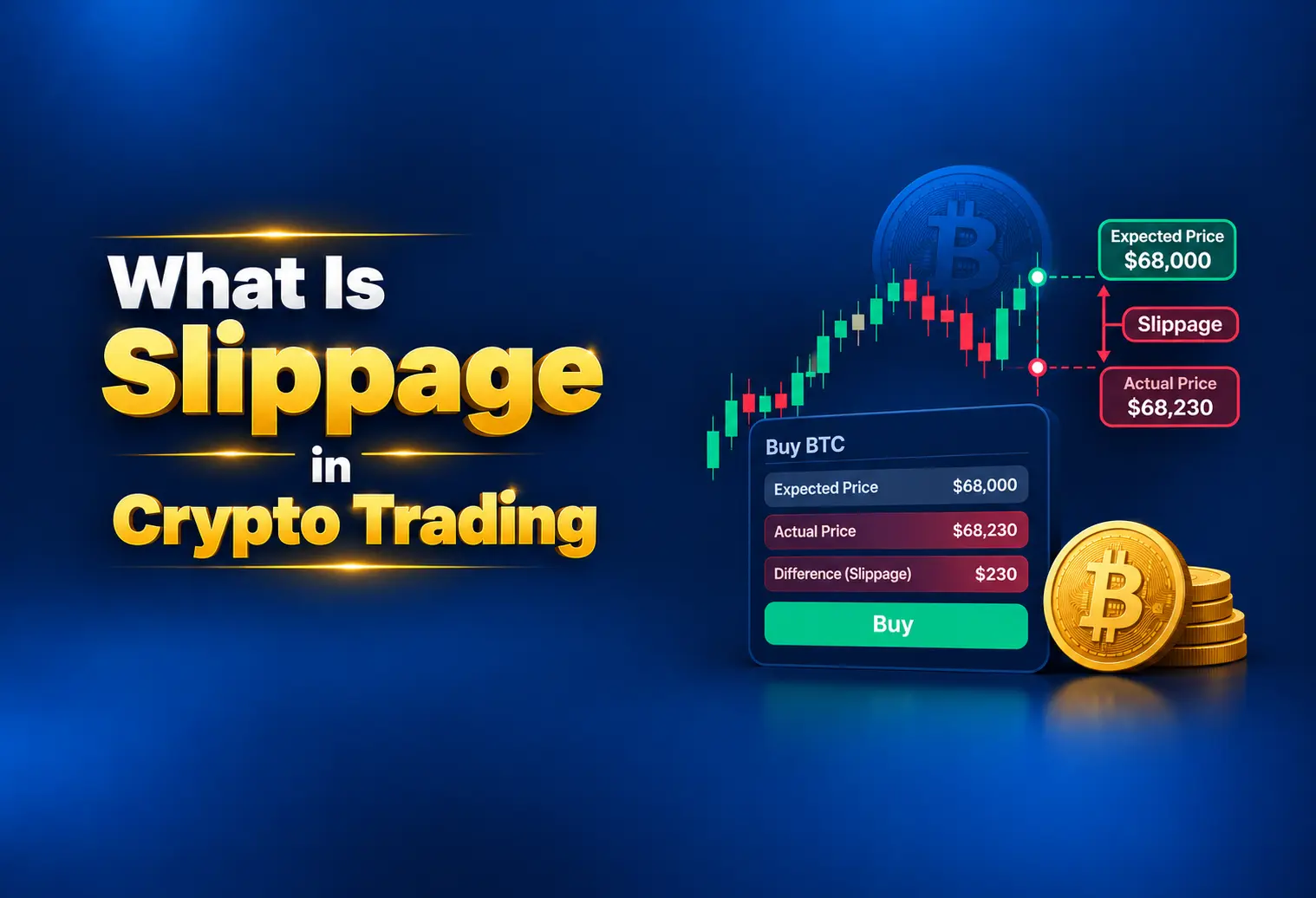
Slippage is the difference between the price you expected when you submitted the order and the average price at which the order actually filled. It occurs mainly when your order size exceeds the volume available at the best price levels, forcing the matching engine to fill the remainder at progressively worse prices.
Worked example of slippage:
-
You want to buy $50,000 of a coin with a market order.
-
The best ask has only $12,000 available.
-
The next levels have $15,000 at a slightly higher price and $23,000 at an even higher price.
-
Your average fill price ends up higher than the original best ask. That difference is slippage.
Good crypto order execution means:
-
Low and predictable slippage for your typical size
-
Fast matching
-
Reliable fills even when markets move quickly
-
Transparent order book data.
Execution speed also matters. Delayed order books or slow matching engines increase the chance of adverse fills, especially in volatile conditions.
Practical Step-by-Step Framework for Crypto Exchange Comparison
Use this structured process whenever you evaluate platforms:
|
Factor |
What to Examine |
Strong Indicator |
Weak Indicator |
|
Liquidity |
Order book depth near mid-price |
Substantial volume within 0.1-0.5% |
Thin book even on major pairs |
|
Bid-Ask Spread |
Percentage spread on your main pairs |
Consistently under 0.05% on majors |
Wide or highly variable spreads |
|
Market Depth |
Cumulative size at multiple price levels |
Steady, balanced depth on both sides |
Large gaps or disappearing liquidity |
|
Estimated or actual fill vs expected price |
Low and consistent across similar sizes |
High or unpredictable |
|
|
Trading Volume |
Genuine recent volume on the specific pair |
High and stable |
Spiky volume with weak depth |
|
All-in Cost |
Fees + spread + expected slippage |
Competitive total cost |
Low fees but wide spread or high slippage |
Recommended steps:
1. Identify the exact pairs and approximate order sizes you trade most often.
2. Open the same pair on three or more reputable exchanges at the same time.
3. Record the current percentage bid-ask spread.
4. Note the cumulative depth within 0.5% of the mid-price.
5. Mentally (or with a simulator) estimate the average fill price for your typical order size.
6. Add the maker/taker fee schedule to calculate total expected cost.
7. Prefer the venue that consistently shows tighter spreads, deeper books, and lower estimated slippage for your use case.
This method works for any cryptocurrency exchange and is far more reliable than relying solely on global volume rankings or marketing claims about being the “best crypto exchange.”
Additional Factors That Affect Real-World Performance
While liquidity, spread, and execution are the core, several secondary factors also influence results:
-
Fee structure - Maker fees are usually lower than taker fees. High-volume traders often receive better tiers.
-
Order types - Availability of limit, stop, iceberg, and advanced order types can improve execution.
-
API quality and reliability - Important for algorithmic or high-frequency traders.
-
Regional availability and regulations - Especially relevant when looking for the best crypto exchange in India or other specific countries.
-
Stability during volatility - Some platforms maintain better depth and tighter spreads when markets move sharply.
Always test with small live orders before committing a larger size. Paper trading or order-book simulators can also help you understand how different venues behave.
Practical Tips to Minimize Spread and Slippage Costs
-
Prefer limit orders when time is not critical so you act as a maker and avoid crossing the full spread.
-
Break large orders into smaller pieces or use time-weighted strategies on thinner markets.
-
Trade the most liquid pairs (especially Bitcoin and Ethereum) during peak activity hours.
-
Avoid chasing price with large market orders on low-depth pairs.
-
Monitor both the order book and the recent trade tape before sending size.
-
Re-evaluate your main venues periodically, because relative liquidity can shift over time.

Conclusion
Selecting a crypto trading platform based only on fees or popularity often leads to higher real costs. The combination of strong crypto exchange liquidity, tight bid-ask spreads, deep market depth, and reliable order execution determines how much of your capital stays working for you instead of being lost to hidden friction.
By developing the habit of checking the live order book, measuring percentage spreads, and estimating slippage for your actual trade sizes, you gain a durable advantage. Whether you are comparing platforms for everyday Bitcoin trading or looking for the best crypto exchange for active trading, these three factors - liquidity, spread, and execution - should sit at the center of your decision process.
Start with the pairs you actually use, compare a few established venues side by side, and let real order-book data guide you. Over time, this disciplined approach compounds into better fills, lower costs, and more consistent results.
(Sources: Coincub, Tokeninsight, Cryptoexchange, Cexdex)

DISCLAIMER: This blog is NOT any buy or sell recommendation. No investment or trading advice is given. The content is only for educational purposes. Always discuss with your SEBI-registered financial advisor for investment-related decisions.
Follow this WhatsApp Channel for the latest updates directly on WhatsApp.