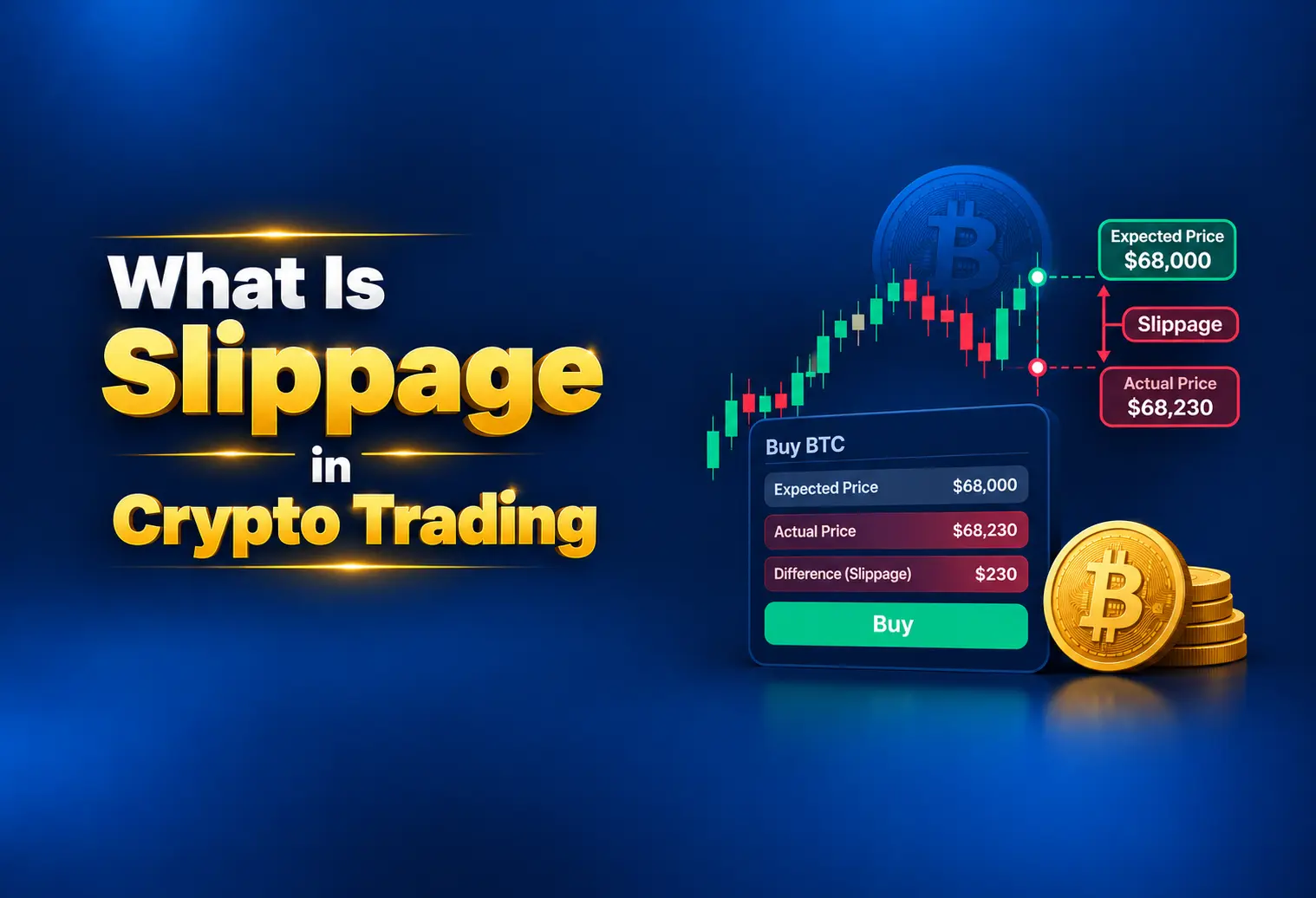
Crypto slippage is the difference between the price you expect when placing a trade and the actual price at which your order executes. In simple terms, it is a common hidden cost in crypto trading that can reduce your profits or increase your losses. You can calculate it easily with this formula:
Crypto Slippage Formula
Slippage (%) = [(Executed Price − Expected Price) ÷ Expected Price] × 100.
This single number tells you the real extra cost of your trade. Understanding and controlling crypto slippage is one of the most practical skills every beginner and intermediate trader should learn.
What Is Slippage in Crypto?
What is slippage in crypto? It is the gap between the price you see on the screen when you click “Buy” or “Sell” and the price at which the exchange or decentralized platform actually fills your order.
Think of it like this: You walk into a shop and see a shirt priced at ₹2,000. By the time you reach the counter, the price has changed to ₹2,050. That ₹50 difference is similar to slippage in crypto trading.
What is slippage in trading in general? The same principle applies to stocks, forex, and futures. However, slippage in crypto trading is usually more noticeable because crypto markets run 24/7, move faster, and many tokens have lower liquidity than major stocks.
There are two types of crypto slippage:
-
Negative slippage - You get a worse price (most common). You pay more when buying or receive less when selling.
-
Positive slippage - You get a better price than expected (rarer but pleasant).
Why Does Crypto Slippage Happen?
Several factors cause crypto slippage:
1. Low liquidity - Not enough buyers or sellers at the price you want, especially in altcoins or small-cap tokens.
2. High volatility - Prices can jump several percentage points in seconds during news events or big market moves.
3. Large order size - Your trade is bigger than the available orders at the best price, so the system fills it at progressively worse prices.
4. Market orders - These execute immediately at the best available price, which may already have moved.
5. Network delays on DEXs - On platforms like Uniswap, the time between submitting the transaction and it confirming on the blockchain can allow the price to change.
On centralized exchanges (Binance, Coinbase, WazirX), slippage mainly comes from the order book. On decentralized exchanges, it comes from the liquidity pool ratio changing with every trade.
How to Calculate Slippage Crypto – Simple Formula and Examples
How to calculate slippage in crypto is straightforward. Use this standard formula:

Example 1: Basic Calculation
-
You want to buy 1 Bitcoin.
-
Expected price: $100,000
-
Actual executed price: $100,200
Slippage = (100,200 − 100,000) / 100,000 × 100 = 0.20%
Your extra cost is $200.
Example 2: Larger Order Walking the Book
Imagine this order book when you place a market buy for 4 BTC:
|
Available Quantity |
Price |
|
1 BTC |
$100,000 |
|
2 BTC |
$100,100 |
|
1 BTC |
$100,300 |
Your order fills across three levels.
Total cost = (1 × 100,000) + (2 × 100,100) + (1 × 100,300) = $400,500
Average executed price = $100,125
Slippage = (100,125 − 100,000) / 100,000 × 100 = 0.125%
Actual extra cost on the 4 BTC trade = $500.
Example 3: DEX Trade
You expect to receive 1 ETH for 3,000 USDC. Because of a thin liquidity pool, you actually receive only 0.97 ETH.
That is roughly 3% crypto slippage.
Understanding the Actual Cost of Crypto Slippage
The percentage is useful, but the real impact shows in money terms.
Actual Cost Formula:
Slippage Cost = Trade Value × (Slippage % ÷ 100)
|
Trade Size |
Slippage % |
Actual Extra Cost |
|
$1,000 |
0.5% |
$5 |
|
$5,000 |
0.5% |
$25 |
|
$10,000 |
1.0% |
$100 |
|
$50,000 |
1.5% |
$750 |
|
$100,000 |
2.0% |
$2,000 |
Over many trades, even small percentages add up. A trader doing 50 trades of $5,000 each with an average 0.6% slippage loses $1,500 just to slippage - often more than the exchange fees.
Slippage Tolerance Crypto – Your Safety Net on DEXs
Slippage tolerance crypto is a setting you control on decentralized exchanges. It tells the smart contract the maximum price difference you are willing to accept. If the price moves beyond your set tolerance, the transaction fails and your funds stay safe.
Common settings:
-
Major pairs (ETH/USDC, BTC pairs): 0.1% – 0.5%
-
Mid-cap tokens: 0.5% – 1%
-
Meme coins or low-liquidity tokens: 3% – 12% (sometimes higher).
Setting tolerance too low causes frequent failed transactions. Setting it too high exposes you to bad fills or sandwich attacks. Most experienced traders start with 0.5% and adjust based on the token’s liquidity and current market conditions.
How to Reduce Slippage in Crypto – Practical Tips
Here are proven ways how to reduce slippage in crypto:
1. Prefer limit orders over market orders
Limit orders only execute at your chosen price or better. You avoid unexpected fills, though the order may not fill immediately.
2. Trade high-liquidity pairs
Stick to BTC, ETH, and major stablecoin pairs during peak hours when order books are deepest.
3. Split large orders
Instead of one big market order, break it into several smaller ones or use TWAP/VWAP tools if available.
4. Check order book depth or pool size
On CEXs, look at the order book. On DEXs, check the liquidity pool size before swapping.
5. Avoid high-volatility moments
Major news, token unlocks, or sudden market crashes increase slippage dramatically.
6. Use reputable aggregators on DEXs
Platforms that route through multiple liquidity sources often find better prices and lower impact.
7. Adjust gas fees wisely on DEXs
Higher priority fees can help your transaction confirm faster, reducing the chance of price movement.
Combining these habits can cut your average crypto slippage significantly over time.
Key Takeaways
-
Crypto slippage is the difference between the expected and actual execution price.
-
It is a normal part of trading but becomes costly if ignored.
-
Calculating it is simple with the percentage formula.
-
Actual cost depends on both the percentage and your trade size.
-
Slippage tolerance protects you on DEXs.
-
Smart order types, better timing, and liquidity awareness are the best ways to reduce it.
Mastering this concept helps you protect profits and make more accurate decisions - especially when trading larger sizes or less liquid tokens.

Conclusion
Crypto slippage is an unavoidable part of trading, but it does not have to be a high or uncontrolled cost. By understanding what it is, learning how to calculate it accurately, and applying simple risk-control habits, any trader can protect a meaningful portion of their capital.
The first step is awareness. Once you start measuring the difference between expected and executed prices, you stop treating slippage as a mystery and start treating it as a manageable expense. The second step is process: choose the right order type, respect liquidity, avoid chaotic market moments, and set sensible slippage tolerance on DEXs.
Over dozens or hundreds of trades, these small improvements compound. A trader who consistently reduces average slippage from 1% to 0.3% keeps far more of their edge. In a market as competitive as crypto, that difference often separates those who grow their accounts from those who slowly bleed capital.
(Sources: WazirX, Coinotag, CryptoNews)

DISCLAIMER: This blog is NOT any buy or sell recommendation. No investment or trading advice is given. The content is only for educational purposes. Always discuss with your SEBI-registered financial advisor for investment-related decisions.
Follow this WhatsApp Channel for the latest updates directly on WhatsApp.