Crypto trading fees in India include more than the small percentage shown by an exchange. The real cost of buying and selling Bitcoin also covers 18% GST on trading fees, 1% TDS on sales, and a flat 30% tax on profits under the 2026-27 rules.
To keep costs low, compare volume-based or subscription plans on platforms such as CoinDCX, WazirX, and Mudrex; use maker (limit) orders; track every charge; and understand the full tax picture so you know exactly what you pay when you trade Bitcoin.
This guide explains crypto trading fees in India and the complete crypto trading charges in simple, beginner-friendly language. You will see how fees, GST, TDS, and the 30% tax work together, with clear tables and real examples.
What Goes into Crypto Trading Fees in India?
When you buy or sell Bitcoin, several costs appear at once:
Trading fees– The percentage the exchange charges on each trade. Most platforms use a maker-taker model or volume tiers. Maker orders (limit orders that add liquidity) usually cost less than taker (market) orders.
Deposit and withdrawal fees– INR deposits via UPI or bank transfer are normally free. Crypto withdrawals carry network (gas) fees that change with blockchain traffic. Some platforms add a small extra charge.
18% GST– Charged only on the exchange’s service fee, not on the Bitcoin value itself. A ₹200 fee becomes ₹236 after GST.
-
1% TDS– Deducted on the full sale amount once annual thresholds are crossed.
-
30% tax on gains– Flat rate on any profit from transferring Bitcoin or other virtual digital assets, plus cess and possible surcharge.
Together, these layers form the true cost of trading Bitcoin in India.
Crypto Trading Fees Comparison – Popular Indian Platforms (2026)
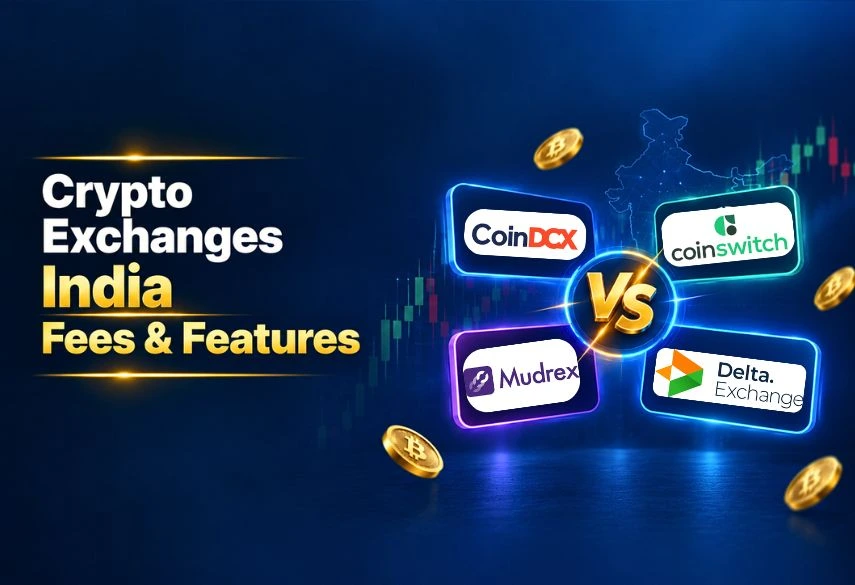
Crypto Trading fees change with your 30-day trading volume and special offers. Always check the latest numbers on the exchange website. Here is a simple comparison of typical base rates for lower-volume users:
|
Exchange |
Spot Trading Fee (Low Volume) |
Special Offers |
Futures (Maker/Taker approx.) |
GST on Fees |
|
CoinDCX |
0.50% (INR pairs under ₹2 lakh) |
Falls to 0.03% at the highest VIP tiers |
0.02% / 0.05% |
18% |
|
WazirX |
0.20% or 0% with ZERO plan |
₹99/month + GST for zero trading fees |
~0.02% / 0.04% with ZERO |
18% |
|
Mudrex |
0.45% falling to 0.12% via tiers |
Volume-based Alpha discounts |
0.02% / 0.05% base |
18% |
|
CoinSwitch Pro |
0% maker / 0.10% taker |
Maker-friendly structure |
Varies by pair |
18% |
|
ZebPay / others |
0.15–0.45% |
Volume discounts common |
Similar low rates |
18% |
Sources include official CoinDCX fee schedules and 2026 platform comparisons. Global platforms may show lower base rates, but Indian users often fund them through P2P, which can add a 0.5–3% premium.
One can open a crypto trading account with CoinDCX.
2026-27 Tax Rules for Bitcoin and Crypto in India
From 1 April 2026, the Income-tax Act, 2025 is fully in force. Budget 2026 kept the main rates the same while tightening reporting. The rules for Tax Year 2026-27 are:
Flat 30% tax on gains– Any income from transferring a Virtual Digital Asset (Bitcoin, other cryptocurrencies, NFTs, and notified crypto-assets) is taxed at 30% under Section 194 of the Income-tax Act, 2025.
Surcharge (10–37%) and 4% Health and Education Cess apply on top. The rate does not depend on how long you held the asset or which income-tax slab you fall into.
Only the cost of acquisition is deductible– You can subtract the original purchase price. Trading fees, GST, network fees, software, or advisory costs are not allowed as deductions.
No loss set-off and no carry-forward– A loss on one trade or one coin cannot reduce gains on another Bitcoin trade, other crypto, salary, or any other income. Losses also cannot be carried forward to future years.
1% TDS on transfers– Under Section 393, 1% of the full sale consideration is deducted once the annual threshold is crossed. For most individuals (specified persons), the threshold is ₹50,000 in a financial year. For companies, firms and higher-turnover individuals, it is ₹10,000. Indian exchanges deduct TDS automatically. On P2P or foreign platforms, the buyer is responsible. TDS is an advance tax you claim back when filing your return.
Stronger reporting from 1 April 2026– Section 509 requires exchanges and other reporting entities to send detailed user-level crypto transaction data to the Income Tax Department. Penalties apply for late or inaccurate filing. Almost every trade on Indian platforms will appear in your Annual Information Statement (AIS).
How to report– Declare VDA income in Schedule VDA of ITR-2 or ITR-3. Match the figures with AIS and Form 26AS before filing.
These rules apply whether you use an Indian exchange or an international platform that serves Indian residents.
Crypto Trading with Delta Exchange India
To start trading on crypto, one can open a crypto account with Delta Exchange India.
Real Cost Example – Buying and Selling Bitcoin
Suppose you buy ₹1,00,000 of Bitcoin and later sell it for ₹1,50,000 (₹50,000 gross gain). You use a platform that charges a 0.20% trading fee.
Buy side
-
Trading fee: ₹200
-
GST at 18%: ₹36
-
Total cost on buy: ₹236
Sell side
-
Sale value: ₹1,50,000
-
Trading fee: ₹300
-
GST: ₹54
-
1% TDS: ₹1,500
-
Net amount after fees, GST, and TDS: about ₹1,48,146
Tax under 2026-27 rules
-
Taxable gain: ₹50,000 (only acquisition cost is allowed)
-
Tax at 30%: ₹15,000
-
Cess at 4%: ₹600
-
Total tax: ₹15,600
-
TDS already paid: ₹1,500 (credit available)
-
Balance tax: ₹14,100
Your net profit after all charges and tax is roughly ₹33,500–34,000. The fees and GST paid are not deductible from the gain.
If you use a zero-fee subscription plan, the trading fees and related GST disappear, but the monthly subscription cost, TDS, and 30% tax still apply.
Why Frequent Trading Costs More Under the Current Rules
Every sale triggers 1% TDS on the full value, not just the profit. High turnover locks up capital with the tax department until you claim the credit. Because losses cannot offset gains, a year of mixed results can still produce a large 30% tax bill on the winning trades.
GST adds to every fee. The new reporting rules under Section 509 mean the tax department receives detailed data from Indian exchanges, making under-reporting harder.
Simple Ways to Lower Crypto Trading Charges in India
1. Match the fee model to your trading style. Calculate whether a monthly zero-fee plan costs less than percentage fees for your volume.
2. Use maker (limit) orders whenever possible to access lower rates.
3. Increase your 30-day volume on platforms that offer tier discounts.
4. Trade liquid Bitcoin pairs to keep spreads and slippage low.
5. Deposit INR only through free UPI or bank transfer methods.
6. Keep a complete record of every buy price, fee, TDS, and sale from the first trade.
7. Plan your sells carefully because losses cannot reduce gains.
8. Reconcile AIS and Form 26AS before filing Schedule VDA.
9. For larger or complex portfolios, consult a chartered accountant familiar with the 2025 Act.
Beginner Checklist Before You Trade Bitcoin
-
Choose an FIU-registered exchange for automatic TDS handling.
-
Read the current fee schedule and GST note.
-
Remember that only the purchase price is deductible and losses cannot be set off.
-
Start with a small amount so you experience the full cost flow.
-
Keep records ready for Schedule VDA.
-
Avoid leaving large long-term Bitcoin holdings only on an exchange.
Conclusion
Crypto trading fees in India are manageable once you see the complete picture. The exchange percentage is only the first layer. Under the 2026-27 rules, GST, 1% TDS, and the flat 30% tax on gains (with no loss relief) decide the real cost of buying and selling Bitcoin.
By selecting the right platform for your volume, using limit orders, and treating tax compliance as part of every trade, you keep more of your money working for you.
Always check the latest fee pages and tax notifications, because both can change. This article is for educational purposes only. Seek professional tax advice for your personal situation.
(Sources: , CoinDCX , Mudrex ,TradeBrains ,CryptoTimes)

DISCLAIMER: This blog is NOT any buy or sell recommendation. No investment or trading advice is given. The content is only for educational purposes. Always discuss with your SEBI-registered financial advisor for investment-related decisions.
Follow this WhatsApp Channel for the latest updates directly on WhatsApp.

.webp)