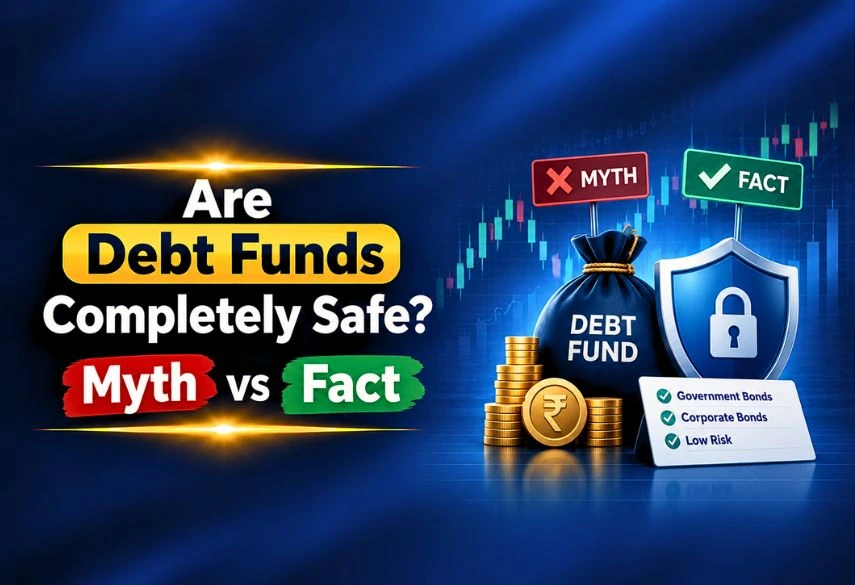
No, debt funds are not completely safe, and debt mutual funds are not risk-free in India. While they are generally safer and far less volatile than equity funds, they can still lose money because of interest rate movements by the RBI, credit events, or liquidity stress. Treating them like bank fixed deposits is one of the biggest debt fund investing myths among Indian investors.
Understanding the real debt fund risks - shaped by SEBI rules, RBI policy, and past crises like Franklin Templeton in 2020 - helps you pick safer options such as liquid funds, overnight funds, ultra-short duration funds, banking and PSU debt funds, or high-quality corporate bond funds.
What Are Debt Funds in the Indian Mutual Fund System?
In India, debt mutual funds invest mainly in fixed-income instruments such as government securities (G-Secs), treasury bills, corporate bonds, certificates of deposit, and commercial papers. SEBI has clearly defined categories based on duration and credit quality so investors can compare schemes easily.
The industry’s debt-oriented assets stood at around ₹17-21 lakh crore in recent months, forming a significant but smaller share of the overall mutual fund AUM compared with equity.
Many Indian investors still believe debt funds are almost as safe as bank FDs. This belief grew stronger after years of relatively stable returns, but events like the IL&FS default in 2018 and the Franklin Templeton wind-up of six debt schemes in April 2020 showed the limits of that assumption.

Debt Funds Myths vs Facts – Indian Investor Perspective
Myth 1: Debt mutual funds are risk-free like bank FDs.
Fact: Debt mutual funds are not risk-free. Bank FDs come with DICGC insurance cover of up to ₹5 lakh per depositor per bank. Debt funds have no such capital guarantee. Their NAV changes every day with bond prices. SEBI’s Risk-o-Meter and Potential Risk Class matrix clearly show that even “low risk” debt funds carry some interest rate and credit exposure.
Myth 2: Debt funds can never lose money.
Fact: Can debt funds lose money? Yes. When the RBI raises the repo rate, bond prices fall and NAVs decline. In October 2026, the RBI raised the repo rate by 25 basis points to 5.50% and shifted to a calibrated tightening stance - the first hike since early 2023. Longer-duration funds felt more pressure. Credit defaults or rating downgrades can also cause losses, as seen in the past.
Myth 3: All debt funds are equally safe.
Fact: Risk differs sharply by SEBI category. Overnight funds and liquid funds invest in very short-maturity papers and carry the lowest risk. Ultra short duration funds and short duration funds sit in the middle. Gilt funds have almost zero credit risk (sovereign guarantee) but high interest rate sensitivity - this is the core of gilt funds' risks. Credit risk funds take higher credit exposure for higher yields and are suitable only for experienced investors.
Myth 4: Debt funds always beat FDs after tax.
Fact: After the Finance Act 2023 changes, gains from debt funds acquired on or after 1 April 2023 are taxed at the investor’s income tax slab rate, just like FD interest. The old indexation benefit is gone. Debt funds still offer the advantage of tax only on redemption (better compounding) and higher liquidity, but the pure tax edge has reduced.
Myth 5: Debt funds are only for retired or ultra-conservative people.
Fact: Different categories suit different Indian goals. Overnight and liquid funds work well for emergency money or short-term parking (a few days to a few months). Short-duration, banking, PSU, and corporate bond funds can fit 1-3 year goals for working professionals as well.
Key Debt Funds Risks
1. Interest Rate Risk- Bond prices and interest rates move in opposite directions. When the RBI hikes the repo rate (as it did in October 2026 to 5.50%), existing bonds become less attractive, and their prices fall. Funds with higher Macaulay duration suffer larger NAV declines. Liquid and overnight funds are least affected.
2. Credit Risk- The risk that the issuer (company or NBFC) fails to pay interest or principal. The IL&FS crisis (2018) and subsequent NBFC stress showed how quickly high-rated papers can turn problematic. SEBI now requires strict disclosure of credit quality.
3. Liquidity Risk- In stressed markets, some bonds become hard to sell at fair prices. The Franklin Templeton episode in April 2020 is the clearest Indian example: the fund house wound up six schemes (worth over ₹25,000 crore at the time) citing redemption pressure and illiquidity in the underlying portfolio. Investors had to wait months or years for full recovery through an orderly liquidation process.
These risks explain why the question “Are debt mutual funds completely safe?” has a clear answer: No. Safety is relative and category-specific.
Debt Funds vs FD: Practical Comparison for Indian Investors
|
Parameter |
Bank Fixed Deposit (FD) |
Debt Mutual Fund |
|
Capital Guarantee |
Yes, up to ₹5 lakh per bank (DICGC) |
No guarantee |
|
Returns |
Fixed at the time of booking |
Market-linked, can fluctuate |
|
Liquidity |
Premature exit usually attracts a penalty |
High - redeem any business day (T+1/T+2) |
|
Taxation (post-April 2023) |
Interest taxed every year at slab rate |
Gains taxed at slab rate only on redemption |
|
Interest Rate Impact |
None after booking |
NAV falls when rates rise |
|
Best Use in India |
Certainty, senior citizens, emergency corpus |
Flexibility, short-to-medium goals, better liquidity |
FDs remain the purest safety option for money you cannot afford to see fluctuate. Debt funds score on liquidity and the ability to benefit when the rate cycle turns favourable.
Safest Debt Mutual Funds Categories in India (2026)
SEBI categories make selection clearer:
Overnight funds - Invest only in securities maturing the next day. Lowest risk. Best overnight funds are ideal for parking surplus money for a few days.
Liquid funds - Residual maturity up to 91 days. Very low volatility and high liquidity. Best liquid funds are the most popular choice for emergency funds and corporate treasury in India.
Ultra short duration funds - Macaulay duration of 3-6 months. Slightly higher yield with still limited rate sensitivity.
Short duration funds - Duration 1–3 years. Suitable for 1-3 year goals.
Banking and PSU debt funds - At least 80% in debt of banks, PSUs, and public financial institutions. Relatively strong credit quality.
Corporate bond funds - At least 80% in highest-rated (AA+ and above) corporate bonds. Better yields than pure G-Secs with controlled credit risk.
Gilt funds carry negligible credit risk but meaningful gilt fund risks from interest rate movements. Long-duration or dynamic bond funds are more suitable when you expect rates to fall.
When looking for the best debt mutual funds 2026, check average maturity, percentage of AAA/sovereign holdings, expense ratio, and consistency rather than chasing the highest yield.
Debt Funds vs Equity Funds in an Indian Portfolio
Debt funds vs equity funds is not an equal risk comparison. Equity funds can fall 20-40% in a bad year. A well-chosen liquid or short-duration debt fund rarely falls more than 1-2% even in difficult periods. Indian financial planners typically recommend using debt funds for money needed in the next 1-5 years and equity for longer goals. This combination reduces overall portfolio volatility.
How Indian Investors Should Approach Debt Funds in the Current Environment
With the RBI in a calibrated tightening mode (repo at 5.50%), shorter-duration categories (overnight, liquid, ultra short, short duration) currently offer better risk-adjusted comfort. Prefer funds with high credit quality. Review the SEBI Risk-o-Meter and the scheme’s portfolio disclosure regularly. Avoid chasing high yields through credit risk funds unless you fully understand and accept the higher risk.
After the 2023 tax changes, the decision between debt funds and FDs rests more on liquidity needs, tax timing (debt funds tax only on exit), and your comfort with mark-to-market fluctuations rather than pure tax arbitrage.

Conclusion
Are debt funds safe? They are relatively safe compared with equity but not completely safe or risk-free. The Indian experience - from IL&FS to Franklin Templeton to the latest RBI rate actions - shows that understanding category-specific risks is essential.
Overnight funds, liquid funds, ultra-short duration funds, banking and PSU debt funds, and high-quality corporate bond funds offer the best balance of safety and utility for most retail investors in 2026.
Treat debt funds as market-linked fixed-income products regulated by SEBI, not as bank deposits. When you do that, they become useful tools for parking money, reducing portfolio risk, and meeting short-to-medium-term goals without unpleasant surprises.
(Sources: Indmoney, ET, Upstox, Livemint)

DISCLAIMER: This blog is NOT any buy or sell recommendation. No investment or trading advice is given. The content is only for educational purposes. Always discuss with your SEBI-registered financial advisor for investment-related decisions.
Follow this WhatsApp Channel for the latest updates directly on WhatsApp.