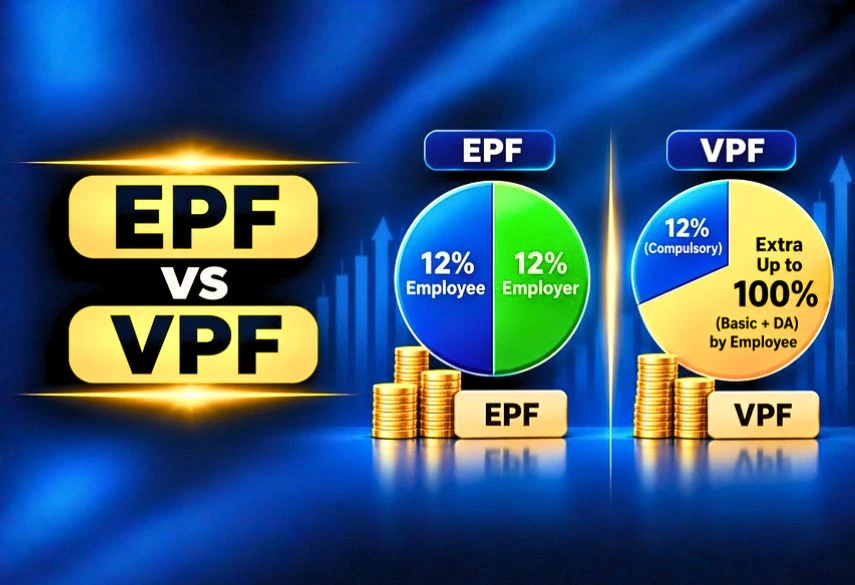
For the majority of salaried employees in India, the most effective approach is not to choose between EPF and VPF but to use both strategically. Mandatory EPF forms the essential foundation of your retirement savings because your employer contributes matching funds. Voluntary Provident Fund (VPF) then acts as a powerful accelerator, allowing you to contribute extra money into the same account at the identical high interest rate.
This combination delivers disciplined, low-risk growth with strong tax efficiency and remains one of the strongest retirement strategies available to salaried professionals today.
What Is EPF?
The Employees’ Provident Fund (EPF) is a statutory retirement savings scheme administered by the Employees’ Provident Fund Organisation (EPFO). It applies to most private-sector salaried employees working in establishments covered under the relevant social security laws.
Under the scheme, both the employee and the employer contribute 12% of the employee’s basic salary plus dearness allowance, subject to the prevailing statutory wage ceiling. A portion of the employer’s contribution is diverted to the Employees’ Pension Scheme (EPS), while the balance remains in the EPF account.
The EPF interest rate for FY 2025-26 stands at 8.25%, making it one of the highest government-backed, largely tax-efficient returns available to salaried individuals. EPF contributions are deducted automatically from salary, which enforces long-term financial discipline.
The accumulated corpus can be withdrawn fully at retirement or under specific permitted circumstances such as unemployment beyond a certain period, medical emergencies, higher education, marriage, or home purchase.
The scheme’s combination of mandatory saving, employer contribution, and competitive interest makes it the cornerstone of retirement planning for millions of Indian employees.

What Is a Voluntary Provident Fund (VPF)?
Voluntary Provident Fund (VPF) is an extension of the EPF scheme that allows an existing EPF member to contribute more than the mandatory 12%. Employees can contribute any additional amount up to 100% of their basic salary and dearness allowance. Critically, the employer is under no obligation to match these extra contributions.
VPF contributions are deposited into the same EPF account and earn exactly the same interest rate as regular EPF balances- currently 8.25% for FY 2025-26. There is no separate account, no additional administrative process in most organisations, and the same withdrawal and tax rules apply. In essence, VPF is simply a higher personal contribution option within the existing EPF framework.
This flexibility makes VPF particularly attractive for employees whose income has risen, whose essential expenses are under control, or who prefer guaranteed returns over market-linked instruments.
EPF vs VPF Difference: Detailed Side-by-Side Comparison
|
Parameter |
EPF |
VPF |
|
Nature |
Mandatory |
Completely voluntary |
|
Contribution by |
Employee + Employer |
Employee only |
|
Standard rate |
12% of basic + DA (subject to wage ceiling) |
Any amount above the mandatory 12%, up to 100% of basic + DA |
|
Employer matching |
Yes |
No |
|
Interest rate (FY 2025-26) |
8.25% |
Same 8.25% |
|
Tax deduction (old regime) |
Eligible under Section 80C (overall ₹1.5 lakh limit) |
Same Section 80C eligibility |
|
Interest tax treatment |
Tax-free on employee contributions up to ₹2.5 lakh per year |
Identical rule |
|
Account structure |
Main EPF account |
Same EPF account |
|
Withdrawal rules |
Restricted but permitted for specific purposes |
Identical to EPF |
|
Primary purpose |
Core retirement foundation |
Accelerating the retirement corpus |
This comparison highlights the fundamental EPF VPF difference. EPF provides the critical benefit of employer matching, while VPF offers the ability to scale personal savings at the same attractive rate and within the same secure structure.
EPF vs VPF: Which Is Better for Retirement?
The question “EPF vs VPF which is better” or “EPF or VPF which is better for retirement” is best answered by recognising that the two are complementary rather than competing options.
Prioritise full utilisation of EPF when:
-
Cash flow is tight and maximising monthly take-home pay is important.
-
You already maintain a diversified investment portfolio that includes equity mutual funds or NPS.
-
You are in the early stages of your career and still building emergency reserves and other short-to-medium-term goals.
Add or increase VPF when:
-
You generate a consistent monthly surplus after meeting expenses and other financial goals.
-
You value guaranteed returns and capital protection over potentially higher but volatile market-linked growth.
-
You wish to maximise the power of compounding at 8.25% without the need to open or manage additional accounts.
-
You continue to follow the old tax regime and can still benefit from the Section 80C deduction.
A modest additional contribution of ₹3,000 to ₹5,000 per month through VPF, sustained over 20 years at 8.25%, can grow into a substantial additional corpus through the effect of compounding. This extra layer of savings sits safely within the same government-backed framework and requires almost no ongoing effort once set up.
In the majority of cases, the optimal outcome in the EPF vs VPF comparison is achieved by combining both: fully utilising the mandatory EPF (including the employer contribution) and then channeling surplus savings into VPF.
How to Contribute to VPF: Practical Steps
Initiating or modifying VPF contributions is straightforward in most organisations:
1. Approach the HR or payroll department with a clear request to start Voluntary Provident Fund contributions.
2. Specify either a fixed additional amount or a percentage of basic + DA (within the overall VPF contribution limit of 100%).
3. Complete any simple internal form or email confirmation required by the company.
4. The extra deduction begins from the subsequent salary cycle and appears in the EPF passbook under the same Universal Account Number (UAN).
5. Most employers allow subsequent increases, reductions, or discontinuation of the voluntary portion with reasonable notice.
No new registration or separate documentation with EPFO is generally required. The process remains internal to the employer’s payroll system.
Detailed Tax Benefits of EPF and VPF
Understanding the tax treatment is essential because it significantly influences the net returns from both EPF and VPF. The benefits operate at three stages: contribution, interest accrual, and withdrawal.
1. Tax Benefit at the Time of Contribution
Under the old tax regime, the employee’s own contribution (mandatory EPF plus any VPF amount) qualifies for deduction under Section 80C of the Income Tax Act. This deduction is subject to the overall annual limit of ₹1.5 lakh, which is shared with other eligible investments such as PPF, ELSS, life insurance premiums, and principal repayment of home loans. The employer’s contribution does not count toward this limit. Under the new tax regime, Section 80C deductions are not available.
2. Tax Treatment of Interest Earned
Interest earned on EPF and VPF is generally exempt from tax. However, a key threshold applies: interest attributable to the employee’s own contributions exceeding ₹2.5 lakh in a financial year becomes taxable at the individual’s applicable income-tax slab rate. The ₹2.5 lakh limit is calculated on the combined employee contribution to EPF and VPF.
The employer’s contribution is excluded from this calculation. If there is no employer contribution (rare in standard employment), the threshold rises to ₹5 lakh. EPFO maintains separate ledgers for the tax-free and taxable portions of interest.
Example: Suppose an employee’s mandatory EPF contribution is ₹1.8 lakh and VPF contribution is ₹1 lakh in a year (total employee contribution ₹2.8 lakh). Interest on the first ₹2.5 lakh remains tax-free, while interest on the excess ₹30,000 becomes taxable.
3. Tax Treatment at Withdrawal
The accumulated balance (including interest) is generally fully tax-exempt if withdrawn after five years of continuous service. Continuous service includes periods of employment with different employers linked through the same UAN. Premature withdrawal before completing five years can attract tax on the interest component and, in some cases, on the principal, depending on the specific circumstances and rules in force.
Practical Tax Planning Tips
-
Track your total employee contribution (EPF + VPF) each financial year to stay within the ₹2.5 lakh tax-free interest threshold if that is a priority.
-
Under the old tax regime, coordinate VPF contributions with other Section 80C investments so the overall limit is utilised optimally.
-
Keep records of your EPF passbook and Form 16 for accurate tax reporting.
-
Consult a tax advisor if your contributions are high or if you switch between the old and new tax regimes.
These tax features make both EPF and VPF highly efficient vehicles for long-term retirement savings, especially when the interest remains fully or largely tax-free.
Understanding NPS and How It Fits with EPF and VPF
The National Pension System (NPS) is a voluntary, market-linked retirement savings scheme regulated by the Pension Fund Regulatory and Development Authority (PFRDA). It is open to all Indian citizens (and certain NRIs) between the ages of 18 and 70.
Unlike EPF and VPF, which offer fixed, government-declared interest, NPS invests your contributions across equity, corporate bonds, government securities, and alternative assets. You can choose the asset allocation yourself (Active Choice) or let the fund manager decide (Auto Choice).
Key features of NPS include:
-
Flexible contribution amounts with no upper limit on Tier-I (the main retirement account).
-
Partial withdrawal allowed under specific conditions after three years.
-
At retirement (normally age 60), up to 60% of the corpus can be withdrawn as a lump sum (tax-free under current rules) while at least 40% must be used to purchase an annuity.
-
An additional tax deduction of up to ₹50,000 under Section 80CCD(1B) over and above the ₹1.5 lakh Section 80C limit (available under the old tax regime).
EPF vs NPS and EPF vs VPF vs NPS - Quick Comparison
|
Feature |
EPF / VPF |
NPS |
|
Return type |
Fixed (currently 8.25%) |
Market-linked (historically higher with equity) |
|
Risk level |
Very low |
Moderate to high (depending on equity allocation) |
|
Employer contribution |
Yes (for EPF) |
Possible in corporate NPS, but not mandatory |
|
Tax on contribution |
Section 80C (up to ₹1.5 lakh) |
Section 80C + extra ₹50,000 under 80CCD(1B) |
|
Tax on maturity |
Largely tax-free after 5 years |
60% lump sum tax-free; annuity taxable |
|
Liquidity |
Restricted |
Restricted with specific rules |
|
Best suited for |
Safety and guaranteed growth |
Higher long-term growth potential |
NPS works best as a complement rather than a replacement. Many salaried employees use EPF + VPF for the safe, guaranteed portion of their retirement corpus and allocate a portion of surplus savings to NPS for equity-driven growth and the extra tax deduction. This combination balances safety with the potential for higher returns over long periods.
Broader Comparison: EPF vs PPF vs VPF and Related Options
A complete retirement strategy often requires placing EPF and VPF in context with other popular instruments:
EPF vs PPF: EPF currently offers a higher interest rate (8.25% versus approximately 7.1% for PPF) and includes employer contributions. PPF is available to all residents, operates independently of employment, and has a fixed 15-year tenure with limited extensions.
VPF vs PPF: For employees already covered under EPF, VPF is usually more convenient and currently higher-yielding. PPF remains useful for those seeking a fully independent account or who are not EPF members.
PPF vs EPF vs VPF: Salaried employees generally benefit most from maximising EPF and adding VPF, then using PPF only if additional tax-efficient debt allocation is still required.
Among the best retirement options for salaried employees in India, a balanced framework typically includes full mandatory EPF, a comfortable level of VPF, selective NPS allocation for growth, and a separate emergency fund.
Practical Decision Framework and Action Steps
1. Ensure you are fully contributing to mandatory EPF and receiving the employer match.
2. Calculate your reliable monthly surplus after essential expenses, existing investments, and emergency fund contributions.
3. Start with a modest VPF amount that does not strain cash flow.
4. Consider adding NPS if you want equity exposure and the extra ₹50,000 tax deduction.
5. Review the contribution mix annually when salary increases, or major life changes occur.
6. Track total employee contributions to stay within preferred tax thresholds.
7. Maintain the EPF/VPF corpus strictly for long-term retirement use and avoid early withdrawals wherever possible.

Conclusion
In the ongoing discussion of EPF vs VPF, the evidence points clearly toward a combined approach. EPF delivers the foundational benefits of mandatory saving and employer contribution.
VPF provides the flexibility to increase personal savings at the same competitive, government-backed rate of 8.25% within an already familiar and secure structure. Adding a measured allocation to NPS can further enhance long-term growth potential and tax efficiency. Together, these instruments form one of the most reliable and well-rounded pathways to building a substantial retirement corpus for salaried employees in India.
Employees who systematically utilise EPF, VPF, and selectively NPS position themselves for greater financial security in retirement while retaining an appropriate balance between safety and growth.
(Sources:BS, Moneycontrol,Livemint,ET)

DISCLAIMER: This blog is NOT any buy or sell recommendation. No investment or trading advice is given. The content is only for educational purposes. Always discuss with your SEBI-registered financial advisor for investment-related decisions.
Follow this WhatsApp Channel for the latest updates directly on WhatsApp.














.webp "growth-vs-idcw-mutual-fund")