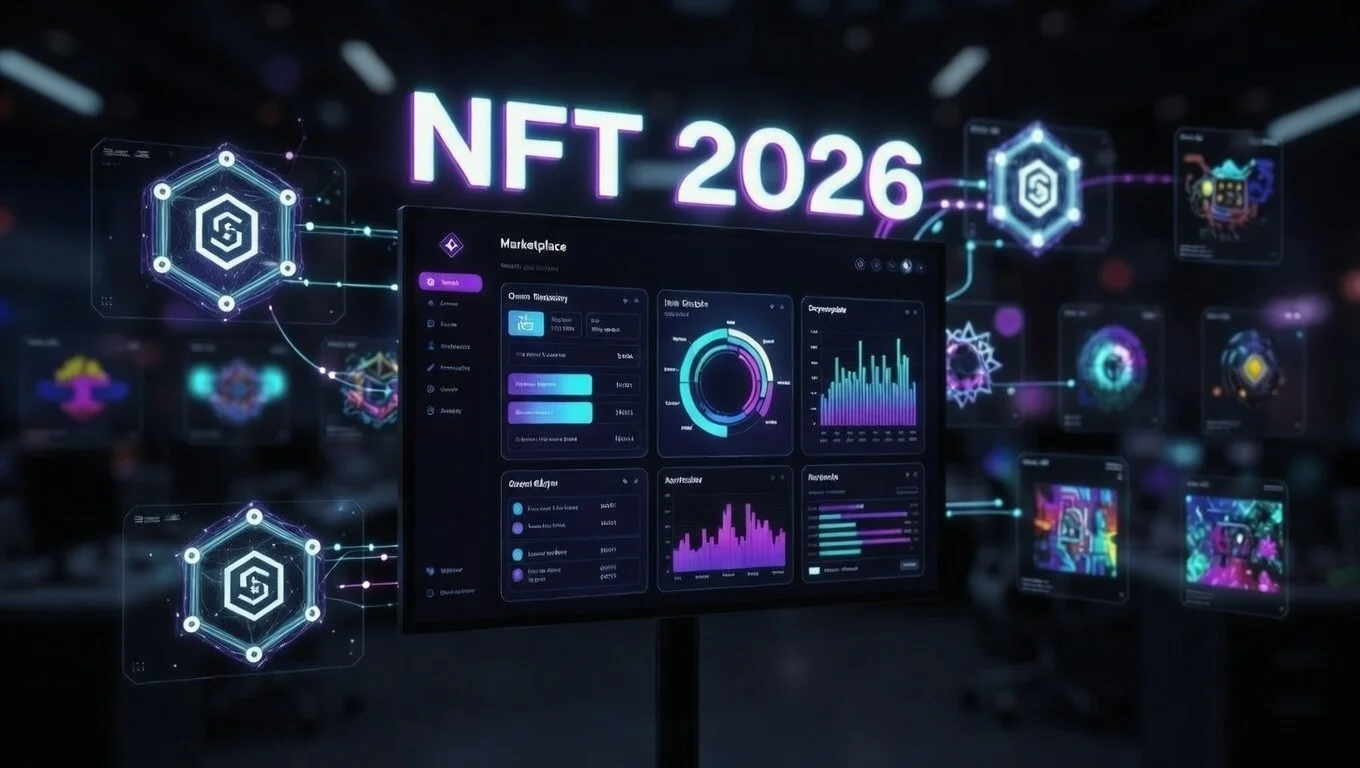
The NFT Marketplace began in 2021 with lots of hype surrounding it. In 2026, hype is gone and the NFT Marketplace is being used to create applications in the digitized and tokenized worlds. White-Label NFT Marketplaces offer speed and custom NFT solutions for businesses on multi-chain solutions.
With the addition of rapid deployment options on NFT platforms, considerable customisation options, and an increase in demand for multi-chain solutions, the NFT Marketplace is leading the way in rapid growth. Covering an NFT Marketplace cost of $60 billion in 2026 is an advantage for NFT Marketplace Developers. This blog will help one understand the trends in consideration for someone looking to invest in the White-Label NFT Marketplaces.
Trends of NFT App Development in 2026
NFTs in 2026 focus on utility, cross-chain technology, and sustainable practices, shifting from crypto-assets speculation as collectibles to functional digital assets. Notable trends in NFT development include the tokenization of real-world assets (RWA), digitizing and splitting physical items like real estate and luxury goods to offer fractional ownership. Such activity will drive growth in the next decade, with estimates as high as $100 billion in valuation of the NFT industry.
AI integration will shift the industry again. With NFTs, Artificial Intelligence will evolve these assets, to create a natural transformation of generated art on an NFT that will change based on user behaviour and certain environmental factors. The user experience will be augmented tremendously as the platform uses AI technology to detect fraud, provide recommendations, and build metadata.
The energy use of blockchains that have caused concern will use layer-2 solutions with eco-friendly NFTs to provide a sustainable solution. NFTs will soon become eco-friendly.
Multi-chain compatibility has become a necessity instead of a nice-to-have. Innovation around cross-chain bridges and interoperability protocols has been a direct result of users’ price sensitivity and transaction speed requirements across ecosystems. With the help of DeFi, NFTs are becoming more financialised by allowing them to be used as loan collateral or for yield farming, thus integrating financial activities with the NFT ecosystem.
Furthermore, the introduction of DAOs (Decentralised Autonomous Organisations) has democratised governance, giving users a stake in decision-making, ultimately boosting loyalty and active engagement.
These developments explain the rapid surge in the white-label NFT marketplace. It illustrates the ability to pivot and adapt to changing circumstances without the need to recreate a whole new marketplace, allowing businesses to save 70% in development time and costs.
Increase in White-Label NFT Marketplaces
Essentially, white-label NFT marketplaces consist of propositions that companies will have the ability to brand and modify to their liking. Unlike tailored solutions that can take anywhere from 6 to 12 months and cost over $100,000, white-label solutions take anywhere from 2 to 4 weeks and cost between $30,000 and $50,000. This ease and efficiency are the reasons for the rapid growth of the concept, with the white-label NFT sector predicted to grow from $130 million in 2024 to $254 million in 2034, representing a CAGR of 8.4%.
Why the increase? White-label solutions offer the basic building blocks of NFT marketplaces out of the box, including the essential blockchain technology, smart contracts, auction functionalities, and payment gateways. This allows companies, such as Codezeros and Blockchain App Factory, to focus their efforts on the marketing and community-building aspects of the venture on the frontend, while outsourcing the backend to one of these vendors. For example, a platform supporting NFTs and other digital assets, including utility tokens, can be tailored to suit a gaming or real estate niche.
Web3 can be particularly attractive for large enterprises looking for opportunities in the white-label NFT market places in 2026. These marketplaces provide a low barrier to entry and an easy way to respond to new trends, such as RWA tokenisation or NFTs driven by artificial intelligence.
If these businesses want to be successful, they must partner with white-label solution providers that have demonstrated the ability to scale. For example, Antier Solutions expertly balances cross-chain interoperability and asynchronous trading at scale to provide adequate support for secure, high-volume trading.
Speed and Efficiency: Hallmarks of 2026 NFT Platforms
Speed and efficiency are the hallmarks of the 2026 NFT marketplace. Users expect near-instantaneous transactions. White-label solution vendors will be able to use Layer 2 scaling and smart contracts to provide sub-second processing times. This is a significant improvement compared to the early days of Ethereum, which were plagued by bottlenecks. Now, new marketplaces are able to integrate with new technologies, such as the Solana blockchain, to process thousands of transactions at a time.
Deployment efficiency does not take a back seat with white-label services establishing plug-and-play solutions, causing development timeframes to decrease by 60-70%. Pixel Web Solutions' tools allow startups to launch with fully set up wallets, royalties, and analytics dashboards, etc which is crucial for a market that has rapid changes, such as dynamic NFTs - NFTs that can evolve over time.
With no custom code, businesses avoid risks and overheads which means more efficient processes. Research shows that white-label NFT marketplace customers are able to move to Web3 with a fraction of the R&D and focus on customer acquisition instead. Simply put, there is a quick ROI for ticketing and supply chain businesses that use NFTs to verify authenticity and ownership of NFTs as they can do this in real-time.
NFT Platform Customization
Here is where white-label solutions really offer the most value - no custom development will be needed and companies will not have to deal with the drawbacks of such. Forecasts for 2026 show the potential for high degrees of customization to be offered, including themed and modular UI/UX customizations for the addition of certain types of auctions, custom NFTs, and payment royalties for certain businesses.
Providers will offer such a high range of personalization that some will allow clients to use their custom CSS files for their private page, as well as allow businesses to set their own smart contract rules.
Key customization areas:
- Branding and Design: Logos, colour schemes, and layouts can be applied to your marketplace to establish your identity. E.g. a marketplace for gamers may integrate NFT AR preview use.
Example Customization Options
- Feature Integration: There are options to include AI personalisation, social forums, or DeFi hooks. Utility NFTs can include access controls for exclusive content.
- Security and Compliance: You can custom-fit different KYC/AML modules to specific regions to be compliant with GDPR or MiCA.
Custom vs white-label? Custom gives you as much control as you want but is much more expensive ($50k+ and months of dev time). White-label is more cost-effective but comes with 80-90% customization, which is a good midpoint. SparxIT provides tools for phased customisation, starting white-label and moving to custom.
The level of customisation is unique. Consider a royalty streaming music marketplace or a vertically integrated AI curated art marketplace. These will drive user retention.
Multi-Chain Innovation: Breaking Blockchain Silos
The multi-chain NFT platform that will launch in 2026 will be a huge improvement in comparison to single-chain NFT platforms that are suffering from limitations like high fees and congestion. They will include Ethereum, Polygon, Solana, and BNB Chain and will allow easy asset transfer via cross-chain bridges. The cross-chain NFT market is expected to rapidly grow from $0.3 billion in 2025 to $5.4 billion by 2035, with a growth rate of 33.5% each year.
Innovative features that we can develop include:
- Interoperability Protocols: We can use Chainlink CCIP to simplify cross-chain secure messaging.
- Liquidity Boost: Users can trade on different chains from a single wallet, which will increase market depth.
Cost Optimisation: Choose less expensive networks for minting, and Ethereum for prestige.
Security Tokenizer and other companies provide white-label, multi-chain NFT platforms with these functions that include RWAs and gaming economies. This concept supports developing trends in NFTs, making platforms easy to use and scalable.
Web3 marketplace solutions for decentralised commerce
In 2026, Web3 marketplace solutions will integrate NFTs and decentralised technologies for user-owned economies. These will prioritise privacy, include AI and automation, and integrate with the metaverse. The Web3 market is estimated to grow from $8.85 billion in 2025 to $12.61 billion in 2026 with a 42.5% CAGR.
Key components include:
- Decentralised Identity: Self-sovereign IDs issued as NFTs that facilitate private, secure transactions.
- AI and Automation: Agents similar to Fetch.ai will conduct trades while data is tokenised through the Ocean Protocol.
- GameFi and SocialFi: These combine gaming and social features to enhance user engagement.
With white-label Web3 marketplace solutions, businesses can implement trends like zero-knowledge proofs to enhance security and trust to thrive in a regulated environment where compliance meets innovation.

Conclusion: Embracing the Future of NFTs
As we look ahead to 2026, white-label NFT marketplaces are the embodiment of speed, customisability, and multi-chain innovation. They democratise access to NFTs.

DISCLAIMER: This blog is NOT any buy or sell recommendation. No investment or trading advice is given. The content is purely for educational and information purposes only. Always consult your eligible financial advisor for investment-related decisions.
Read Next: How to Open an Account on Delta Exchange India
Read Next: Top 10 Cryptos to Watch in January 2026
Read Next: Top 5 Cheapest Crypto Tokens to Buy in 2026