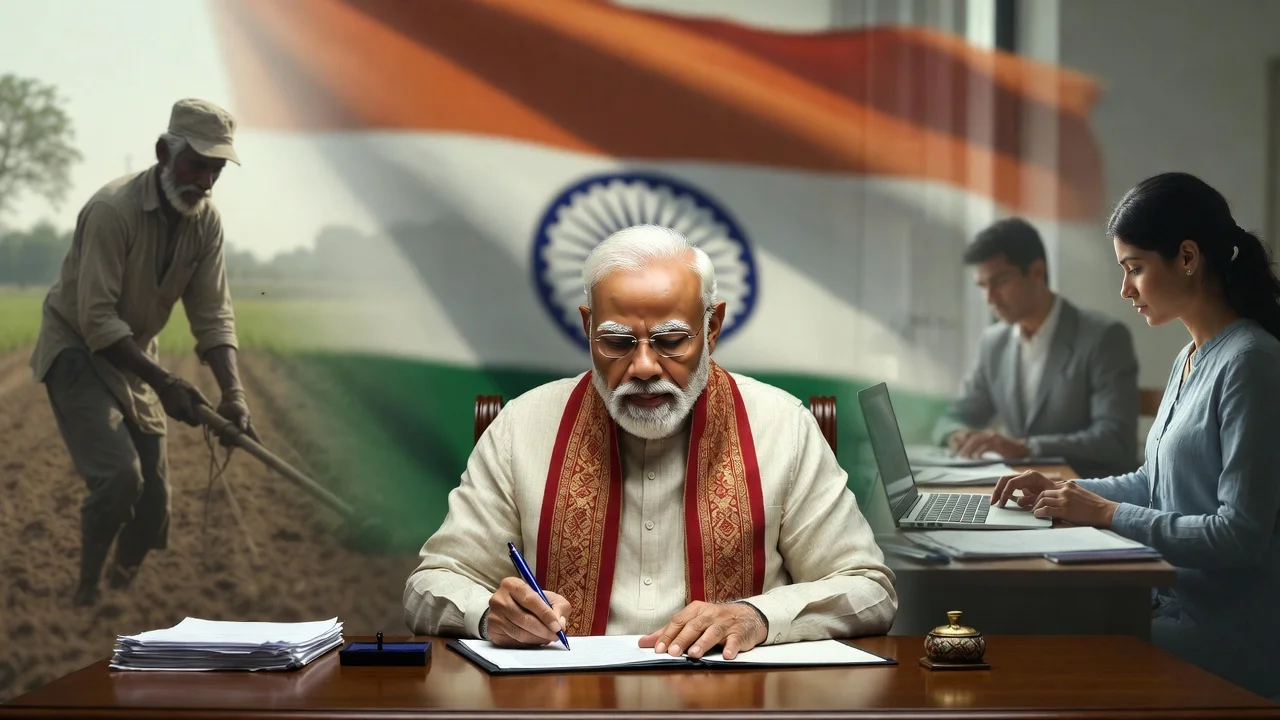
New Seva Teerth, as a Show of Citizen First Governance, PM Modi has begun a new phase of operation. In what would be the first of many decisions from the new PMO, on 13th February 2026, four historic decisions were made that affect the lives of women, farmers, the youth, and the economically weaker sections of society.
This government policy update indicates a significant change in the new PMO priorities from big-ticket infrastructure projects to people-first, immediate welfare projects. The announcements scale and emotionally connect the government to the PM Modi welfare schemes that provide actual benefits on the ground.
These initiatives are a result of the government's prompt response in doubling the support in rural infrastructure, women entrepreneurs, and the youth, next empowering innovations in the development of inclusive schemes. Farmer schemes 2026, and the youth employment schemes will be discussed to see how they affect the lives of the average Indian.
Moving to Seva Teerth: New Priorities of the PMO
Seva Teerth is a new name for the South Block of the Prime Minister’s Office that signifies an intentional decolonial shift to a more service-oriented focus (as opposed to an ownership focus). Within hours of moving to new offices on Kartavya Path, PM Modi signed many files that were emblematic of that sevaethos.
These are not typical day-to-day PMO decisions; they are new PMO priorities that place at the very top of the national agenda the income security of farmers, the economic empowerment of women, and entrepreneurship for the youth. By acting on Day One from the new office, the government has redefined the rhetoric: the first priority is welfare, not an afterthought.

Farmer Schemes 2026: Agriculture Infrastructure Fund Doubled to ₹2 Lakh Crore
One of the biggest announcements is that the Agriculture Infrastructure Fund has been increased from ₹1 lakh crore to ₹2 lakh crore. This is a major government policy update that will change the entire agri-value chain.
What does the Fund Support
- Cold Storage & Warehouse Facilities
- Food Processing Facilities
- Facilities for Sorting, Grading, and Packaging
- Modern Supply Chain Logistics
- Primary Processing & Marketing Infrastructure.
Due to a lack of adequate post-harvest infrastructure, farmers are forced to forfeit approximately 30–40% of their produce. The expanded fund directly responds to this problem. The provision of affordable credit (with interest subvention) to farmers, FPOs, and agri-entrepreneurs is expected to directly reduce the problem of post-harvest losses, improve price realisation, and increase rural income.
Impact on Ground
- Improved modern storage access for small and marginal farmers (86% of the farming community in India) is expected to be seen.
- Improved market linkages will be beneficial for women farmers, a significant section of the agricultural workforce.
- Eastern and southern states in the Indian subcontinent will benefit the most. The states that are expected to have the fastest uptake are those that have large quantities of rapidly perishable produce (fruits, vegetables and dairy).
The infrastructure-focused approach of this scheme is a first of its kind. The scheme is expected to revolutionise farming in India. The scheme is a continuation of earlier farming initiatives such as PM-KISAN, PM Fasal Bima Yojana, and Soil Health Cards.
Target Of Lakhpati Didi Programme Doubles To 6 Crore By 2029
In a historic move for women empowerment schemes, PM Modi has announced a doubling of the Lakhpati Didi programme. Just over a year ahead of the initial deadline of March 2027, the government has hit the 3 crore mark. The government has reached the 3 crore milestone, and now aims for 6 crore Lakhpati Didis by March 2029.
How the scheme works
The women's Self Help Groups (SHGs) of the Deendayal Antyodaya Yojana-National Rural Livelihoods Mission (DAY-NRLM) receive training, credit facilitation, and marketing assistance. The women who achieve the status of Lakhpati Didis are those who earn ₹1 lakh or more per year.
Why this matters
- Nearly 9 crore women are already members of 83 lakh SHGs across the country.
- The scheme has transformative potential beyond just financial inclusion.
- Many Lakhpati Didis now own and operate successful businesses in dairy, poultry, organic farming, handicrafts, and value-added food processing.
This programme adds to the many recently created women's empowerment schemes. The direct impacts are on household income, women’s nutrition and health, and it increases women’s say in decisions at the family and community level. With more financial independence, the prosperity of entire villages improves, as is evident from existing government reports.
Youth Employment Scheme: Startup India Fund of Funds 2.0 with a Corpus of 10,000 Crore
The fourth major decision taps into India’s demographic dividend. The India Fund of Funds 2.0 with ₹10,000 crore is a direct investment into the youth employment scheme ecosystem.
Focus areas
- Deep tech
- Innovation in the early stage
- Manufacturing of advanced technologies that break through (AI, semiconductors, biotech, green energy, etc.)
How it creates jobs
The Fund of Funds model is based on investing in daughter funds, which are run by professional venture capitalists. Hence, for every government spent fund, 3-4 private capitals are invested. The private capital is expected to employ lakhs of young engineers, designers, and entrepreneurs; this is the private capital’s actual job creation.
Why does it qualify as a youth employment scheme?
- More than 60% of India’s population is below 35.
- For the last 10 years, startups have created in excess of 1.2 crore job opportunities.
- The new fund aims at young working populations in the sectors of law, coding, data, product design, and R&D.
With the Prime Minister’s Internship Scheme and skill development initiatives, this announcement reinforces the continuum from education to employment.

PM RAHAT Scheme: Saving the Lives of Vulnerable People
The last scheme to be signed is the PM RAHAT Scheme- Road Accident Victims Hospitalisation and Assured Treatment. This scheme offers cashless emergency treatment of ₹1.5 lakhs to road accident victims in the “golden hour” (the first hour after the accident, which is critical for treatment).
This scheme is not exclusive to road accident victims, and the following groups may benefit in particular: farmers (who must cross the roads); women (who may be pillion riders, or road accident victims, or pedestrians), and young people (who are members of the road traffic accident victims’ groups, and a large proportion of road users are on two wheelers). It is a measure of compassion and practical welfare in a country where road accident deaths exceed 1.5 lakhs each year.
These Schemes and the Viksit Bharat Vision
When viewed in unison, these four decisions embody a cohesive strategy:
|
Sector |
Scheme |
Key Benefit |
Target/Timeline |
|
Farmers |
Agri Infrastructure Fund |
Better storage & price realisation |
₹2 lakh crore |
|
Women |
Lakhpati Didi |
Financial independence |
6 crore by Mar 2029 |
|
Youth |
Startup India FoF 2.0 |
Innovation & job creation |
₹10,000 crore corpus |
|
Vulnerable Citizens |
PM RAHAT |
Cashless emergency care |
Up to ₹1.5 lakh |
The focus on balanced development of all four sectors shows the new PMO priorities under the leadership of PM Modi.
Broader Government Policy Update and Effects
India is also looking at fast expansion towards Viksit Bharat @2047. The government policy update is very important because:
- It shows quick decision-making (signed on Day One of the new office).
- It evidences continuity — building on successful earlier programmes, instead of starting from scratch.
- It is focused on results — income, employment, safety, and dignity.
According to economists, even a partial rollout of the Agriculture Infrastructure Fund can add 1–1.5% to agricultural GDP. The expansion of Lakhpati Didi is expected to boost rural economies by thousands of crores every year. The Startup Fund is projected to generate a private investment of ₹30,000–40,000 crore in the next few years.
Who Will Be The Most Benefited?
Rural households: From higher incomes for farmers and from women-led enterprises.
Young graduates: From employment through funded startups and in tech careers.
Women in Self-Help Groups (SHGs): Now have a clear, time-bound pathway to earning ₹1 lakh or more a year.
Every Citizen: Who may one day need emergency medical care without financial worries.
How Can You Access These Benefits?
Farmers can access loans through the Agriculture Infrastructure Fund portal or through local banks/FPOs. Women can join or enhance their Self-Help Group (SHG) through the nearest Common Service Centre or DAY-NRLM office.
Youth and Startups can create an account on the Startup India portal and watch out for the announcement of the Fund of Funds 2.0.
PM RAHAT: The scheme guidelines will be released very soon, and hospitals will be empanelled for cashless treatment.

Conclusion: A New Beginning of Seva and Development
The relocation to Seva Teerth, accompanied by the signing of the PM Modi welfare schemes, indicates an ambitious and empathetic government. Doubling aid to farmers, mass mobilisation of women, youth innovation, and the protection of the economically vulnerable are new PMO focuses that resonate with the hopes and aspirations of a New India.
These policy announcements are commitments to a brighter future for the family of every farmer, every woman, and every young innovator. As India edges closer to its target of becoming a developed nation, these schemes ensure that no one is left behind.
The Seva Teerth is pointing in one direction: Seva is the highest form of governance.
(Source: Business Today)

DISCLAIMER: This blog is NOT any buy or sell recommendation. No investment or trading advice is given. The content is purely for educational and information purposes only. Always consult your eligible financial advisor for investment-related decisions.








 72.jpg)