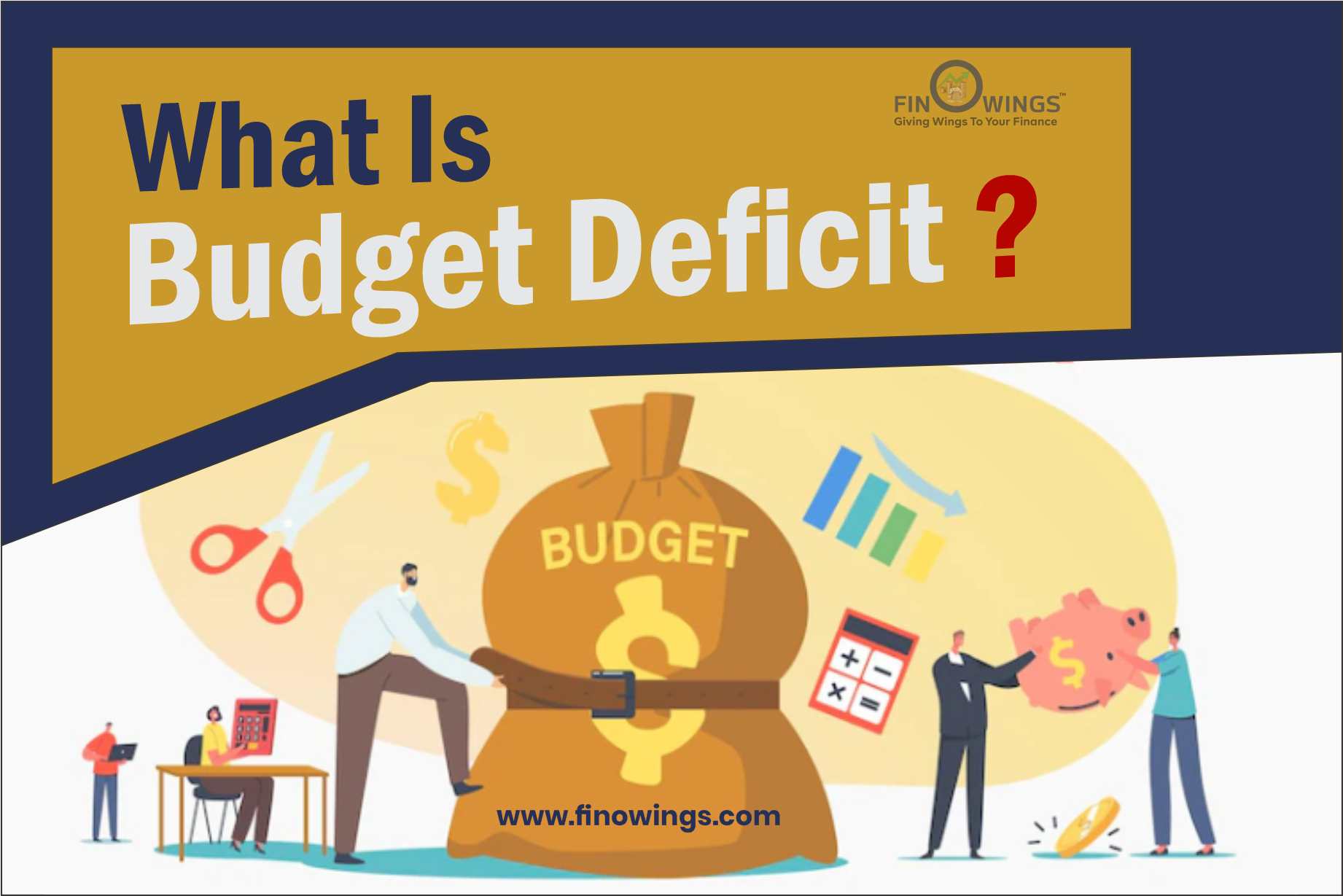
A budget deficit happens when total spending exceeds total income over a given period — for a household, a company, or a government. For India’s central government, the headline number is the fiscal deficit, targeted at 4.3% of GDP (₹16.96 lakh crore) for FY2026-27 under the Union Budget presented on February 1, 2026, continuing a multi-year fiscal consolidation path guided by the FRBM Act, 2003.
Definition: Budget Deficit (India Context)
The shortfall that arises when the government’s total expenditure exceeds its total non-borrowed receipts (tax revenue + non-tax revenue) in a financial year. It is covered through market borrowings and is tracked using four related measures — fiscal, revenue, primary, and effective revenue deficit — each reported in every Union Budget.
What Is a Budget Deficit?
A budget deficit occurs when spending exceeds income over a given period. The same principle scales from a household budget (monthly expenses greater than monthly salary) to a company (operating costs greater than revenue) to a national government (total expenditure greater than total receipts, excluding borrowings). At the national level in India, this gap is what the Union Budget calls the fiscal deficit, and it is covered by government borrowing — primarily through the sale of government securities (G-secs) and treasury bills.
Types of Budget Deficit in India
Indian Budget documents — and the annual “Key Features of Budget” publication from the Ministry of Finance — report four related but distinct deficit measures. Each answers a slightly different question about the government’s finances.

1. Fiscal Deficit
The total gap between the government’s expenditure and its total receipts, excluding borrowings. It represents the total amount the government needs to borrow in a given year.
Formula
Fiscal Deficit = Total Expenditure – Total Receipts (excluding borrowings)
A high fiscal deficit generally means higher borrowing, more pressure on interest rates, and — if not backed by productive (capital) spending — a risk of inflation and “crowding out” private investment.
2. Revenue Deficit
The excess of revenue expenditure (day-to-day running costs — salaries, subsidies, interest payments) over revenue receipts (tax and non-tax income). A revenue deficit signals that the government is borrowing even to meet routine expenses, not just to build assets.
Formula
Revenue Deficit = Revenue Expenditure – Revenue Receipts
3. Primary Deficit
The fiscal deficit minus interest payments on past borrowings. It shows how much the government is borrowing for current-year spending, stripped of the burden of servicing old debt.
Formula
Primary Deficit = Fiscal Deficit – Interest Payments
A zero primary deficit means the fiscal deficit exactly equals interest payments — in other words, the government is borrowing only to service existing debt, not to fund any fresh expenditure.
4. Effective Revenue Deficit (India-Specific Measure)
Introduced through the FRBM (Amendment) Act, 2012, this measure strips out grants given to states and other bodies for creating capital assets (like roads or schools) from the revenue deficit — because although these are booked as “revenue” spending, they still build productive assets. It gives a more accurate picture of purely consumption-driven borrowing.
Formula
Effective Revenue Deficit = Revenue Deficit – Grants for Creation of Capital Assets

The four deficit measures reported in India’s Union Budget 2026-27, as % of GDP (Budget Estimate).
India’s Fiscal Deficit Trend: Budget 2026-27 Snapshot
The Union Budget for FY2026-27, presented by Finance Minister Nirmala Sitharaman on February 1, 2026, projected the fiscal deficit at 4.3% of GDP — continuing a steady, multi-year decline from the pandemic-era peak.

India’s fiscal deficit as a share of GDP, FY2023-24 (Actual) through FY2026-27 (Budget Estimate).
|
Metric (FY2026-27, BE) |
Value |
|
Fiscal deficit |
4.3% of GDP (₹16.96 lakh crore) |
|
Total expenditure |
₹53.5 lakh crore |
|
Non-debt receipts |
₹36.5 lakh crore |
|
Capital expenditure |
₹12.2 lakh crore |
|
Debt-to-GDP ratio |
55.6% (down from 56.1% in FY2025-26 RE); long-term goal ~50% by March 2031 |
Figures are Budget Estimates (BE) as tabled in Parliament; actuals are reported through the year by the Controller General of Accounts (CGA) and can differ from the original estimate.
What Causes a Budget (Fiscal) Deficit in India?
● Narrow direct-tax base: a relatively small share of the population files income tax, which limits how much a tax-rate change alone can move total revenue.
● Large subsidy bill: food, fertiliser, and LPG subsidies are politically important but recurring, revenue-side expenses.
● Interest burden on existing debt: interest payments on past borrowings are one of the largest single items in the expenditure budget, and they have to be paid regardless of how the economy is doing that year.
● Revenue shortfalls during slowdowns: GST and corporate-tax collections dip when growth slows, widening the gap even if spending stays flat.
● A deliberate capex push: a rising share of the deficit in recent Budgets is capital expenditure (roads, railways, ports) rather than consumption — this is generally viewed as a “better quality” deficit, though it still adds to borrowing in the short term.
● External shocks: events like the COVID-19 pandemic (fiscal deficit spiked to 9.5% of GDP in FY2020-21) or global trade disruptions can force higher spending and lower revenue at the same time.
How Is India’s Fiscal Deficit Financed? The RBI’s Role
Unlike a common misconception, the Reserve Bank of India does not simply “print money” to cover the government’s deficit. Since the FRBM Act, 2003 came into force, Section 5 of the Act specifically restricts the central government from borrowing directly from the RBI, except in defined emergency circumstances declared by the Centre.
In practice, the deficit is financed mainly through:
● Market borrowings: the government issues dated securities (G-secs) and treasury bills, which the RBI auctions on its behalf to banks, insurers, mutual funds, and other investors.
● Small savings and other receipts: instruments like the National Small Savings Fund also contribute to financing.
● Ways and Means Advances (WMA): a short-term RBI facility that helps the government manage temporary cash mismatches within a year — not a source of deficit financing itself.
The RBI’s Monetary Policy Committee separately tracks the size and financing pattern of the fiscal deficit because heavy government borrowing can push up bond yields and interact with inflation — one reason fiscal and monetary policy are closely watched together in India.
Impact of a High Fiscal Deficit on the Economy
● Higher interest payments: more borrowing today means a larger interest bill in future Budgets, which can crowd out spending on health, education, and infrastructure.
● Inflation risk: if borrowing is large and persistent, it can add to demand-side inflationary pressure.
● Crowding out private investment: heavy government borrowing can push up bond yields, raising borrowing costs for private companies too.
● Sovereign rating and investor sentiment: rating agencies (such as Moody’s, S&P, and Fitch) factor fiscal deficit and debt trends into India’s sovereign credit rating, which in turn affects the cost of overseas borrowing.
● Not automatically harmful: a moderate deficit used to fund capital expenditure can support growth — the composition of the deficit matters as much as its size.
The FRBM Act, 2003: India’s Legal Framework for Fiscal Discipline
The Fiscal Responsibility and Budget Management (FRBM) Act was enacted by Parliament in 2003 (effective July 5, 2004) to bring legal discipline to government borrowing. Its journey reflects how India’s fiscal targets have evolved:
● Original goal: eliminate the revenue deficit and bring the fiscal deficit down to 3% of GDP by March 2008 — a target repeatedly postponed after the 2008 global financial crisis.
● 2012 amendment: introduced the Effective Revenue Deficit and a Medium-Term Expenditure Framework Statement to improve transparency.
● 2016-17 review: the N.K. Singh Committee recommended a more flexible glide path and, eventually, using the debt-to-GDP ratio as the key long-term anchor rather than a single fixed fiscal-deficit number.
● Pandemic escape clause: the Act allows deviation from targets during exceptional circumstances — used in FY2020-21, when the fiscal deficit rose to 9.5% of GDP.
● Current framework: Budget 2024-25 announced that from FY2026-27 onward, fiscal policy would target a declining central government debt-to-GDP ratio (aiming for roughly 50% by March 2031) as the primary anchor, alongside keeping the fiscal deficit near or below 4.5% of GDP.
How the Government Plans to Reduce the Deficit
● Capex-led growth: prioritising capital expenditure over consumption spending, on the reasoning that infrastructure investment “crowds in” private investment and expands the tax base over time.
● Widening the tax base: continued push toward formalisation, GST compliance (e-invoicing, data-matching), and reducing tax evasion rather than only raising rates.
● Asset monetisation and disinvestment: raising non-tax revenue by monetising operating public infrastructure and selling stakes in select public-sector enterprises.
● Subsidy targeting: shifting subsidies toward Direct Benefit Transfer (DBT) to reduce leakage, rather than broad, universal subsidies.
These are budgeted intentions rather than guarantees — actual fiscal deficit outcomes are reported through the year by the CGA and can diverge from the original Budget Estimate.
Personal Finance Lesson: Avoiding Your Own “Budget Deficit”
The deficit concept applies just as directly to personal finances, and the discipline the government aims for is a useful model for individual money management too.
● Track your monthly income accurately: this is trickier with freelance work, variable incentives, or multiple income sources — use a simple expense-tracking app or spreadsheet to get a realistic monthly average rather than assuming your best month is typical.
● Track your monthly expenses, including irregular ones: annual insurance premiums, festival spending, and EMIs are easy to forget when budgeting month-to-month; average them out across the year.
● Build a small buffer (an emergency fund): aim to build 3–6 months of essential expenses in a liquid instrument (savings account or liquid mutual fund) before directing surplus money toward other goals — this plays the same role the government’s fiscal buffer plays against shocks.
● Prioritise “capital” spending over “revenue” spending in your own life: paying down high-cost debt (credit cards, personal loans) or investing through SIPs builds your net worth, the way capital expenditure builds productive assets — while it’s worth distinguishing that from recurring discretionary spending that leaves nothing behind.

Conclusion
A budget deficit — whether for a household, a company, or a government — simply means spending has outrun income over a period. For India, the story in 2026 is one of steady fiscal consolidation: the Union Budget has narrowed the fiscal deficit from 5.8% of GDP in FY2023-24 to a targeted 4.3% in FY2026-27, anchored by the FRBM Act, 2003 and, from this year, a fresh emphasis on bringing the debt-to-GDP ratio down toward 50% by March 2031. What matters for the economy isn’t only the size of the deficit but its quality — a deficit funding capital expenditure and productive assets is a very different proposition from one funding recurring consumption. The same principle, in miniature, is worth applying to your own finances: know your numbers, prioritise spending that builds long-term value, and keep a buffer for the years that don’t go to plan.

DISCLAIMER: This blog is NOT any buy or sell recommendation. No investment or trading advice is given. The content is only for educational purposes. Always discuss with your SEBI-registered financial advisor for investment-related decisions.
Follow this WhatsApp Channel for the latest updates directly on WhatsApp.












.png)