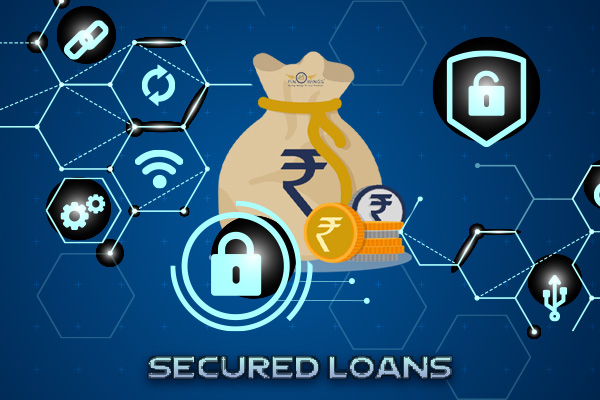
A secured loan is credit backed by collateral — gold, property, securities, or a fixed deposit — that the lender can legally repossess and sell if you stop repaying. In exchange for that reduced risk, secured loans typically carry lower interest rates and higher approval odds than unsecured loans. If a secured loan turns into a Non-Performing Asset (90 days overdue), most Indian banks and NBFCs can invoke the SARFAESI Act, 2002 to recover the asset without going to civil court — after a mandatory 60-day notice
Definition: What Is a Secured Loan?
A secured loan is a loan in which the borrower pledges an asset — gold, real estate, securities, mutual funds, or a fixed deposit — as collateral. The lender holds a legal charge over that asset until the loan is repaid. If the borrower defaults, the lender has the right to take possession of the asset and sell it to recover the outstanding dues, following the process laid down under Indian law.
What Are Secured Loans?
A secured loan is credit extended against collateral — an asset the lender can legally claim if you stop repaying. In India, the two most common forms are loans against gold jewellery and loans against property, but the category also covers vehicle loans, business loans, and loans against financial assets like securities, mutual funds, and fixed deposits.
Because the lender's risk is reduced by the collateral, secured loans are generally easier to get approved, come with lower interest rates, and allow larger loan amounts than unsecured credit such as personal loans or credit cards. The trade-off is straightforward: default, and you risk losing the pledged asset through a legally defined recovery process.

Types of Secured Loans in India
|
Loan Type |
Collateral |
Typical Use |
|
Loan Against Property (Mortgage) |
Residential or commercial property |
Large-ticket personal or business funding |
|
Vehicle Loan |
The vehicle being financed |
Purchasing a new or used car/two-wheeler |
|
Loan Against Property — Overdraft Facility |
Residential or commercial property |
Flexible drawdown; interest charged only on the amount used (India's closest equivalent to a US HELOC) |
|
Loan Against Land |
Unencumbered land parcel |
Financing a land purchase or raising funds against owned land |
|
Gold Loan |
Gold jewellery/ornaments (18–22 karat) |
Quick, short-tenure funding for emergencies or working capital |
|
Business Loan (secured) |
Equipment, inventory, commercial property |
Working capital, expansion, equipment purchase |
|
Loan Against Securities / Mutual Funds |
Listed shares, bonds, mutual fund units |
Short-term liquidity without selling investments |
|
Loan Against Fixed Deposit |
Bank fixed deposit |
Low-cost borrowing while the FD keeps earning interest |
|
Loan Against Life Insurance Policy |
Whole life / endowment / ULIP with surrender value |
Funding against an existing insurance policy's cash value |
Eligibility Criteria
Exact eligibility varies by lender and loan type — there is no single nationwide rule — but most banks and NBFCs check for the following before approving a secured loan:
● Age: Typically 18–65 years at loan maturity (varies by lender and product).
● Residency: Indian resident with valid KYC documents (some lenders also serve NRIs for property-backed loans, with additional documentation).
● Income: A minimum annual income is common but lender-specific — figures anywhere from ₹1.5 lakh to ₹5 lakh+ per year appear across different banks and NBFCs depending on the loan type and city.
● Income source: Salaried, self-employed, or business income, generally with proof for the last 2–3 years.
● Business vintage (for business loans): Many lenders prefer 2–3 years of operating history and profitability, though this is an underwriting preference, not a legal requirement.
● Asset ownership: Clear, marketable title to the asset being pledged, free of existing liens (except where the loan itself is against that lien, e.g., a loan against an under-construction property).
Documents Required
|
Document Category |
Examples |
|
Identity proof |
PAN card, Aadhaar, passport, voter ID |
|
Age proof |
Birth certificate, PAN, passport, voter ID |
|
Income proof |
Last 3 months' salary slips, Form 16, ITR (for self-employed/business) |
|
Residence proof |
Aadhaar, utility bill, rental agreement, bank statement |
|
Asset documents |
Original title deed/sale deed (property), gold purity certificate (gold loan), demat/FD statement (securities/FD loans) |
Note: For gold loans, lenders cannot disburse more than ₹20,000 in cash per borrower under Section 269SS of the Income Tax Act, 1961 — the rest must be paid via bank transfer, cheque, or demand draft.
Interest Rates & Loan-to-Value (LTV) Ratios
Interest rates on secured loans move with RBI's repo rate and each lender's cost of funds, so quoting a fixed number here would go stale quickly — check your bank or NBFC's current rate card, or aggregators like the RBI's own lending rate disclosures, before applying. What is stable and worth knowing precisely is the regulatory LTV ceiling, since it caps how much you can actually borrow against your collateral.

RBI's tiered gold-loan LTV structure, effective 1 April 2026, replaced the earlier flat 75% cap.
Worked Example — Gold Loan LTV
Suppose your pledged gold is valued at ₹4,00,000 at the prevailing market rate.
This falls in the ₹2.5 lakh–₹5 lakh bracket, where the maximum LTV is 80%.
Maximum loan eligible = ₹4,00,000 × 80% = ₹3,20,000.
If the same gold were valued at ₹2,00,000 instead (under the ₹2.5 lakh bracket, 85% LTV), the maximum loan eligible would be ₹1,70,000.
Advantages of Secured Loans
|
Advantage |
Why It Matters |
|
Lower interest rates |
Collateral reduces the lender's risk, which typically translates into a lower rate than unsecured credit. |
|
Larger loan amounts |
Loan size is tied to asset value, so high-value collateral (property, gold) unlocks bigger loans. |
|
Faster approval |
Less reliance on credit history alone; strong collateral can speed up underwriting. |
|
Flexible tenure |
Many secured loans (especially LAP and gold loans) offer flexible repayment structures, including overdraft-style drawdowns. |
|
Lower income thresholds |
Collateral value can offset a lower or irregular income profile for some lenders. |
Disadvantages & Risks
|
Risk |
What It Means |
|
Asset seizure |
Default gives the lender a legal path to repossess and sell your collateral. |
|
Paperwork |
Asset-related documentation (title deeds, purity certificates, demat statements) adds processing time versus unsecured credit. |
|
Credit score damage |
An NPA classification is reported to credit bureaus (CIBIL, Equifax, Experian, CRIF High Mark) and significantly hurts your score. |
|
Shortfall liability |
If the asset sale doesn't cover the outstanding dues, you remain liable for the balance — recoverable via the DRT or a civil suit. |
What Happens If You Default — The SARFAESI Act
This is the part most secured-loan guides skip — and it's the part that matters most. In India, once a secured loan (with outstanding dues above ₹1 lakh, excluding agricultural land) is classified as a Non-Performing Asset, most banks and NBFCs can invoke the Securitisation and Reconstruction of Financial Assets and Enforcement of Security Interest (SARFAESI) Act, 2002 to recover the asset without approaching a civil court.

The SARFAESI recovery timeline, from missed EMI to possession and auction.
How the SARFAESI Process Works
Day 0–90: Missed EMIs accumulate. After 90 days overdue, RBI's IRAC norms require the account be classified as a Non-Performing Asset (NPA).
Day 90: The lender issues a written demand notice under Section 13(2), giving you 60 days to clear the dues in full.
During the 60 days: You can repay, negotiate a settlement, restructure the loan, or file written objections — the lender must respond to valid objections within 15 days.
After 60 days: If dues remain unpaid, the lender can take possession of the asset and proceed to valuation and public auction under Section 13(4).
Your rights: You can appeal to the Debt Recovery Tribunal (DRT) under Section 17 if you believe the process was procedurally flawed. Note that the Supreme Court has held (CELIR LLP vs. Bafna Motors, 2024) that the right to redeem the property ends once the auction sale notice is published — so acting during the notice period matters.
Shortfall/surplus: Under Section 13(7), any surplus from the sale after clearing dues and costs goes back to you. If there's a shortfall, the lender can pursue the balance through the DRT or a civil suit — not through a US-style “deficiency judgment,” which has no equivalent standing under Indian secured lending law.

Secured vs. Unsecured Loans — Side-by-Side
|
Factor |
Secured Loan |
Unsecured Loan |
|
Collateral required |
Yes (gold, property, securities, FD, etc.) |
No |
|
Typical interest rate |
Lower (collateral reduces lender risk) |
Higher |
|
Approval speed |
Can be faster with clear asset title |
Depends heavily on credit score/history |
|
Loan amount |
Tied to asset value — can be large |
Usually capped lower, tied to income/credit profile |
|
Risk on default |
Loss of pledged asset via SARFAESI/legal process |
No asset at risk, but credit score and legal recovery action still apply |
|
Examples |
Home loan, LAP, gold loan, vehicle loan, LAS |
Personal loan, credit card, most education loans |
How to Choose the Right Secured Loan
Match the loan to the asset you're comfortable pledging and the urgency of your need. A gold loan is typically the fastest to disburse and suits short-term needs; a loan against property suits large, long-tenure requirements but takes longer to process; a loan against securities or FD suits short-term liquidity without disturbing your long-term investments. In every case, confirm the lender's current interest rate, processing fee, prepayment charges, and — critically — what triggers default classification under that specific lender's policy, before signing.

Conclusion
Secured loans can be a genuinely useful, lower-cost way to borrow — but the collateral that makes them cheaper is also what makes the downside real. Before taking one, understand exactly which asset is on the line, what LTV limit applies to it under current RBI rules, and what the SARFAESI Act actually allows a lender to do if repayments stop. Read the loan agreement's default clauses as carefully as the interest rate, and never pledge an asset you cannot afford to lose.

DISCLAIMER: This blog is NOT any buy or sell recommendation. No investment or trading advice is given. The content is only for educational purposes. Always discuss with your SEBI-registered financial advisor for investment-related decisions.
Follow this WhatsApp Channel for the latest updates directly on WhatsApp.









.jpeg)
.jpeg)
.jpeg)