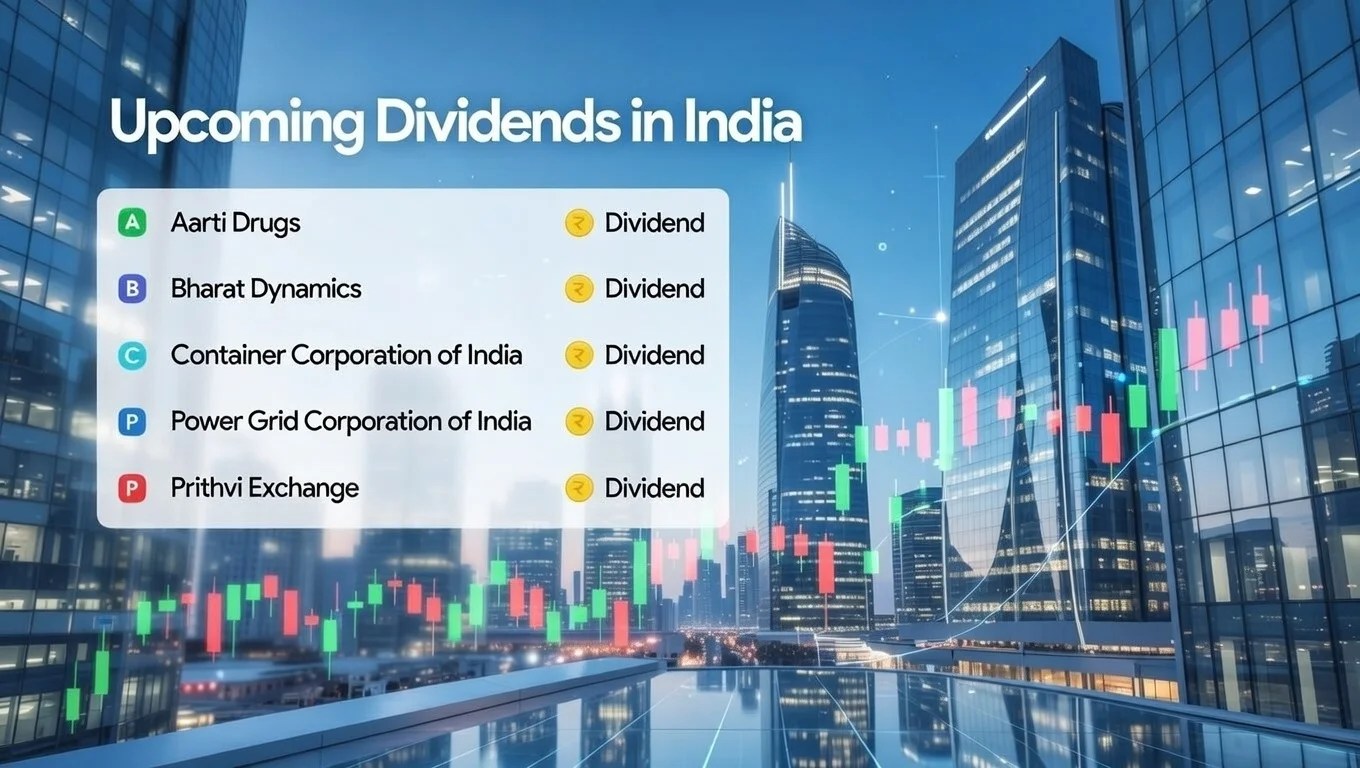
NSE and BSE dividends have boosted investor interest and altered stock market behaviour. Indian stock market dividends are a consistent technique to earn money. Dividend investing is a great long-term strategy to increase your capital. Investing in dividend stocks and understanding the NSE dividend calendar along with the BSE dividend list is crucial.
Investing and return to investors are intertwined concepts. Given the 2026 dividend calendar has stock market-listed companies, the potential for smart investing is immense. Multiple dividends are listed on NSE and BSE and multiple dividends will be paid in 2026.
What Are Dividends and Why Are They Important?
Dividends paid to shareholders by a company are part of the company’s earnings. Payments of dividends are usually made on a quarterly or yearly basis.
NSE and BSE are examples of stock exchanges in India where many companies are listed. Dividends are a signal of a company’s ability to earn profit and reward investors.

Why Invest in Upcoming Dividends in India?
The passive income that dividends provide is enough reason to consider investing in dividend stocks in India. This method of investment is a hedge against the unstable economy. Dividends in India represent stocks of major players in the economy such as the energy, finance, and consumer goods sectors. These stocks have a consistent market presence, and hence provide stability, regardless of market fluctuations.
Data shows that consistent dividend-paying stocks have better market performance in the long term compared to stocks of companies that do not pay dividends. Consider the case of high-yield dividend reinvestment stocks - investing a modest amount in a high dividend-paying stock will yield exponential returns due to the phenomenon of compounding.
Due to the consistent growth of the Indian economy, dividend-paying stocks will continue to be a good investment in the future. Specifically, dividends will be a great value add to your investment in India in the year 2026.
Additionally, dividends form a portion of the total returns that an investor receives, including the value increase of the stock over time and the yield, maximised from the investor's pocket. For income-focused investments, the yield could be between 4-7%, significantly better than a fixed deposit investment. The payout ratio (percentage of earnings that is paid out to shareholders) and long-term sustainability of dividends are key factors to consider when investing in dividend stocks in India. Dividend stocks are a good way to invest in the stock market.
What Are Ex-Dividend Dates?
When looking for dividends in India, one of the most important things investors need to know is what an ex-dividend date is. In simple terms, it is the cut-off date for determining which investors will receive the next dividend payment. An investor who buys shares of a dividend-paying company on or after the ex-dividend date will not receive the dividend payment. Instead, the seller will receive the payment. Ex-dividend dates are usually set one or two days before the record date.
The record date is when the company will snap a snapshot of its shareholders to see who qualifies to receive the dividend payment. Additionally, the ex-dividend date also influences stock prices. In most cases, stock prices will decrease or dip by the value of the dividend due to an upcoming dividend payment.
For example, if a dividend payment of Rs 5 is announced and the ex-dividend date is February 9, 2026, the stock is most likely to open on February 9 at a price that is Rs 5 lower than the previous closing price. This payment is the reason investors will buy the stock. This rush to purchase stock to receive dividends is the reason why most investors avoid missing the ex-dividend date.
Due to the SEBI guidelines on disclosures, dividend declarations are also disclosed on the stock exchanges. For this reason, it is recommended that stock screeners be used to set filters on dividend dates and dividend yields so that investors can avoid missing the ex-dividend date.
Best Dividend Stocks in India for 2026
Look for companies paying dividends that have stable high yields and solid fundamentals. Analysts have built a case for the following companies' stock dividends to be paid in 2026. These income-generating stocks provide diversification as they cover a wide range of industries.
1. Vedanta Ltd.: With a massive dividend yield of 6.64%, Vedanta is a leader in the metals and mining industry. The company makes a lot of money selling commodities, so there are dividend payments to be made in the near future in India.
2. Coal India Ltd.: Maintains stable coal production as a major player in the mining industry, and therefore is expected to continue paying dividends in the range of 4.93% - 7%.
3. Hindustan Zinc Ltd.: A mining company with a dividend yield of over 5% and a major player in the production of zinc and silver. Due to the profit margins in the production of these two metals, the company is able to maintain dividend payments to its shareholders.
4. REC Ltd.: For income stocks, the Government of India provides support financing power projects and has yields of 4.72% - 6% (which is stable and ideal for income stocks).
5. ITC Ltd.: Papers & Packaging, Hotels and Restaurants, and Tobacco are the three sectors the company has diversified into, and therefore has a high dividend yield of 4.57%.
6. ONGC Ltd.: The company has dividends of 4.59% - 6% due to the purchases of oil made globally.
7. Power Finance Corporation (PFC) Ltd.: Like REC, but with the added advantage of 5% - 6% yields.
8. Castrol India Ltd.: Firm making lubricants. Dividend yield ~4%. Reliable dividend payments.
9. NMDC Ltd.: Mining PSU. 7% dividend yield. Dealing in iron ore.
10. Indian Oil Corporation (IOC) Ltd.: Refining, 6-9% dividend yield. A good stock for dividends.
These stocks are chosen based on yields and history. Yields are dynamic and depend on stock prices; for recent yields, check BSE dividend list or NSE websites. PSUs like Coal India and ONGC perform well because of the government policy of high dividend payments, usually 30-50% of profit.

NSE Dividend Calendar for February 2026
The NSE dividend calendar is the most popular method to check for dividends in India. We have compiled information for some of the announcements made for February 2026.
|
Company |
Dividend Type |
Amount (Rs./Share) |
Ex-Dividend Date |
Record Date |
|
Container Corporation of India (CONCOR) |
Interim |
3.40 |
Feb 9, 2026 |
Feb 9, 2026 |
|
Bharat Dynamics Ltd. (BDL) |
Interim |
4.50 |
Feb 9, 2026 |
Feb 9, 2026 |
|
Triveni Turbine Ltd. (TRITURBINE) |
Interim |
2.25 |
Feb 9, 2026 |
Feb 9, 2026 |
|
Power Grid Corporation (POWERGRID) |
Interim |
3.25 |
Feb 9, 2026 |
Feb 9, 2026 |
|
NHPC Ltd. |
Interim |
1.40 |
Feb 10, 2026 |
Feb 10, 2026 |
|
Hero MotoCorp Ltd. |
Interim |
110.00 |
Feb 11, 2026 |
Feb 11, 2026 |
|
IRCTC |
Interim |
N/A |
Feb 20, 2026 |
Feb 20, 2026 |
|
Firstsource Solutions |
Interim |
55% (approx. Rs. 5.50) |
Feb 20, 2026 |
Feb 20, 2026 |
|
Cantabil Retail |
Interim |
37.5% (approx. Rs. 0.75) |
Feb 20, 2026 |
Feb 20, 2026 |
|
NMDC Ltd. |
Interim |
2.50 |
Feb 13, 2026 |
Feb 13, 2026 |
The NSE dividend calendar shows dividends for energy and infra companies, which indicates strength in these sectors. Apart from these, announcements will be made until the end of March for Nestle India (Feb 6, Rs. 7) and other companies.
BSE Dividend List for 2026
Like NSE, the BSE dividend list shows upcoming actions. BSE usually mirrors NSE for dual-listed stocks, so this is a specific list for February 2026.
|
Company |
Dividend Type |
Amount (Rs./Share) |
Ex-Dividend Date |
Record Date |
|
Aarti Drugs Ltd. |
Interim |
2.00 |
Feb 9, 2026 |
Feb 9, 2026 |
|
ASM Technologies |
Interim |
2.50 |
Feb 11, 2026 |
Feb 11, 2026 |
|
Hero MotoCorp |
Interim |
110.00 |
Feb 11, 2026 |
Feb 11, 2026 |
|
Cummins India |
Interim |
20.00 |
Feb 11, 2026 |
Feb 11, 2026 |
|
Mazagon Dock Shipbuilders |
Interim |
7.50 |
Feb 13, 2026 |
Feb 13, 2026 |
|
BEML Ltd. |
Interim |
2.50 |
Feb 12, 2026 |
Feb 12, 2026 |
|
RVNL |
Interim |
1.00 |
Feb 11, 2026 |
Feb 11, 2026 |
|
Nirlon |
Interim |
N/A |
Feb 20, 2026 |
Feb 20, 2026 |
The focus for this list is manufacturing and defence. For 2026, expect more income-supportive yields from PSUs like BPCL and NTPC.
Income Stocks: Building a Dividend-Focused Portfolio
Income stocks, or high-dividend payers, are essential for passive income. In India, having a mix of PSUs (like REC, PFC) and private companies (Vedanta, ITC) provides diversification. A portfolio yield of 5-6% is ideal, with diversification across 10-15 stocks to minimise risk. Dividend Reinvestment Plans (DRIPs) should be used to help with compounding.
Things to look for: at least 5 years of consistent dividend history, free cash flow, and level of debt. Resources like lists of dividend aristocrats show the longest-running dividend payers. In 2026, with inflation expected to moderate, income stocks should be outperforming growth stocks. Dividends are tax-free up to Rs. 5,000, and then taxed at slab rates.
Tracking and Investing in New Dividends
You can check for updates on new dividends through the NSE and BSE websites and through apps like Moneycontrol and Tickertape. Brokers often provide dividend trackers for their clients. Investing in dividends means taking into consideration the total cost of the investment along with any tax and brokerage fees that may apply. Beginners should consider mutual funds that invest in stocks that pay dividends.

Conclusion
Using the NSE dividend calendar and BSE dividend list, investors can find the dividends that will be paid out in the near future. Focusing on dividend-paying stocks in India, knowing the ex-dividend dates, and investing in good dividend-paying stocks like Vedanta and Coal India, will help you make the most out of your investments. It is important to do enough research before investing in a company, as it is possible to lose your investment.
It is smart to understand that dividends can be a source of income as long as the company is doing well. Investing is good, but it is important to understand the potentially negative outcomes.

DISCLAIMER: This blog is NOT any buy or sell recommendation. No investment or trading advice is given. The content is purely for educational and information purposes only. Always consult your eligible financial advisor for investment-related decisions.