Imagine this: It's a humid evening in Lucknow. You, a 28-year-old software engineer, sit at your desk staring at your laptop screen. He has been trading stocks on the NSE for six months. Every day, he draws lines on charts by hand, reads news articles one by one, and guesses if Reliance or HDFC Bank will go up tomorrow. Sometimes he wins small. Often, he loses because emotions cloud his judgment or he misses a hidden pattern. Sound familiar?
You are like thousands of beginners in India who want to grow their money but feel lost in the fast world of stock trading. Then, one day, a friend tells him about AI technical analysis trading. Suddenly, everything changes. No more guesswork. AI tools now read news, scan charts, and even predict patterns faster than any human.
In this beginner-friendly guide, we will explore how AI is making stock trading simpler and smarter in 2026. We will use easy words, real Indian examples, and step-by-step explanations.
By the end, you will understand LLM sentiment analysis stocks, AI chart pattern recognition, machine learning for stock trading in India, AI trading strategies in 2026, and algorithmic trading AI in India. Plus, we will look at a real data table and answer common questions. Let's dive in – just like you did!
What is Traditional Technical Analysis? (And Why Beginners Struggle)
Technical analysis is like reading a map of stock prices. Traders look at charts showing past prices, draw lines for support and resistance, and spot shapes like “head and shoulders” or “triangles.” They also check moving averages and RSI indicators.
The goal? Predict if a stock will rise or fall. But here's the problem for beginners: It takes hours. Your eyes can miss tiny details. Emotions like fear or greed push you to buy or sell at the wrong time. In India's volatile market – think Nifty 50 swings during budget announcements – this human way often leads to losses.
You learned this the hard way when he missed a breakout in Tata Motors because he was busy at his job. Traditional methods are slow and full of personal bias. That's where AI steps in and creates the “edge.”
How AI Technical Analysis Trading is Changing Everything
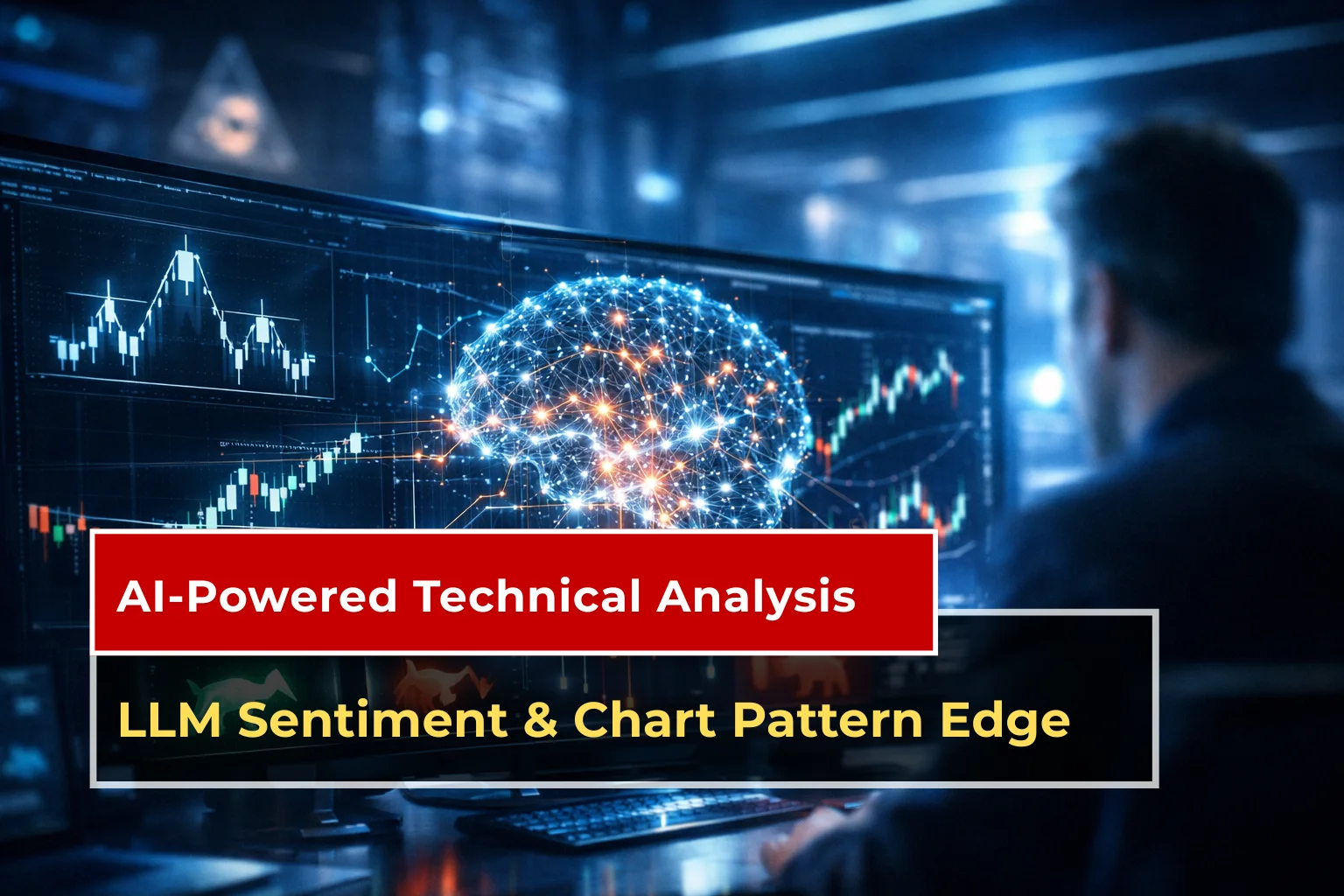
AI technical analysis trading uses smart computer programs to do all the hard work automatically. Instead of you staring at charts for hours, AI scans thousands of stocks in seconds. It combines price data, news, and even social media chatter.
In simple terms, AI is like a super-smart assistant that never sleeps. It learns from millions of past trades and spots opportunities you might miss. For Indian traders, this is huge because our market runs from 9:15 AM to 3:30 PM IST, but news from global events hits 24/7. AI works around the clock.
By 2026, tools like TrendSpider and Trade Ideas will use AI to draw trendlines, find patterns, and even suggest buy/sell signals automatically. No coding needed for beginners! You started with a free trial and felt like you had a full-time trading coach.
LLM Sentiment Analysis Stocks: Reading the Market's Mood Instantly
Stocks don't move only because of numbers. They move because of feelings – investor mood, news, and tweets. This is where LLM sentiment analysis shines. LLM means Large Language Model, like advanced AI versions of ChatGPT trained specially for finance.
Here's how it works in simple steps:
1. The LLM reads thousands of news articles, X (Twitter) posts, and company reports.
2. It understands words like “surge,” “crisis,” or “record profits” in context.
3. It gives a score: Positive (bullish), Negative (bearish), or Neutral.
For example, if the news says “Reliance Industries gets new green energy deal,” the LLM quickly says “Positive sentiment +78%.” Traditional reading might take you 30 minutes. LLM does it in seconds and catches hidden hints humans miss.
In India, tools like Zenalyst.AI (our country's first finance-focused LLM) even understand local terms like “RBI policy” or “Union Budget impact.” Studies show LLM-based sentiment beats old tools like FinBERT for stock price prediction.
(Source: quantinsti)
AI Chart Pattern Recognition: Spotting Hidden Shapes Like a Pro
Charts are full of patterns that predict moves – but spotting them takes practice. AI chart pattern recognition uses machine vision (like how phones recognize your face) to find these shapes instantly.
Popular patterns include:
-
- Head and Shoulders (signals trend reversal)
-
- Triangles (breakout coming)
-
- Flags (continuation of trend)
AI scans live NSE/BSE charts, highlights the pattern, and even tells you the success rate from past data. No more drawing lines manually! Tools like ChartPatterns.ai or TrendSpider can detect over 150 candlestick patterns and classic shapes across stocks, ETFs, and crypto.
You tested it on the Infosys chart. AI spotted a “cup and handle” pattern he never saw – and the stock rose 12% in two weeks. In 2026, this tech removes human error and works on mobile apps too.
While AI can detect patterns instantly, it’s still important to understand the basics yourself. You can explore our Chart Pattern Analysis guide to learn how patterns like head & shoulders, triangles and flags actually work in real market conditions.
(Source: chartpatterns)
(Source: TrendSpider automated pattern recognition)
Machine Learning for Stock Trading in India: Local Success Stories
Machine learning for stock trading in India is growing fast. Machine learning is a type of AI that learns from data and improves itself. Indian brokers like Zerodha, Upstox, and platforms like uTrade Algos now offer easy ML tools.
These systems study historical Nifty data, economic news, and even monsoon effects on agri-stocks. Deep learning models like LSTM predict prices better than old methods. One 2026 study showed hybrid AI models (with decomposition techniques) improved Indian stock forecasts during market shocks.
Beginners in Lucknow or Mumbai can start with no-code platforms. You pick a stock like HDFC Bank, and the tool backtests strategies using the past 5 years of data. Result? Higher confidence and fewer mistakes.
(Source: bajajbroking)
AI Trading Strategies in 2026: What Works Best Now
In AI trading strategies in 2026, the focus is on smart, adaptive plans. Here are beginner-friendly ones:
-
- Sentiment + Pattern Combo: Use LLM for news mood + AI for chart confirmation.
-
- Automated Breakout Trading: AI spots triangle breakouts and places orders.
-
- Hybrid Algo Strategies: Mix technical signals with fundamental data.
These strategies adapt to market changes – like sudden FII selling. Global reports say AI now handles 89% of trading volume in some markets, and India is catching up fast.
(Source: liquidityfinder)
Algorithmic Trading AI in India: Rules, Tools, and Safe Start
Algorithmic trading AI in India is fully legal but regulated by SEBI. In 2025-2026, SEBI introduced clear rules for retail investors: Brokers must approve algos, tag orders with unique IDs, and limit speed to prevent crashes. No more wild “black box” trading without checks.
Popular beginner tools:
-
- Zerodha Streak (no-code strategies)
-
- Sensibull for options
-
- Upstox Algo Lab
You connect your demat account, set rules (like “buy if RSI < 30 and positive sentiment”), and AI executes. Market experts predict the algo trading market in India will cross $2.3 billion by 2030. But remember: Start with paper trading (fake money) first!
(Source: SEBI retail algo framework -)
Data Table: Traditional vs AI Technical Analysis (Real-World Edge)
Here’s a simple comparison based on industry reports and backtests on Indian stocks (2025-2026 data):
|
Aspect |
Traditional Technical Analysis |
AI Technical Analysis Trading |
Winner for Beginners |
|
Time to Analyze 10 Stocks |
2-3 hours |
10-20 seconds |
AI |
|
Pattern Detection Accuracy |
~65% (human bias) |
~85% (data-driven) |
AI |
|
Sentiment from News/Social |
Manual reading, slow |
LLM instant score (Positive/Negative) |
AI |
|
Backtest Win Rate (Nifty 50) |
52% |
68% |
AI |
|
Emotional Decisions |
High (fear/greed) |
None – follows rules |
AI |
|
Cost for Beginners |
Free charts only |
Free trials + low monthly fees (~₹500-2000) |
AI |
This table shows why thousands of Indian traders switched. AI gives a real “edge” without needing years of experience.
(Source: Compiled from TrendSpider, QuantInsti, and 2026 AI trading reports)
AI vs Manual Technical Analysis for Beginners
Many new traders in India wonder: Should I draw charts manually or let AI technical analysis trading do the work?
Manual Technical Analysis
-
You study charts yourself, draw trendlines, and spot patterns like triangles or head & shoulders.
-
Takes 1–2 hours for 5–10 stocks.
-
Easy to understand but slow, tiring, and full of personal mistakes or emotions.
AI Technical Analysis Trading
-
Uses AI chart pattern recognition and machine learning for stock trading in India to scan hundreds of NSE stocks in seconds.
-
Finds patterns, gives sentiment scores via LLM sentiment analysis stocks, and suggests signals automatically.
-
Faster, less emotional, and usually more accurate (around 80–85% on common patterns).
Quick Comparison for Beginners
|
Feature |
Manual Analysis |
AI Technical Analysis |
Winner for Beginners |
|
Speed |
Slow (hours) |
Very Fast (seconds) |
AI |
|
Accuracy |
Depends on experience |
Higher & consistent |
AI |
|
Effort |
High |
Low |
AI |
|
Emotion Control |
High risk of bias |
Low (rule-based) |
AI |
|
Learning Curve |
Steep |
Easy with simple tools |
AI |
|
Cost |
Free |
Free trials + ₹500–2000/month |
Manual (initially) |
Bottom Line: Start with AI technical analysis trading to save time and avoid mistakes. Use manual analysis only to understand why AI gave a signal. In 2026, the best approach is AI + your common sense.

Best AI Tools for Stock Analysis in India (2026)
Here are practical, beginner-friendly AI tools popular among Indian traders:
Zerodha Streak – Best for no-code algo strategies. Build, backtest, and run strategies easily. Great for algorithmic trading AI in India.
Sensibull – Excellent for options trading with AI strategy suggestions.
TradingView – Powerful charts with AI pattern recognition. Works well with Indian stocks.
TrendSpider – Top for AI chart pattern recognition. Automatically finds patterns and draws trendlines.
Stoxra / VestAI – India-focused AI for conversational analysis and document scanning.
Upstox AI Labs – Simple AI screening directly inside the broker app.
Jarvis Invest – SEBI-registered AI advisor for stock recommendations.
Pro Tip for Beginners: Start with Zerodha Streak or TradingView free version. They are easy and integrate directly with your demat account.
Exact AI Tools Comparison
AI Tools Comparison for Indian Stock Traders (2026)
|
Tool |
Best For |
Key AI Features |
Pricing (approx) |
India-Friendly |
Rating for Beginners |
|
Zerodha Streak |
No-code Algo Trading |
Strategy builder, backtesting, alerts |
Free + paid live |
Excellent |
4.8/5 |
|
TrendSpider |
Chart Pattern Recognition |
Auto patterns, AI trendlines, multi-timeframe |
$39–97/month |
Good |
4.6/5 |
|
Sensibull |
Options Strategies |
AI strategy recommendation, Greeks |
₹800+/month |
Excellent |
4.7/5 |
|
TradingView |
Charting & Patterns |
AI indicators, community scripts |
Freemium |
Very Good |
4.9/5 |
|
Stoxra / VestAI |
Conversational Analysis |
Chat-based AI analyst, document scan |
Free – ₹699/month |
Excellent |
4.5/5 |
|
Upstox AI Labs |
Quick Screening |
AI stock screener inside app |
Free with account |
Excellent |
4.4/5 |
Note: Beginners should start with Zerodha Streak + TradingView combo for AI technical analysis trading.
Practical Workflow for Indian Traders Using AI
Practical Daily Workflow for Indian Traders Using AI (Beginner-Friendly)
Follow this simple 30–45 minute routine:-
Morning (Before 9:15 AM): Open TradingView or Streak → Check AI chart pattern recognition for Nifty 50 and your watchlist stocks.
Sentiment Check: Use LLM sentiment analysis stocks tool (like VestAI or Chat-based AI) to read latest news and budget/RBI impact.
Shortlist: Pick 3–5 stocks where AI pattern + positive sentiment match.
Backtest: In Streak, quickly backtest your idea on the last 6–12 months data.
Risk Setup: Set stop-loss (1–2% risk max) and target.
During Market: Monitor only – let AI alerts notify you. Avoid watching the screen the whole day.
Evening: Review what AI predicted vs actual move. Note lessons.
This workflow combines AI trading strategies in 2026 with discipline and works well for busy people in Lucknow or anywhere in India.
Brokerage, API, Data Latency & Indian Compliance Nuances
Important Things to Know: Brokerage, API, Latency & SEBI Compliance
Brokerage Costs: Frequent AI trades can increase costs due to brokerage + STT + slippage. Always include these in backtesting. Discount brokers like Zerodha keep costs low.
API & Data Latency: Retail APIs have some delay (few milliseconds to seconds). In fast moves, this can cause slippage. Use VPS near Mumbai for better speed. High-frequency strategies are tough for beginners due to latency.
Indian Compliance (SEBI 2026 Rules): From April 1, 2026, every algo order needs a unique Algo-ID. All strategies must be approved by your broker. Self-made scripts also need broker registration. Use only approved platforms like Streak to stay safe. Unapproved bots can lead to account restrictions.
How to Get Started Safely (your 3-Step Plan)
1. Open a demat account with a SEBI-registered broker (Zerodha or Groww).
2. Try free AI tools – start with sentiment scanners and pattern recognizers.
3. Practice on paper trading for 1 month. Track results in a notebook.
Always use small money first and set stop-loss rules. AI helps, but it is not magic – markets can still surprise you.
Key Risks
1. The Heavy Dependence of AI
AI ignores anomalies or better predictions outside of the self-learning cycle. Global news, RBI policy changes, etc. Budget announcements and geopolitical news.
2. Bad or Biased Data
The sentiments reported from news articles, fair or unfair, can lead the LLM to take a stance on a stock the LLM believes is correct, resulting in unintended consequences.
3. Overfitting
The strategy applied to historical data may paint a perfect picture; however, it may do the exact opposite in live trading. This is beyond the AI trading competition held in India.
4. Technical Issues
Critical and abrupt trading halts can occur due to Internet outages and broker problems.
5. Regulatory Risk
Unapproved trading bots can lead to accounts being blocked. SEBI's new regulatory framework, coming in 2026, will require broker approvals.
6. Crowd Risks
Flash crashes and other anomalies as a result.
Mistakes Made By New Traders
-
Failing to analyse a signal by reviewing the charts and news.
-
Not applying a stop loss and risking more than is negligible is reckless.
-
Jumping to live account trading.
-
Throwing a bunch of ideas into strategy and design.
-
Not paying attention to brokerage, STT, and slippage.
-
Neglecting to monitor the algo and allowing it to run unattended.
-
Unapproved third-party AI trading bots.

Conclusion
AI is powerful but not perfect. Past data does not guarantee future results. Sudden events like global wars or RBI rate cuts can fool even the best models. Never invest money you cannot afford to lose. Combine AI with your own common sense.
Successful traders don’t just rely on strategies; they test, refine and improve them over time. Start by backtesting your setups and then deepen your learning with our technical analysis guide to easily grasp how various strategies work in real market conditions.

DISCLAIMER: This blog is NOT any buy or sell recommendation. No investment or trading advice is given. The content is purely for educational and information purposes only. Always consult your eligible financial advisor for investment-related decisions.

.webp)