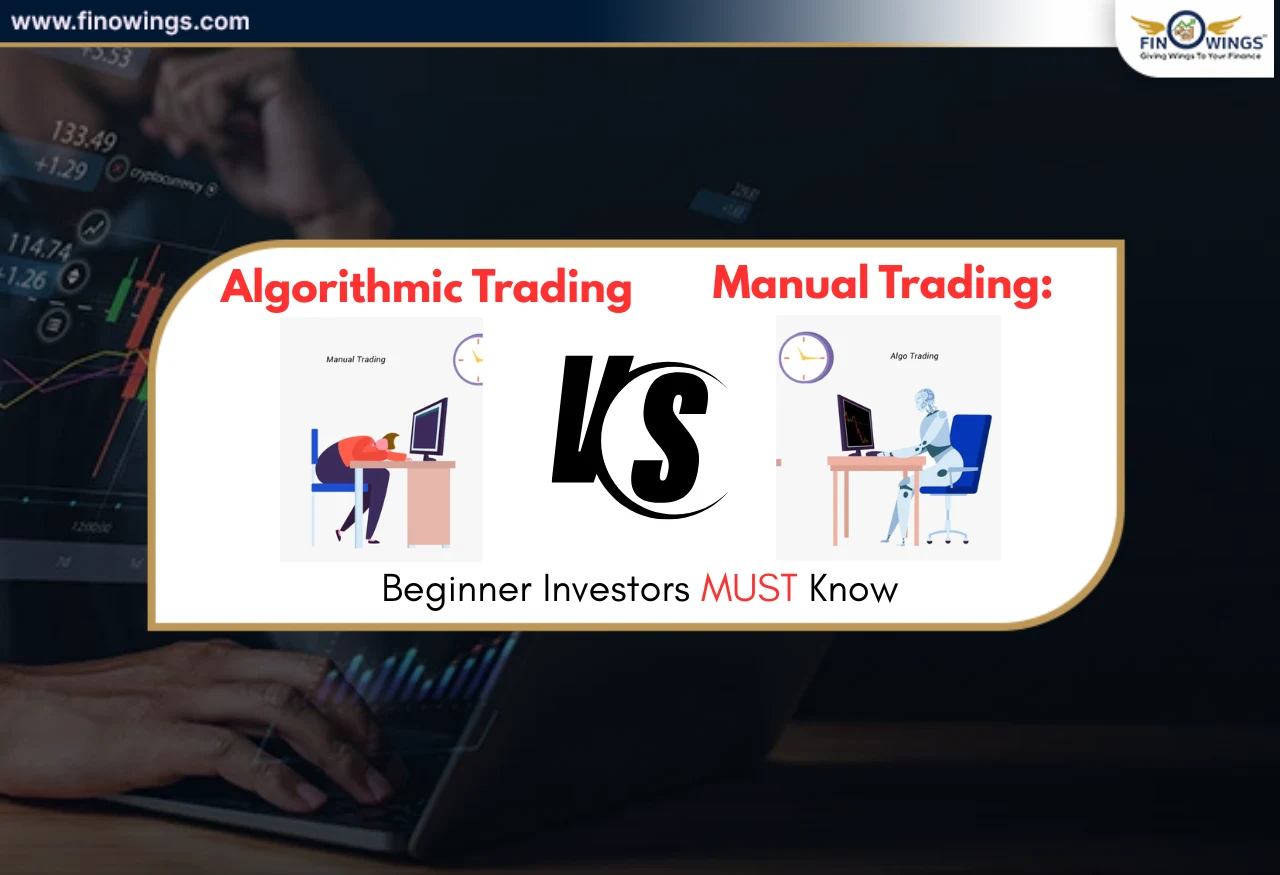
When you are trading for the first time, the first question you should ask is, Should you trade manually or use trading algorithms?
The first question you should ask yourself is, Should you trade manually or use trading algorithms? Over the years, technology has changed how trading works, as financial markets have moved to advanced charting and fully automated trading systems. This poses the challenge of understanding algorithmic trading vs. manual trading.
This guide is designed to give the beginner the simplest explanation of the pros and cons of each method in terms of their workings, differences, advantages, disadvantages, step-by-step examples, and finally which one suits the beginner the most.
What is Algorithmic Trading?
In the simplest terms, it is automatic trading done through a computer based on a set of programmed 'rules' which are called an algorithm in this context.
The computer programme decides:
- When to buy trading stock
- When to sell trading stock
- How much of the stock should be traded
- The stop loss amount to prevent further loss when trading, and
- The target (profit)
The algorithm trades based on preset actions and executes the trade with no emotional goals. More specifically, it works as follows:
Example-
Automatically buy when Nifty rises above yesterday's high and trading volume (the amount of stock traded) increases.
The algorithm also automatically sells when the trading price falls below the support (the price that needs to be traded for the algorithm to buy). This is the basis of what is called algo trading.
What Is Manual Trading?
In this case, you, as a trader and market analyst, have control over the actions of the computer. You are the one who enters the orders to buy or sell.
In trading, there are several actions for the trader to decide for themselves including:
- Options for entry timing.
- Options for exit timing.
- Position size.
- Stop loss.
- Targets.
Trading manually is the most tedious form of trading as it requires reading charts, as well as psychological mastery.
Here is the most basic example of manual trading. Let's say the Nifty is moving up. You would assume it would continue going up, at which point you would decide to manually buy.

Manual vs Algorithmic Trading. What Are the Main Differences?
The following are the main differences between manual and automated trading and how each party chooses to set their trading strategies.
|
Factor |
Algorithmic Trading |
Manual Trading |
|
Control |
Automated |
Human-driven |
|
Speed |
Very fast |
Slow |
|
Emotions |
Zero |
Very high |
|
Scalability |
High |
Low |
|
Skills needed |
Coding/logic |
Chart reading |
|
Time required |
Very less |
A lot |
|
Accuracy |
Rule-based |
Emotion-based |
How does Algorithmic Trading Work?
Trading strategies are designed and tested manually before being automated for algo trading. Trading strategies are created and tested for effectiveness and efficiency by inspecting the:
- Indicators
- Signals on the charts
- Market Data
- Behaviour of the market
- Model of market patterns
-Lastly, everything is consolidated into a set of fixed rules.
The automated trading system checks at an unprecedented rate the following for trading opportunities:
- Current price
- Market trading patterns
- Trading volume
- Current trading market conditions
And then instantly executes trades in seconds.
Example of Algorithmic Trading Logic
If the price is above a 200-day Simple Moving Average (SMA) and the Relative Strength Index (RSI) is above 60, buy.
If the price then falls below the 200 SMA, exit. This is an example of algorithm trading for SMA and RSI.
Different Classes of Algorithmic Trading
There are several forms of algorithmic trading strategies, which include:
- Trend following
- Mean reverting
- Arbitrage
- Statistical methods
- News-based trading
- High-frequency trading
- Options strategies
- Quant strategies
Most newcomers to algorithmic trading tend toward a minimalistic trend-following algo strategy.
Algorithmic Trading for Beginners - Its Increasing Popularity
-
Beginners encounter.
-
Losing.
-
Trading too often.
-
Being too greedy.
-
Being brash.
-
Being indecisive.
Algorithmic trading tackles all of this.
It offers discipline, rules, rationality, predictable risk and steadiness. Hence, the term "Algorithmic trading for beginners".
Benefits of Algorithmic Trading
1. No Emotion - Algorithms will adhere to the rules.
2. Execution in No Time - Milliseconds can change the course of the market.
3. Historical Testing - You can apply the strategy to previous market data.
4. Completely Rule-Based - No risk of guesswork.
5. More Than Enough - With more strategies, there will be more opportunities.
Downsides of Algorithmic Trading
-
Configuration and Tools.
-
Requires an API, a broker, coding, and software.
-
Provides A High Level of Automation.
-
Algos may be intelligent, but if the rules are not, losses will be inevitable.
Definition of Manual Trading
Manual trading relies on reading charts, analyzing data patterns, trending movements and market psychology. A trader locks in a position and manages a trade.
Advantages of Trading Manually
Beginning - There are no tools to learn and no code to write.
Control - You are free to make any decisions at any time.
Cost - There are no costs of any kind associated with automation.
Disadvantages of Trading Manually
Emotion - There is always at least some level of fear, greed, and/or excitement.
Time - If you are doing everything manually, you will have to invest time yourself.
Discipline - Overtrading is a common issue with beginners.
Manual Trading vs. Algo Trading
|
Feature |
Algo Trading |
Manual Trading |
|
Accuracy |
High |
Medium |
|
Emotional control |
Very High |
Very Low |
|
Learning curve |
Medium |
Difficult |
|
Risk management |
Strong |
Weak |
|
Time required |
Low |
High |
In the long run, algorithms will always outperform manual trading.
Which Trading Style is More Appropriate For Beginners?
Choose algo trading for beginners if you want-
- Less stress
- No emotions
- Adherence to rules
- Consistent results
- Trading done on autopilot
Choose manual trading if you want
- Analysing the charts
- Studying the market
- Total control
Best Approach For Beginners
Most beginners are taught to start with manual trading while they learn to chart, understand price, and then slowly transition into algorithmic trading.
This results in a hybrid trading method, which is manual + algo trading, and it is the most beginner-friendly.
For example, you could enter the trade manually, then let the algorithm exit, set the stop loss, and set a trailing stop.
Step-By-Step Guide on Algorithmic Trading
Step 1 – Understand technical indicators RSI, MACD, SMA
Step 2 – Build rules for trades. Define entrance and exit criteria.
Step 3 – Test and validate ideas on historical charts.
Step 4 – Simulated Trading. Make trades in a realistic environment without spending real money.
Step 5 – Make a real trade for real using a small amount of capital to reduce risk exposure. And there you have it, the simplest algorithmic trading guide available.
Step-By-Step Manual Trading Guide
Step 1 – Understand market charts. Learn how to read candlestick charts and the price action of the market.
Step 2 – Understand market structure. Support and Resistance
Step 3 – Learn trend trading
Step 4 – Start with simulated Trading
Step 5 – Control your emotions. Make the less emotional and execute more trades correctly.
What are the Potential Earnings of Each Trading Technique?
Looking at the historical data. Manual traders have lost money more often. Algorithmic traders have made money consistently over the long-term. Emotions are the biggest trading obstacle.
Why do Most Beginners lose Using Manual Trading?
-
It is common to hold onto losing trades for too long (Holding losers).
-
Selling winners too early is a common pitfall (Selling winners early).
-
Not having a stop loss is a significant risk without the potential for reward.
-
Trading too much in a small period of time is a common mistake (Overtrading).
-
Trading out of all emotion is a common trap of manually trading. (Revenge trading).
-
All of these lose potential profits, and algorithmic trading removes these issues.
Is it possible to combine both trading techniques?
Definitely! There is a common practice of manually selecting a trade and allowing algorithmic trading to handle the rules you’ve set.
Sample hybrid system:
- Certain trends selected manually.
- Entries filled in by the algorithm.
- Trailing is done automatically by the algorithm.
Simple real-life example
Manual trader:
“I think it’s going up in the future.”
- Buys it
- Holds it and feels the emotions of the trade
Algorithmic trader:
- If there’s an EMA crossover → buy
- If there’s an EMA cross-down → exit
No emotions at all, just pure logic.
The psychology: the biggest difference
In manual trading, it’s emotional decision-making. In algorithmic trading, it’s purely rule-based. That is the main reason why 95% of manual traders lose.
Skills needed:
- For algo trading
- vs. for manual trading
Current global trends are:
- There is a rise in algorithmic trading.
- There is a decline in manual trading.
Even brokers are now integrating pre-built algorithms for trading.

Conclusion
When it comes to algorithmic trading vs manual trading, algorithmic trading wins in consistency, discipline and ease for beginners.
Manual trading wins in the psychology aspect but algorithmic trading loses the psychology aspect and instead follows logic. New traders will begin manual trading but are expected to shift towards algorithms eventually, so a beginner-friendly algorithmic approach is best.

DISCLAIMER: This blog is NOT any buy or sell recommendation. No investment or trading advice is given. The content is purely for educational and information purposes only. Always consult your eligible financial advisor for investment-related decisions.

.webp)