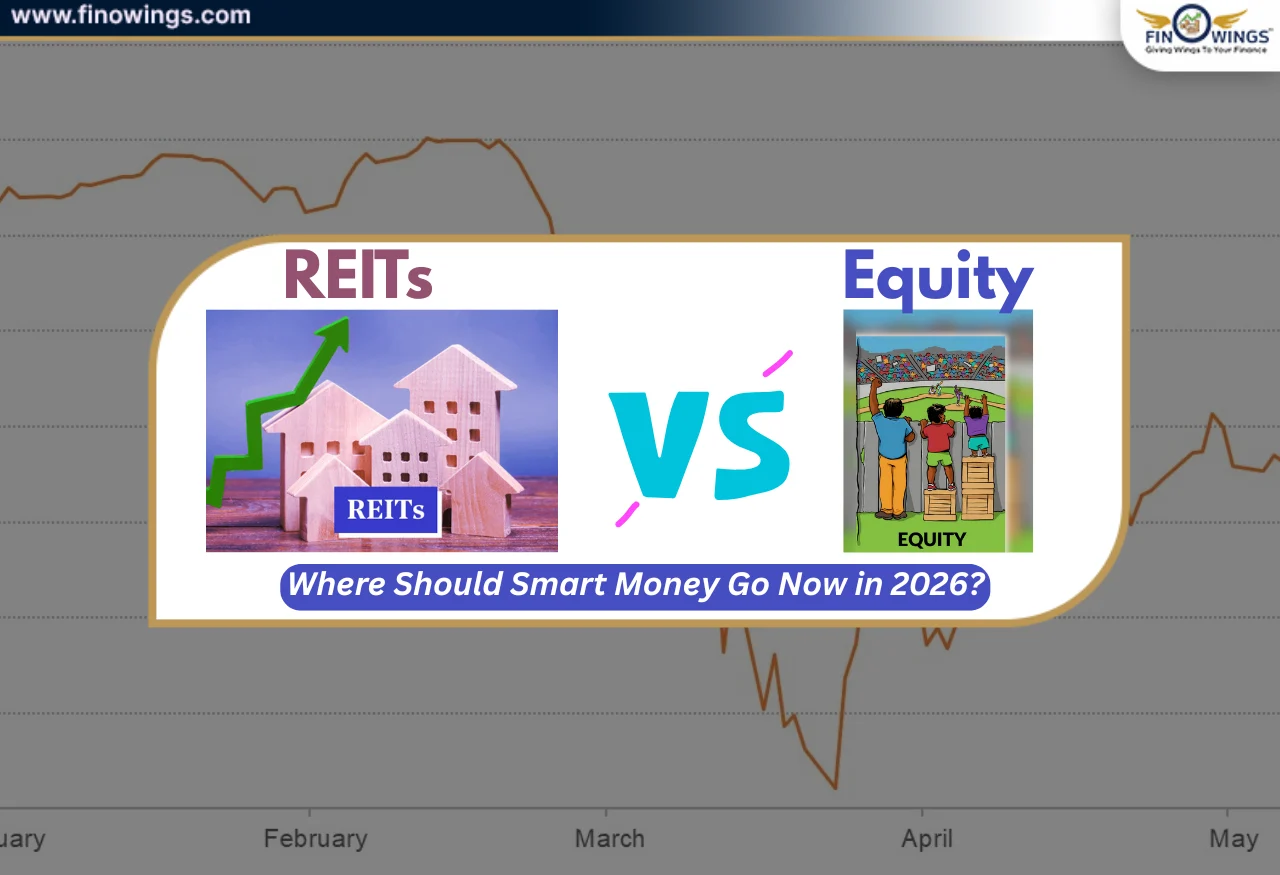
2026 presents new questions for investors. Interest rates are stabilising. Inflation is cooling. Real estate demand is recovering across India. Investors are asking, “REITs vs Equity. Where is smart money going now?”
REITs (Real Estate Investment Trusts) and equities (stocks) are both strong vehicles for building wealth, but their behaviour, returns, volatility, and suitability are starkly different. Understanding these differences is important when choosing REITs investment vs equity investment.
This blog presents REITs vs Stocks, the performance in 2026, and a risk vs reward. Depending on your objectives, we might recommend one of the asset classes.
What are REITs?
A REIT (Real Estate Investment Trust) is an organisation that purchases and/or manages real estate that has the potential to bring in income. They are involved with:
-
Grade-A commercial real estate
-
Warehouses
-
Shopping centres
-
Hotels
People can invest in these firms and buy shares, which will then allow them to gain:
-
Dividends paid out every three months
-
Distributions from rents
-
An increase in investment value (this if the net asset value goes up).
In India, REITs such as Embassy, Mindspace, Brookfield, and Nexus are required to hand out 90 percent of their net distributable cash flows, which makes them a desirable and safe investment.

What is Equity (Stocks)?
Equity investment is purchasing shares in businesses that are available on the stock market. Investors can gain from:
-
Growth in the value of the stock
-
Payments in the form of dividends
-
The value is accumulating over time.
Equity investing can be a bit unpredictable, but it has the potential to bring in great profits.
REITs vs Equity
|
Feature |
REITs |
Equity |
|
Volatility |
Low to moderate |
High |
|
Returns |
Stable dividends + moderate appreciation |
Potentially high long-term returns |
|
Income |
Regular payouts |
Irregular dividends |
|
Risk Level |
Lower risk |
Higher risk |
|
Liquidity |
Medium (listed but low volume vs stocks) |
High |
|
Correlation with Market |
Low-medium |
High |
|
Best For |
Income seekers, conservative investors |
Growth investors with higher risk appetite |
REITs vs Equity Returns: 2026 Outlook
Expected REITs Outlook In 2026
Likely improving because of:
-
Office occupancy rates are always increasing.
-
Hybrid work is here to stay, as opposed to working from home entirely.
-
Strong demand for work is consistently coming from IT, BFSI, and GCCs.
-
Interest rates are falling, making REITs even more attractive.
In 2026, expect returns ranging from 9% to 13% total return for REITs (6 to 8% as dividends and 3 to 5% as appreciation). Stable cash flows are estimated for REITs in the present year.
Expected Equity Outlook in 2026
Equity is expected to grow substantially in 2026 because of:
-
Expansion of corporate earnings.
-
Reduced interest rates, improving the market situation.
-
More domestic liquidity and flows from systematic investments.
-
Increased capital expenditure from both public and private sectors.
High-quality midcap are expected to outperform, and sectors to look at are manufacturing, capital goods, defence, EVs, tech services, and financial services.
REITs vs Equity: Risk
1. Risk in REITs
The following is a list of risks that are present in REITs:
-
Demand for leasing offices on the market may decline.
-
Interest rates might remain high, making the yield less desirable.
-
Slowdowns in the area of commercial real estate.
-
Large amounts of office spaces are available for leasing.
Regardless, the volatility in REITs is significantly less than what you would find in average stock.
2. Risk in Equity
Equities are exposed to:
-
Market crashes
-
Earnings downgrades
-
Global events
-
Sector specific risks
-
High volatility.
Equity risk decreases over time for long-term investors; focus on the long-term.
REITs vs Stocks: Income vs Growth
REITs = Income-Oriented
As an investor, if you want:
-
Steady and consistent income distribution
-
Lower volatility with price stability
-
Positive cash flow stability
-
Exposure to real estate
Investing in REITs would be ideal for you.
Equity = Growth-Oriented
As an investor, if you want:
-
Significant long-term wealth creation with growth
-
Benefits from the power of compounding your investment
-
Higher risk reward
Equity investment would be the better option.
Taxation Comparison (2026 Rules)
REITs Taxation
REIT distributions may include:
Dividend→ Taxable according to slab
Interest→ Taxable in its entirety
Capital gains→ STCG (≤6 years): 15%
LTCG (>6 years): 10%
Equity Taxation
STCG (≤1 year): 15%
LTCG (>1 year): 10% after ₹1 lakh exemption
for companies, no dividend tax; however dividends are taxed according to the investor’s slab. In total, equities have tax benefits for the long-term investors. They are also the most taxed.
REITs vs Equity Returns: Historical Data (India)
|
Asset |
3-Year Avg Return |
5-Year Avg Return |
|
REITs |
8%–11% |
9%–12% |
|
Equity (Nifty 50) |
12%–15% |
14%–18% |
There is no argument that REITs are outperformed by equities over extended periods of time.
Which is Better in a Volatile Market?
-
REITs are more defensive.
-
Equities are more aggressive.
-
In a volatile market, REITs act as stability providers, and equities act as return providers when the market is no longer volatile.
Portfolio Strategy for 2026: REITs vs Equity
Instead of one single choice, smart investors in 2026 are going for a hybrid strategy.
Suggested Allocation According to Your Risk Tolerance
Ryder
-
60% of REITs
-
40% of equities
Mid Tolerance Investor
-
30% of REITs
-
70% of equities
High Tolerance Investor
-
10% of REITs
-
90% of equities
REITs Or Equities? What Should I Choose?
Choose REITs if you consistently want the following:
-
Stability
-
Real Estate exposure without property or buying it
-
Passive Income Periodically
-
Lesser fluctuations or volatility
Choose Equities for the following benefits
-
A lot of opportunities for growth.
-
High significant returns.
-
Very high creation of wealth for the long term.
-
Compounding.
-
More returns even when the fluctuations and volatility are high.

Conclusion
In 2026 and 2023, REITs and equities are both opportunities but for different reasons. It's not only about choosing REITs vs equities, but also balancing both with the right goals, risk, and time layout. Investors smartly diversify to achieve both and enjoy steady income with equities.

DISCLAIMER: This blog is NOT any buy or sell recommendation. No investment or trading advice is given. The content is purely for educational and information purposes only. Always consult your eligible financial advisor for investment-related decisions.

.webp)