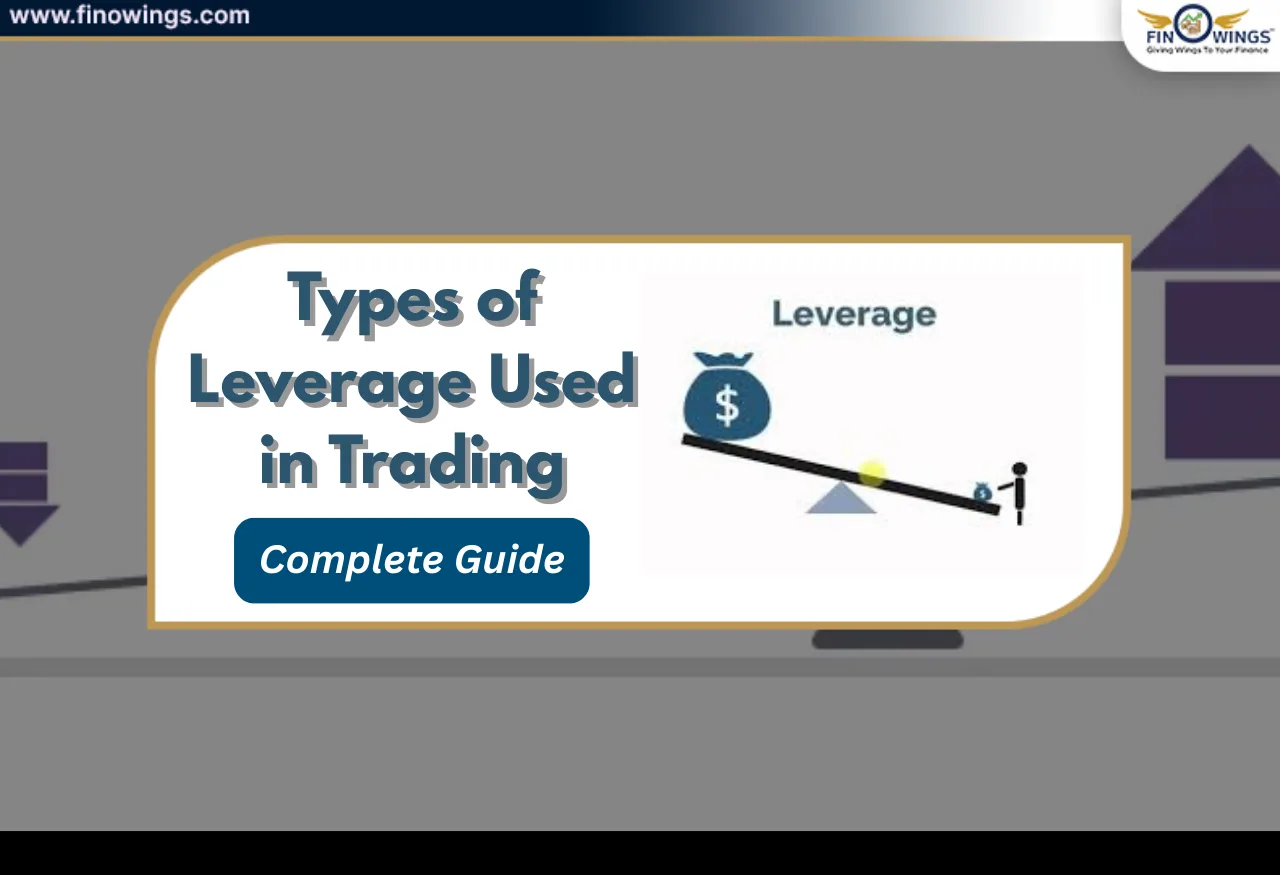
Leverage is one powerful multifunctional tool in the financial sector. It enables traders to play a huge role while putting in a minimal amount of money. Using leverage correctly will earn a trader a lot of gains. Misusing it will lead to the fast disappearance of one’s capital.
In a detailed guide, we will try to explain leverage types, leverage trading, trading leverage, margin trading, financial leverage and practical trading strategies.
Understanding Leverage in Trading
Trading leverage means overextending one’s trading position due to an increase in borrowed money.
Simple Example.
Your capital: Rs. 1,000.
Leverage: 10x.
Total position size: Rs. 10,000.
If the price moves 1% to your advantage, you earn 10%.
If it moves, 1% against you, you lose 10%.
This amplification is the selling point and danger of trading leverage.

Why Leverage?
Some of the most common reasons for using leverage are:
-
To increase the likelihood of making a profit.
-
To open and manage large positions without fully owning the allocated capital.
-
To optimise the efficiency of the capital being utilised.
-
To manage multiple open positions in a portfolio.
That being said, leveraging capital should never be perceived as a means to profit without risk.
Case Leverage
Various forms of leverage entail different risks that are common in different markets.
1. Financial Leverage
Using borrowed capital to increase the potential return of an investment or asset by a trader is called financial leverage.
Where It’s Used
-
Trading equities.
-
Corporate Financing.
-
Derivatives markets.
Example
Should a trader have Rs. 2,000 of their own money and take a margin of Rs. 8,000, their total investment would be Rs. 10,000 as follows.
If the asset appreciates, the profit increases. If the asset depreciates, the loss increases. Financial leverage is the foundation of all leveraged trading.
2. Margin Trading Leverage
Most retail investors use margin trading as the most popular form of leverage.
How To Margin Trade
-
Start with a margin deposit.
-
A broker provides extra money.
-
Your trading position is then leveraged.
Example of Margin Trade
Your Capital: Rs. 5,000
Margin Requirement: 20%
Leverage: 5x
Position Size: Rs. 25,000.
When trading, if losses reach a set amount, a margin call is issued, or a forced liquidation of the position is triggered.
Margin trading is common with equity, commodities, and derivatives trading.
3. Fixed Leverage
A fixed leverage option has an appropriate leverage ratio that is predetermined and is kept constant throughout trading or investing. Some common fixed leverage options include:
2x
5x
10x.
Pros
-
High ease of use.
-
Predictable risk structure.
Cons
-
Lack of flexibility in times of high volatility.
-
Risk of high losses still exists.
-
Fixed leverage is a common practice in traditional equity margin accounts.
4. Variable (Dynamic) Leverage
Variable leverage refers to the practice of adjusting the amount of trading leverage according to:
-
Market volatility.
-
Asset type.
-
Size of the trade.
For example, a strategy to control risk is to reduce leverage during high volatility periods.
Advantages
-
Improved risk control.
-
A sudden liquidation is less likely.
Disadvantages
-
Lack of simplicity and increased difficulty in tracking.
-
Less profit potential in high volatility moves.
-
This type of trading leverage is more common in derivatives or institutional-type trading.
5. Risk of Leverage in Derivatives
In derivatives, leverage is easily identifiable in the ability to control a large contract value with a small upfront cost.
Different Derivative Financial Instruments
- CFDs
- Options
- Futures contracts
Example with Futures
Margin Required: Rs. 10,000.
Contract Value: Rs. 100,000.
Effective Leverage: 10×
Financial leverage in derivatives means that you do not need to borrow money.
6. Leverage in Forex Trading
Another popular trading instrument is the forex market, where leverage ranges up to very high levels.
Example
- 50× leverage.
- Rs. 1,000 capital.
- Position Size: Rs. 50,000.
In your forex trading account, a 0.5% movement in price can greatly impact your account.
In forex trading, leverage means you can quickly magnify profits and losses.
7. Options Implicit Leverage
In trading, some instruments have leverage indirectly, as is the case with options and implicit leverage.
Reason for Options Leverage
- Delta price movement is fixed
- As a small premium controls a larger notional value
Example
A contract for Rs. 200 can control stock worth Rs. 10,000.
Options trading is very flexible in the risk you can take, but it also requires a lot of knowledge of the market.

Understanding the Key Risks of Leverage in Trading
Traders need to understand leverage in trading and the consequent risks.
Major Risks of Using Leverage
-
Loss of capital quickly.
-
Margin calls can lead to liquidation.
-
Emotional stress can lead to overtrading.
-
Slippage on volatile markets.
Leverage doesn't impact the markets - it just magnifies the results.
Leverage Trading Strategies
Leverage can be used with relative safety if there's some self-control.
1. Low-Leverage Trend
-
Leverage between 2×-3×.
-
Trade with the dominant trend.
-
Use wider stop losses.
2. Position Sizing
-
Risk a maximum of 1-2% of capital on a trade.
-
Change the position size rather than using a different amount of leverage.
3. Volatility-Adjusted Leverage
-
Use less leverage when the market is volatile.
-
Use a bit more when there is a stable trend.
4. Stop-Loss-First
-
Add a stop loss to the position before entering a trade.
-
Never move stop loss out of fear.
-
These leverage trading strategies start with survival, then a focus on profit.
How Much Leverage is Safe?
There's no specific answer, but some general rules can be useful.
Safe Leverage Guidelines
Beginner: 1×-2×
Intermediate: 2×-5×
Advanced: Based on strategy, not your ego.
No, high leverage doesn't indicate high either.
Common Errors Traders Make with Leverage
Most traders don't fail because of bad market analysis, but because of the incorrect use of leverage.
Frequent Errors
-
Using the maximum leverage available.
-
Ignoring margin requirements.
-
Trading without stop losses.
-
Revenge trading after losses.
-
Consider leveraging a tool rather than a shortcut.
Leverage vs No Leverage: Which Is Better?
|
Aspect |
With Leverage |
Without Leverage |
|
Capital efficiency |
High |
Low |
|
Risk level |
High |
Low |
|
Learning curve |
Steep |
Smooth |
|
Emotional pressure |
High |
Low |
For the majority of traders, controlled leverage is superior to extreme leverage or no leverage at all.
Who should use leverage?
Traders who use leverage must:
-
Understand risk management.
-
Have a proven trading strategy.
-
Control their emotions.
-
Professionally accept losses.
-
Traders concerned with capital preservation should use leverage minimally.

Conclusion
Traders use leverage to gain exposure to large trading positions with a fraction of the capital, though this increases risk. Before using leverage, it is important to know the various types of leverage, how margin trading works, and how financial leverage functions.
Leverage is not inherently destructive. If users take the time to learn discipline, develop suitable strategies and implement strict risk control, leverage can easily become a powerful and effective tool rather than a destructive one.

DISCLAIMER: This blog is NOT any buy or sell recommendation. No investment or trading advice is given. The content is purely for educational and information purposes only. Always consult your eligible financial advisor for investment-related decisions.