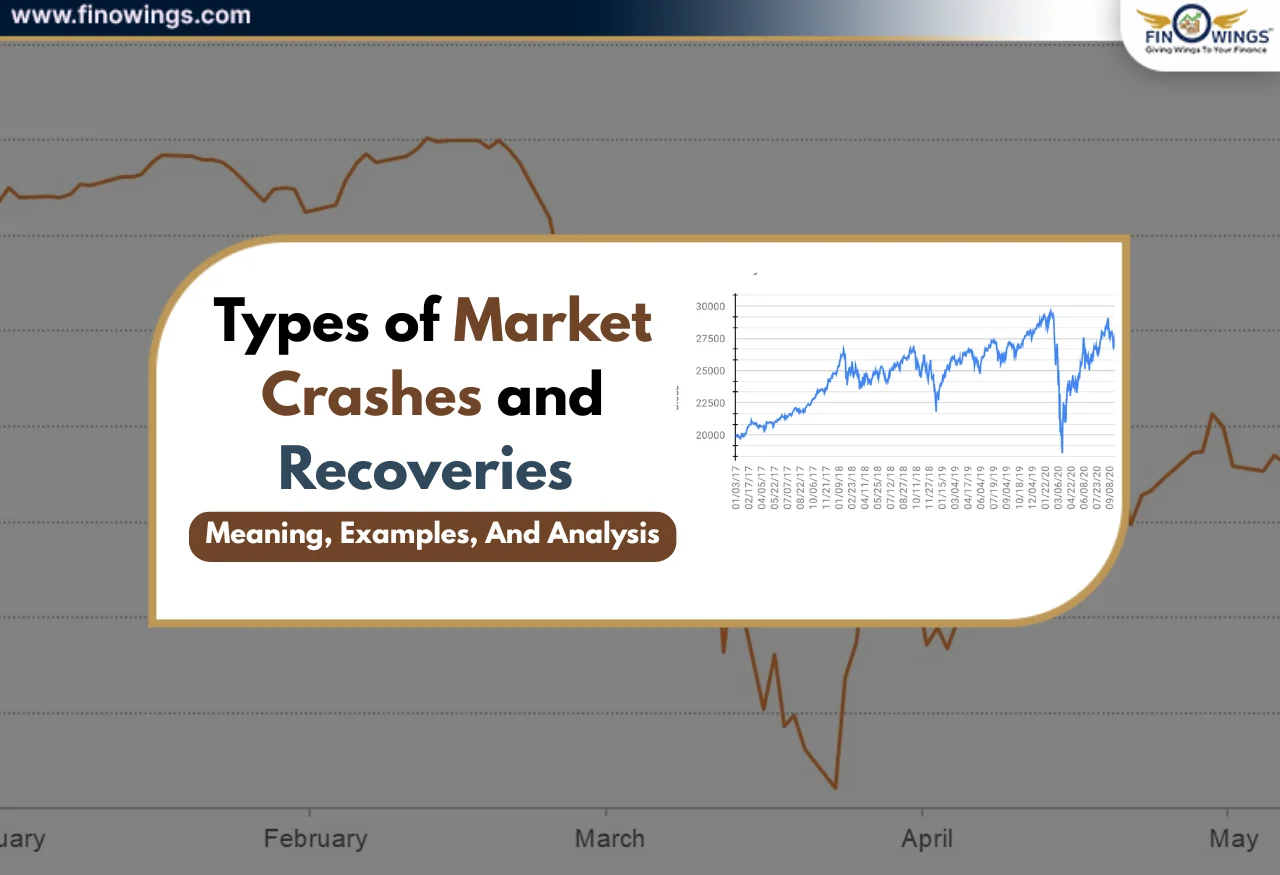
The stock market is fundamentally cyclical in nature, defining the market through periods of growth, correction, decline, and recovery. Every investor, regardless of their investing experience, should know the characteristics of the types of market downturns, and should also be familiar with patterns of recovering from market downturns. History has demonstrated that crashes do stabilise, although, the form and rate of recovery can be extremely different from one instance to the next.
In this comprehensive guide, we will analyse and assess how to define a market crash, and what a market crash means, what types of crashes in the stock market exist, what causes financial markets to crash, what are the most relevant international and Indian financial market crashes, how to analyse different cycles of recovery from a market downturn.
Let’s go through the basics first.
What is a Market Crash?
A market crash is the sharp and extreme decline of stock prices and is characterised by a:
Drop of 20-50% in major indices.
In a time span of days to weeks.
Caused by loss of investor confidence, extreme panic selling, or insufficient liquidity - or a combination of all of the aforementioned.
Unlike regular downturns and corrections, a crash has a much more incredible emotional component to it, which is usually a reflection of a cycle in a deeper economic core component, or a structure that is inherently weak.
Let us take a look at the past examples:
-
The Global Financial Crisis of 2008
-
The COVID-19 Crash of 2020
-
The Harshad Mehta Scam Crash of 1992 in India
-
The Dot Com Crash of 2000-2002.
These events are very unfortunate for the investors. However, for those who understand the concept of financial market crashes and the cycle of recovery, these events also allow for new and beneficial opportunities.

Different Types of Market Crashes Based on the Reason Behind the Crash
Now, we will outline the major different types of market crashes based on the cause of the market crash.
1. Economic Crashes
These types of crashes are a result of:
-
Economic Recession
-
High Inflation Rate
-
Increase in the Interest Rate
-
Unemployment
-
Weak Industrial Output
Example:
The US Subprime Housing Crisis 2008 Crash that spread on a global scale.
2. Structural Crashes
These are the crashes that take place due to fraud, scams, manipulation of the market, or fraud in the regulatory body.
Example:
The Harshad Mehta Scam of 1992 caused the Sensex to fall nearly 55%.
3. Liquidity Crashes
These occur when investors are forced to sell en masse due to a credit crunch or a lack of cash.
Example:
In March 2020, a large number of foreign investors liquidated their positions around the globe.
4. Geopolitical Crashes
These are the crashes caused due to War, Terrorism, Trade Wars and Political Instability.
Examples:
How the Russia-Ukraine war affects world trade.
9/11 caused the stock market to halt for several days.
5. Off-the-Job Events
External phenomena like pandemics, natural catastrophes, or world-illness shocks.
Example: Nifty dropped by 38% in 2020 due to the pandemic.
6. Speculative Crash Bubbles
Forecasting inflation and rising stock prices causes a massive spike in the market.
Example: From 2000 to 2002, the Internet bubble burst.
This category of the stock market crash identifies the speculative nature of some and the severity of others.
Why Do Financial Market Crashes Happen?
They occur for a multitude of reasons; some of the frequent ones are:
-
Investor loss of confidence
-
Over-optimism
-
Excessive leverage
-
Poor company performance
-
Macroeconomic crisis
-
Shocks from outside the country
-
New limits and restrictions.
Investors are losing the ability to forecast future cycles based on these reasons.
Market Crash Recovery Patterns
The most important thing about market crashes is that they will always bounce back in some form. Every investor should know the main market crash recovery patterns.
1. V-Shaped Recovery
-
This is a rapid decline followed by a rapid recovery.
-
Market climbs at a significant pace.
-
Recovery happens quickly.
-
Caused by a sudden economic crash followed by a strong recovery due to positive public policies.
Example: In 2020, the Nifty index bounced back in 6 months from the crash.
2. U Shaped Recovery
After experiencing a rapid decline, there is a long period of stagnation before there is a recovery. The economy takes time to recover. Period of consolidation for months or years.
Example: 1980s Recession in the United States.
3. W Shaped Recovery (Double Dip)
Market declines, then experiences a period of growth. Then, there is a decline in the market again before it finally increases in value.
-
Occurs in unstable environments.
-
Slow recovery.
Example: European debt crisis between 2010-2012.
4. L Shaped Recovery
Market crashes, then stagnates for a prolonged period of time, with little to no recovery. This is the worst-case recovery cycle.
Example: Japan experienced a L-shaped recovery in the 1990s, where the stock market crash took over 30 years to recover.
5. Swoosh-Shaped Recovery
The market experiences a decline, followed by a prolonged period of gradual, steady growth (as if with a swoosh, like the Nike logo). The recovery is long, but there is consistent improvement.
-
Gradual return in investor confidence.
-
This recovery is common after long structural recessions.
6. K Shaped Recovery
Recovery can vary across different sectors of the economy. Some sectors experience growth, while others stagnate or decline.
Example: India's economy after the COVID-19 pandemic saw the growth of the IT and pharma sectors, while the hospitality and aviation sectors stagnated for a prolonged period of time.
These K shaped recoveries help investors predict where to allocate their funding.

Stock Market Crash Types Based on Severity
As well as by their causes, market crashes can also be classified based on their speed and depth.
1. Flash Crash
Duration: A few minutes up to a few hours.
Cause: Automated trading or other technical malfunctions.
Effect: A drastic and sharp reduction in prices, followed by an equally quick recovery.
Sample Event:
Date: 2010
Location: United States
Event: Flash Crash
2. Cyclical Crash
Characteristics: Part of an overall economic decline, this kind of crash takes a longer time to recover.
Sample Event:
Date: 2008
Location: United States
Event: Recession
3. Panic Crash
Cause: Sudden selling of assets (panic selling). The selling is usually based on hot rumours, misinformation, or sudden fear.
Sample Event:
Date: 2020
Location: United States
Event: Panic during the lockdown of COVID-19
4. Structural Crash
Cause: Fraud, policy failure, or breakdown of a system resulting in a collapse of structures.
Sample Event:
Date: 2018
Location: India
Event: The IL&FS crisis (the collapse of infrastructure financing in India) negatively impacted Non-Banking Financial Companies)
Major Examples of Financial Market Crashes
Sample events that have caused crashes in the history of the market.
1. The Great Depression.
Year: 1929
Loss: 89% of the total value of sites in the Dow Jones.
Impact: Took 25 years to recover; caused a recession that was worldwide in scope.
2. Dot-Com Bubble
Year: 2000 to 2002
Loss: 78% of the total value of nest-ark (stock market).
Contains: A Burst of many technology startups (overly) valued.
3. Global Financial Crisis
Year: 2008
Loss: 52% of Nifty Index.
Contains: Global credit freeze.
Event: Collapse of the Lehman Brothers financial services company.
4. COVID-19 Crash
Year: 2020
Contains: The most rapid decline (drop) in the history of the market.
Loss: 38% of Nifty Index, over a 2-month period.
Event: Rapid recovery (supply and demand) of the market.
These events clarify the scope in terms of time, depth, causes, and recovery of financial market crashes.
How Do Markets Stabilise After a Crash?
-
All businesses change and adjust.
-
Governments continue to support liquidity.
-
The demand of the consumer will always resurface.
-
The earnings of businesses will always improve.
-
Long-term investors will always buy good stocks.
-
Market evolution consists of many cycles.
The Psychology of Market Crashes
-
There is a fear of the unknown.
-
There is a greed that can create a monetary bubble.
-
A loss of self-control can cause overconfidence.
-
There is always a herd mentality.
-
Mistakes can be avoided when the smart investors pick up on the trends early.
How to Identify the Recovery Patterns of Previous Market Crashes?
-
The Liquidity Condition.
Recovery will always be quicker with lower interest rates.
-
The Corporate Earnings.
There would always be a stable recovery if the earnings increase.
-
The FII/DII Flows.
There is always increased optimism with foreign investments.
-
The Economic Indicators.
There is always a clear correlation between GDP, inflation and unemployment with the state of recovery.
-
The Sector Rotation.
Some sectors always lead the recovery and some always lag. Keeping the right signals in mind allows one to better predict the market recovery cycles.
What Should Investors Do in Market Crashes?
-
Do not panic sell.
It is only a temporary crash; good stocks always survive.
-
Stick to asset allocation.
Balanced portfolios always lessen the impact.
-
Getting SIPs To Average Costs
SIPs allow an investor to invest an equal amount at fixed intervals of time with an option to cancel at any time. SIPs are considered to be the best strategy during a market downturn.
-
Assessing the Strong Fundamentals
Cash flows are what keep a business going, so the quicker a business can obtain cash flow, the quicker it will be able to recover during a downturn.
-
Remaining Liquid
Significant market downturns are rare, so they can be a great time to buy.
Examples of Recovery Time in Major Crashes
|
Crash |
Index Fall |
Time to Recover |
|
Harshad Mehta Scam (1992) |
55% |
2–3 years |
|
Dot-Com Crash (2000) |
78% (Nasdaq) |
15 years |
|
2008 Global Crisis |
52% (Nifty) |
18 months |
|
COVID Crash |
38% |
6 months |
This table shows that recovery speed depends on what kind of market crash it is.

Final Thoughts - Understanding Market Crashes and Recoveries
There will always be a speculative bubble, and a recession will always be accompanied by a structural failure, and it will always be the long-term investors who will benefit the most. So what are the reasons for the crash? How deep does it go? What will the market crash recovery patterns look like? Which sectors will recover first? How to position the portfolios for the upside?
These questions are essential to understanding the market and how it works. The market operates in cycles, and in this case the crash is just as predictable as the recovery.

DISCLAIMER: This blog is NOT any buy or sell recommendation. No investment or trading advice is given. The content is purely for educational and information purposes only. Always consult your eligible financial advisor for investment-related decisions.