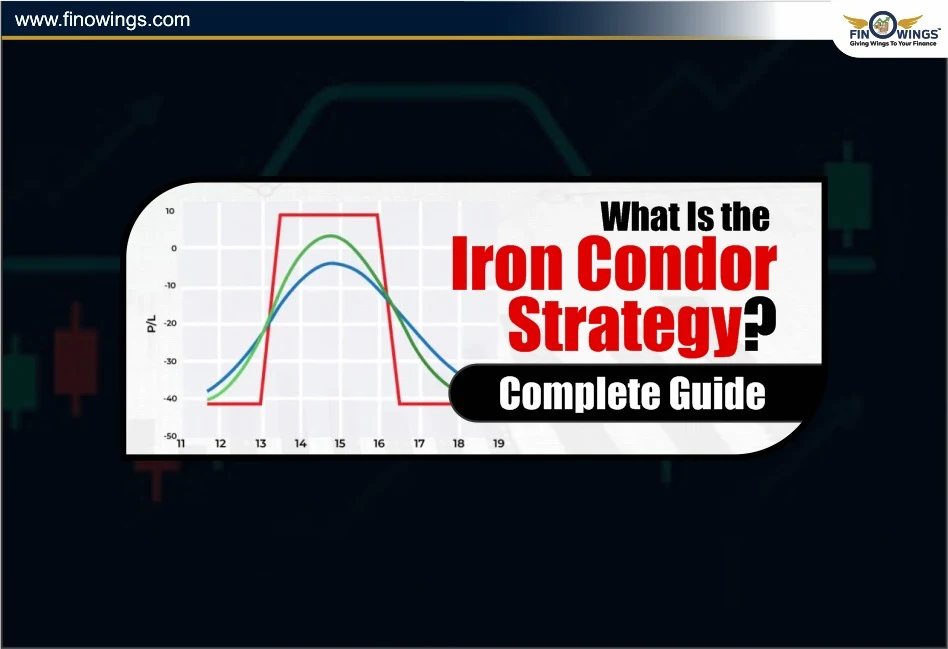
In the arena of options trading, one of the most popular and versatile strategies for earning consistent income in a sideways or low-volatility market is the Iron Condor Strategy.
This advanced options strategy is typically used by more seasoned professionals who seek to maintain their returns in a steady fashion without exposing themselves to high risk.
In this blog, we’ll break down what is the Iron Condor strategy, how it operates, the payoff structure, the potential upsides and drawbacks, and real-life use cases in illustrated phases for the complete beginner.
What is Iron Condor Strategy?
The Iron Condor option strategy is a neutral options strategy and makes money when the price of an asset is within a certain range.
It is constructed by merging two credit spreads, one of which is a Bull Put Spread and the other is a Bear Call Spread, on the same underlying asset and same expiration date.
Put simply, an Iron Condor is a non-directional strategy. It is employed when a trader predicts that a stock would stay range-bound, without making aggressive moves vertically in either a bullish or bearish direction.

Iron Condor Strategy Explained
To get an idea of what is Iron Condor strategy, picture two wings — one from a bull put spread (located beneath the current price) and the other from a bear call spread (located above the current price).
Observe the structure:
1. Sell one Out-of-the-Money (OTM) Put
2. Buy one Lower Strike Put (for protection)
3. Sell one Out-of-the-Money (OTM) Call
4. Buy one Higher Strike Call (for protection)
Then, you would have created a position that earns profit when the stock stays between the two short strikes - that’s your profit zone.
Iron Condor Option Strategy Example
Let’s assume a practical strategy:
Nifty is trading at ₹22,000. You think Nifty would remain between ₹21,500 and ₹22,500 until expiry.
An Iron Condor is set up like this:
|
Leg |
Action |
Strike Price |
Option Type |
|
1 |
Buy |
₹21,400 |
Put |
|
2 |
Sell |
₹21,500 |
Put |
|
3 |
Sell |
₹22,500 |
Call |
|
4 |
Buy |
₹22,600 |
Call |
Here’s what happens:
-
You receive net premium from selling the middle strikes (₹21,500 Put and ₹22,500 Call).
-
You lose a little of what you received in premiums for selling the ₹21,500 Put and ₹22,500 Call when you buy the outer strikes (₹21,400 Put and ₹22,600 Call).
-
If Nifty is in the range of ₹21,500 and ₹22,500 up to expiry, you hold onto the net premium - this is your maximum profit.
Iron Condor Payoff Diagram
An Iron Condor payoff graph looks like a bird. It has wide, outstretched wings in the middle (the profit zone) but shrinks on both ends (the zone of loss).
Maximum Profit: The price is stuck between the short put and short call strike prices.
Maximum Loss: The loss occurs when the price exceeds the outer bought options.
Breakeven Points:
Lower Breakeven = Short Put Strike − Net Premium Received
Upper Breakeven = Short Call Strike + Net Premium Received
This structure ensures that your risk is capped, while your reward is limited but steady.
Why Traders Use the Iron Condor Strategy
The Iron Condor strategy is favoured by traders for several reasons:
1. Low Volatility Market Advantage:
It works best when the underlying stock or index is not expected to make big moves.
2. Defined Risk and Reward:
Both maximum profit and maximum loss are predefined, making it safer for risk-managed trading.
3. Steady Income:
The strategy allows traders to earn regular premiums through time decay.
4. Flexibility:
You can adjust strikes, expiries, and ratios based on your market outlook.
Understanding the general market trend is essential before implementing sophisticated setups like the Iron Condor. A great addition to range-bound tactics like the Iron Condor, the 200-Day Moving Average: Meaning, Chart & Strategy serves as a crucial indicator of long-term trend direction and assists you in determining whether the market is bullish, bearish, or sideways.
Short Iron Condor Strategy
The Short Iron Condor is the most commonly used form of the strategy. In this version, traders sell two options (a put and a call) and buy two protective options further out of the money. This setup results in a net credit, meaning you receive money upfront when you initiate the trade.
You profit if the market stays within your expected range. Normally, a Long Iron Condor is less usual since it entails a net debit and only makes money with a dramatic spike in volatility, in contrast to most Iron Condor situations, where losses are associated with increased volatility.
Iron Condor Profit and Loss Calculation
Maximum Profit:
The total net profit will be the premium received from selling options minus the premium paid for buying protective options.
Maximum Loss:
In the example where the premium received is a net value of ₹100, and the value of the contracts involves a ₹500 difference, you arrive and display the loss as
Max Loss = ₹500 − ₹100 = ₹400
This makes Iron Condor an excellent risk defined options trading strategy.
Ideal Market Conditions
Specifically, the strategy Krylon Condor, or called Iron Condor, works under the pretense that the underlying asset is still. It will profit from decreasing implied volatility and the underlying asset will perform sideways around the time of the close, where time erosion or theta will work in the asset holder's favour.
Benefits of the Iron Condor Strategy
-
Controlled Risk and Reward
-
Neutral Market Constraints
-
Income Stream Quasi-Flexible
-
Clear Breakeven Calculations
Drawbacks of the Iron Condor Strategy
-
Profit Cap
-
Needs High Margins
-
Loss Potential In Highest Volatility
-
High Complexity For New Traders.
How To Trade Iron Condor Options
1. Use Nifty, Bank Nifty and other high liquidity equities.
2. Place your 20-25 days before expiry method.
3. Use Implied Volatility (IV). Trade when high and sell when low.
4. Adjust the position of your strikes when the base of your position is threatening one of your strike levels.
5. Always determine your max loss limit before trading.
Practical Iron Condor Example In Nifty
For example, let's say Nifty is trading for ₹22,000.
You set an Iron Condor with 21,500 (Put) strike, 21,400 (Buy Put) strike, 22,500 (Call) strike, and 22,600 (Buy Call) strike.
You earn ₹120 as total premium.
If Nifty stays in the range of ₹21,500-₹22,500 till expiry, you earn a ₹120 profit per lot. If Nifty crosses ₹21,400 or ₹22,600, you take a limited loss. That’s why the Iron Condor is a low-risk, high-probability trade setup. You earn consistent time decay profit.

Conclusion
One of the best option trading setups for traders anticipating a sideways market is the Iron Condor strategy. It keeps your risk under control while enabling you to earn a steady income from time decay. It's not entirely risk-free, though, like other option strategies, so time and risk management are crucial.
You may develop a disciplined, professional approach to options trading by mastering this technique, whether you're investigating the Iron Condor option strategy, preparing a short Iron Condor, or just studying what is Iron Condor strategy.

DISCLAIMER: This blog is NOT any buy or sell recommendation. No investment or trading advice is given. The content is purely for educational and information purposes only. Always consult your eligible financial advisor for investment-related decisions.


.webp)