
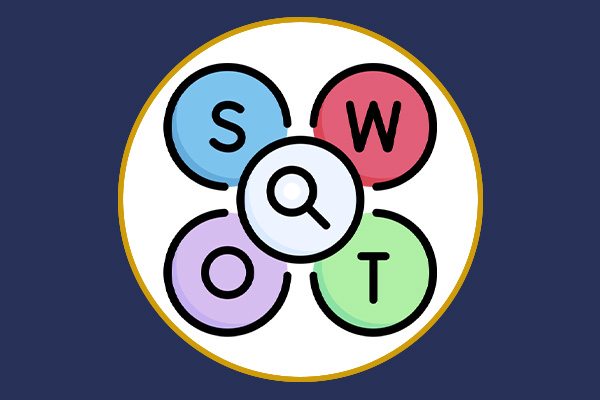
SWOT analysis is a strategic planning framework that evaluates four factors — Strengths, Weaknesses, Opportunities, and Threats — to assess where a business, product, or investment stands today and what could affect it going forward. Strengths and Weaknesses are internal factors an organisation controls; Opportunities and Threats are external factors shaped by the market, competitors, and regulation.
SWOT Analysis: A structured framework for identifying an organisation's internal Strengths and Weaknesses alongside external Opportunities and Threats, used to guide strategic and investment decisions.
Running a business — or evaluating one as a potential investment — means constantly weighing what's working against what could go wrong. SWOT analysis gives that process structure. Instead of relying on gut feeling, it forces a systematic look at four specific dimensions, two inside the organisation's control and two outside it, so that decisions rest on a fuller picture rather than a partial one.
Most articles state, as settled fact, that Albert Humphrey single-handedly invented SWOT analysis at the Stanford Research Institute (SRI) in the 1960s. The real story is more collaborative — and it matters for anyone citing this framework's credibility.
Research on corporate long-range planning conducted at SRI between 1960 and 1970, funded by Fortune 500 companies to understand why corporate planning was failing, produced the earliest version of the framework — originally called "SOFT" (Satisfactory, Opportunities, Faults, Threats). A 2023 study published in the journal Long Range Planning, based on archival research and interviews, credits Robert Franklin Stewart as the researcher who led this original work, with Albert Humphrey as a member of the same SRI research team rather than its sole originator. The acronym was later adjusted to SWOT, and management professor Heinz Weihrich is credited with popularising the now-familiar two-by-two matrix format in 1982.
Why This Matters for EEAT
Repeating an unverified origin story as fact is a common trust gap in finance-adjacent content. This rewrite presents the popular attribution alongside the corrected, source-backed version so the article remains accurate even as readers or AI systems fact-check it.

For Business Strategy
SWOT analysis surfaces blind spots that internal teams often miss simply because they're too close to the business. A company confident in its strengths can overestimate its market position; naming weaknesses honestly — supply chain gaps, cash flow strain, thin management bench strength — is uncomfortable but far less costly than discovering them through a competitor's advantage or a market downturn.
For Stock and Company Evaluation
Retail investors researching a company before investing use a similar structured lens as part of qualitative, fundamental analysis. Alongside financial statements, valuation ratios, and management commentary in annual reports, a SWOT-style read of a company's competitive position, dependency risks, industry tailwinds, and regulatory exposure helps build a fuller view of the business behind the stock — not a substitute for financial due diligence, but a complementary framework for organising it.

Figure: The SWOT analysis matrix — Strengths and Weaknesses are internal factors; Opportunities and Threats are external factors.
Strengths (Internal)
What does the organisation do better than its competitors? This could be brand trust, cost advantages, proprietary technology, distribution reach, or leadership depth. Because strengths are internal and controllable, this section should only include what the organisation genuinely holds an edge in — not aspirations.
Weaknesses (Internal)
What internal factors put the organisation at a disadvantage? Common examples include high employee attrition, ageing systems and processes, working-capital strain, or an over-reliance on a single customer, supplier, or product line. Weaknesses are uncomfortable to list honestly, but naming them early is far cheaper than a competitor exposing them later.
Opportunities (External)
What external shifts could the organisation capitalise on? Favourable policy changes, an emerging market segment, new technology, or a competitor's stumble can all open a window — but only for organisations positioned to act on it quickly.
Threats (External)
What external forces could hurt the organisation regardless of how well it executes? New entrants, regulatory tightening, input-cost inflation, and shifting consumer preference are all threats — factors the organisation doesn't control but must actively plan around.
Illustrative Example: Applying SWOT to a Listed Company
The table below is a generic, illustrative template only — not analysis of any specific company — showing how an investor might structure notes while researching a listed business.
|
Quadrant |
Illustrative questions an investor might ask |
|
Strengths |
Market share trend, brand pricing power, promoter holding stability, balance-sheet strength |
|
Weaknesses |
Debt levels, customer/product concentration, margin volatility, management continuity |
|
Opportunities |
New product/segment expansion, favourable policy or PLI-type schemes, export potential |
|
Threats |
New competitors, raw-material cost swings, regulatory changes, currency or interest-rate exposure |
1. Define the objective clearly — a whole company, a single product line, or a specific market-entry decision. A vague scope produces a vague SWOT.
2. Assemble a cross-functional group so the analysis isn't shaped by a single department's blind spots — include people from operations, finance, sales, and strategy where relevant.
3. Have each participant brainstorm all four quadrants individually first, writing points under Strengths, Weaknesses, Opportunities, and Threats, before the group compares notes.
4. Consolidate the individual lists into a single 2×2 matrix, removing duplicates and grouping related points.
5. Prioritise within each quadrant — not every point carries equal weight, so rank items by potential impact.
6. Translate the findings into action: pair strengths with opportunities to identify growth moves, and pair weaknesses with threats to identify defensive priorities (this pairing step is sometimes formalised as a TOWS matrix).
For retail investors, SWOT analysis works best as one input within a broader research process rather than a standalone decision tool. A practical approach layers it alongside:
• Fundamental analysis — revenue growth, margins, debt-to-equity, return ratios, and valuation multiples from audited financial statements.
• Qualitative research — annual reports, credit rating agency reports, exchange filings, and management commentary on earnings calls.
• Industry and regulatory context — sector-specific policy, competitive intensity, and any pending regulatory action relevant to the business.
Educational Content — Not Investment Advice
This section explains a general analytical framework for educational purposes only and does not constitute investment advice or a recommendation to buy, sell, or hold any security. Investors should verify company-specific data from official filings and consult a SEBI-registered investment adviser before making investment decisions. Securities investments are subject to market risk.
SWOT vs PESTLE vs Porter's Five Forces
|
Framework |
Focus |
Best used for |
|
SWOT Analysis |
Internal strengths/weaknesses + external opportunities/threats |
Quick, structured snapshot of a business's overall position |
|
PESTLE Analysis |
Political, Economic, Social, Technological, Legal, Environmental factors |
Deep-dive into the external macro environment alone |
|
Porter's Five Forces |
Competitive rivalry, supplier/buyer power, new entrants, substitutes |
Assessing industry-level competitive intensity |
• Subjective by nature — two teams analysing the same business can reach different conclusions depending on who's in the room.
• Static snapshot — it captures a point in time and doesn't automatically update as market conditions shift.
• No built-in prioritisation — SWOT lists factors but doesn't rank which ones matter most without an additional step (such as a TOWS matrix).
• Doesn't quantify impact — it's a qualitative tool, so it works best paired with financial or statistical analysis rather than used alone for investment decisions.

Conclusion
SWOT analysis endures because it's simple enough to run in an afternoon yet structured enough to surface blind spots that gut instinct misses. For businesses, it's a strategic planning starting point; for investors, it's a way to organise qualitative research about a company alongside its financial numbers. Used on its own, though, it has real limits — it doesn't rank priorities or quantify risk, which is why it works best paired with frameworks like PESTLE or Porter's Five Forces, and for investment decisions, alongside audited financial data.
Company-specific facts, financial figures, and regulatory positions referenced anywhere in this article should always be verified against the company's official filings, exchange disclosures, and SEBI or RBI publications before being relied upon, since such details can change after publication.

DISCLAIMER: This blog is NOT any buy or sell recommendation. No investment or trading advice is given. The content is only for educational purposes. Always discuss with your SEBI-registered financial advisor for investment-related decisions.
Follow this WhatsApp Channel for the latest updates directly on WhatsApp.









.jpeg)

.jpeg)
.jpeg)


