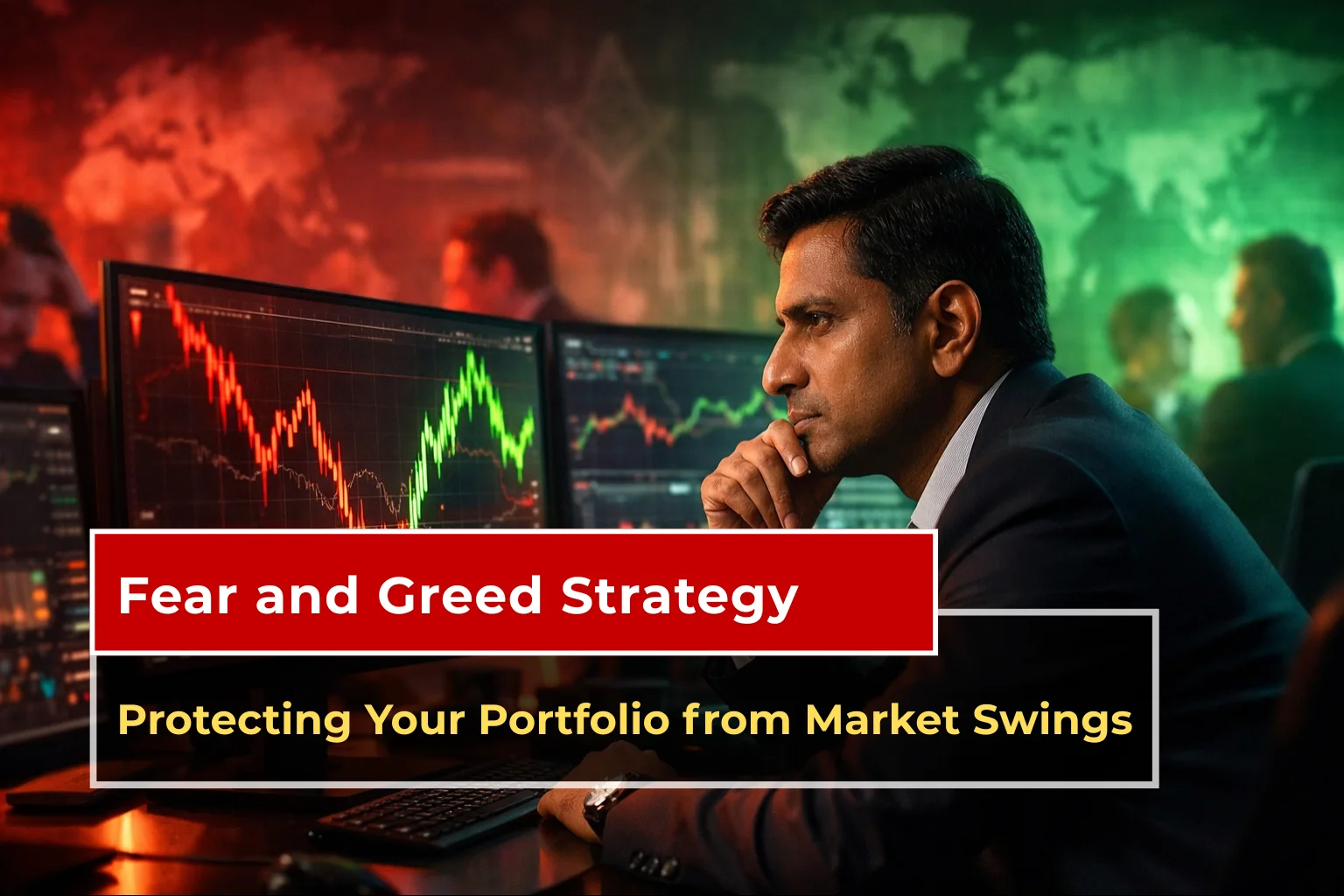
Investing will never be pure numbers. It will always be a human activity. In Investments 2025, the dominant global market emotions were fear and greed. Pricing extremes, abrupt market crashes and wildering even the most seasoned investors were all driven by these two emotions.
Moving towards investing in 2026, knowing market psychology in 2025 is not as important as it is required to be. This is the main focus of this blog: the fear and greed index, and investor decisions for 2025 and what it ultimately reflects upon investor behaviour and market sentiment analysis in 2026, for making decisions in 2026 and what impact it will have.
Basics of Greed and Fear in Financial Markets
Every market cycle builds from two foundational emotions:
Greed: The more the money, the higher the desire.
Fear: The more the loss, the greater the desire to protect what is left.
The very basic framework of the fear and greed index tries to encapsulate all these. Based on how extreme volatility is, how bullish or bearish the current sentiment is, how demand for safe ETFs is trending, and how the current volume is, the index will try to measure how extreme the greed and fear are in the current market.
In Market Psychology 2025, the combined impact of global uncertainty, rapid information flow, and social media influenced investing emotionally, as driven by narratives.
Fear and Greed Index of 2025
In Investments 2025, the fear and greed index recorded extreme values for the majority of the time. Long spells of greed were, however, repeatedly followed by fear of triggers correcting the market. The market, however, reflected a state of emotional imbalance.
If you're trying to understand market sentiment in depth, it's equally important to look at current signals. We’ve explained how the Market Mood Index in 2026 is reflecting fear and greed-driven investor behaviour, helping you interpret real-time sentiment more effectively.
Some highlights of market sentiment analysis in 2025 include:
- Predominantly driven by market fundamentals and rapid corrections, the confidence lost was short-lived and was followed by strong retracements.
- Retail increased the emotional volatility.
- Data was bypassed in favour of the headlines to drive the short-term investors.
The index reflected the sentiment of the investors, more than what the market was supposed to do.
Understanding the Fear and Greed Index in Investing
The fear-and-greed strategy is a powerful approach that helps investors navigate emotional market cycles. Instead of reacting impulsively to news or price swings, this strategy uses the Fear and Greed Index as a contrarian tool to make more rational decisions.
The Fear and Greed Index measures market sentiment trading by combining seven different indicators, including stock price momentum, stock price strength, stock price breadth, put and call options, junk bond demand, market volatility, and safe-haven demand. It generates a score from 0 to 100:
Example
|
Index Zone |
Meaning |
Investor Action |
|
Extreme Fear |
Panic |
Watchlist buying |
|
Fear |
Caution |
Staggered accumulation |
|
Greed |
Confidence |
Review risk |
|
Extreme Greed |
Overheating |
Rebalance / partial booking |
- 0–24: Extreme Fear
- 25–49: Fear
- 50–74: Greed
- 75–100: Extreme Greed
Practical Investor Framework by Risk Type
Here’s a ready-to-use portfolio protection strategies framework tailored to the fear and greed strategy:
- Conservative Investors (Low Risk): When index <25 (Extreme Fear), increase allocation to gold, sovereign bonds, and large-cap defensives by 10-15%. Maintain 20-30% cash during Greed phases.
- Moderate Investors (Balanced): Rebalance quarterly based on the index. At current 32 (Fear) in April 2026, add 5-10% to quality midcaps in IT/pharma. Trim greed-driven sectors like auto when the index >75.
- Aggressive Investors (High Risk): Use volatility trading strategy — buy protective puts or volatility instruments only when fear is extreme. Deploy fresh capital into beaten-down sectors during war-induced dips.
Beginner vs Long-Term Investor Guidance
Beginners: Start simple. Check the Fear and Greed Index once a week via CNN Markets. Avoid panic selling during war news — treat extreme fear as a “buy signal” for blue-chip SIPs. Never invest more than you can afford to hold for 3+ years.
Long-Term Investors: Ignore daily swings. Historical data prove that following the fear-greed index strategy during geopolitical events has delivered superior risk-adjusted returns. Focus on rupee-cost averaging during fear phases rather than trying to time the exact bottom.
What to Do Now (April 2026 Angle)
As of April 9, 2026, the Fear and Greed Index is at 32 (Fear) amid the ongoing West Asia conflict. Nifty is down ~10% from February peaks — a classic fear-driven dip similar to 2022.
Immediate Action Steps:
- Review your portfolio: Reduce exposure if greed levels were high pre-conflict.
- Deploy 5-10% fresh capital into high-quality Indian stocks (especially those with strong balance sheets) if the index falls below 25 again.
- Hedge selectively with gold ETFs or defensive sectors.
- Set alerts for index crossing 50 — that’s your cue to reassess profit-taking.
This is not the time for knee-jerk moves but a textbook opportunity to apply the fear and greed strategy while markets price in war uncertainty.
Market Psychology 2025: Why was it All About Emotions?
Some of the elements that increased the dimensions of market psychology 2025 include:
1. Information Overload
Investors were bombarded with a streaming, continuous flow of updates ranging from news alerts, social media comments and market commentary in real-time. Emotional trigger points were easier to reach.
2. Short-term Performance Pressure
Investors set themselves success measurement timelines that averaged weeks and months instead of an extended year. This resulted in amplified fear of corrections and increased greed in rapid short-term growth.
3. The Collective Decision
People made the same decisions quickly, thinking they would “lose out.” Then they sold as a group when the price fell. This behaviour made price changes more extreme.
4. The Rapid Decline of Patience
The markets became more emotionally fragile as they ignored investing practices and kept a focus on rapid buying and selling.
Phases of Greed in Investments 2025
When greed dominated the markets, several mutual characteristics could be understood: Rapid changes in evaluation, unstable and high-risk assets outstripped established and steady counterparts, negative news fell into the background and optimistic news rose to the forefront.
In Investments 2025, greed clouded the judgment of investors, convincing them with claims of “this time is different”. The markets chose to ignore the stability provided by defensive investing and, in increasingly reckless investing, they created vulnerability which could be magnified when the market sentiment changed again.
The growing markets and investment activity provide a solid place to invest money. Unfortunately, it put most of the investment community in a position of danger as it clouded their judgment.
Phases of Fear and Panic of Selling
The price fell quickly in 2025 due to shifts in instability and events that fell beyond the expected limits. During these events, price volatility increased and investors flocked to cash as their focus changed and safe assets became available.
Long-term investing became a thing of the past. Quality and weak assets were sold. This provided evidence of a key factor in sentiment analysis of the market. The destructive ability of fear is several magnitudes more and can act with much greater speed and decisiveness than greed.
Fear caused a lot of people to sell when they shouldn't have, turning paper losses into realised losses.
Investor Behaviour: Learning from 2025
Learning from investor behaviour in 2025 helps us look into the future:
1. Emotions Influence Decisions
Most investment mistakes were of an emotional nature, not analytical.
2. Emotional Feelings as a Timing-Based Strategy Does Not Work
Buying during peak greed and selling during peak fear destroyed long-term returns.
3. Discipline Outperforms Smarts
Investors who stick to a simple, disciplined strategy often perform better than those trying to come up with big, complex ideas.
4. Patience as a Virtue
Those who stayed invested during fear phases were better positioned when sentiment recovered.
How Analysing Market Sentiment Helps Investors
Market sentiment analysis provides context rather than trying to predict the next market movements. Combined with the fundamentals, it stretches the potential of sound decision-making to the next level.
Sentiment analysis helps with the following:
- Recognising emotional extremes
- Not making herd-driven decisions.
- Enhanced entry and exit decision-making.
- Keeping the rational perspective in the midst of volatility.
In investing in 2026, sentiment analysis will drive emotions, not fundamentals, to determine the price.

Investing in 2026: What Changes and What Doesn’t
With the advent of investing in 2026, the market environment will shift; however, the behavioural aspects of human nature will remain unchanged.
What may change:
- Economic cycles
- Policy environments
- Market leadership
What will not change:
- Fear during uncertainty
- Greed during rallies
- Emotional decision-making
The same patterns seen in market psychology 2025 are likely to repeat in different forms.
Volatility Trading Strategy with Fear and Greed
The fear and greed strategy pairs exceptionally well with a volatility trading strategy. High volatility periods (common during wars) often coincide with extreme readings on the index.
Traders can:
- Sell volatility (or reduce risk) when greed is extreme and volatility is low but expected to rise.
- Buy volatility instruments or protective puts when fear is extreme and panic has already driven prices down.
By combining market sentiment trading signals from the Fear and Greed Index with volatility analysis, you create a more robust framework for navigating uncertain times like geopolitical conflicts.
Strategies to Manage Fear and Greed in 2026
To succeed in investing in 2026, investors must focus as much on emotional control as on analysis.
1. Create a Rules-Based Plan
Having predefined rules reduces emotional reactions during volatile periods.
2. Focus on Process, Not Predictions
Markets are unpredictable. A strong process matters more than perfect forecasts.
3. Use the Fear and Greed Index as a Signal, Not a Trigger
Extreme readings should encourage caution or opportunity - not impulsive action.
4. Think in Years, Not Weeks
Long-term thinking helps neutralise short-term emotional noise.
Long-Term Perspective Beats Emotional Timing
One of the biggest takeaways from Investments 2025 is that emotional timing consistently underperformed patient investing.
Markets reward:
- Consistency
- Discipline
- Rational decision-making
They punish:
- Panic
- Overconfidence
- Emotional reactions
By understanding investor behaviour, investors can step back from the crowd and make decisions aligned with their goals.
Key Benefits of Following This Approach
- Reduces emotional decision-making.
- Helps identify potential turning points in the market.
- Improves risk-adjusted returns over the long term.
- Provides a structured way to handle the war's impact on stock markets.

Final Thoughts: Using Psychology as a Tool
Fear and greed are not enemies, but rather attunements. In Market Psychology 2025, these emotions exposed decision-making weaknesses and gaps and opportunities for more disciplined investors.
As you prepare for investing in 2026, remember: The fear and greed index is a metric that reflects emotions and should not be taken as a measure of eventual market outcomes. Market sentiment analysis will provide you with an emotional detachment from the markets to help you remain objective. (Source: BS, TradingView)
Making a study of investor behaviour will help you avoid costly mistakes. The investors who succeed in 2026 will not be the ones who predict markets perfectly, but those who manage their emotions. Learning from the lessons of 2025 will allow you to turn fear and greed from obstacles to tools for smarter investing.

DISCLAIMER: This blog is NOT any buy or sell recommendation. No investment or trading advice is given. The content is purely for educational and information purposes only. Always consult your eligible financial advisor for investment-related decisions.

.webp)