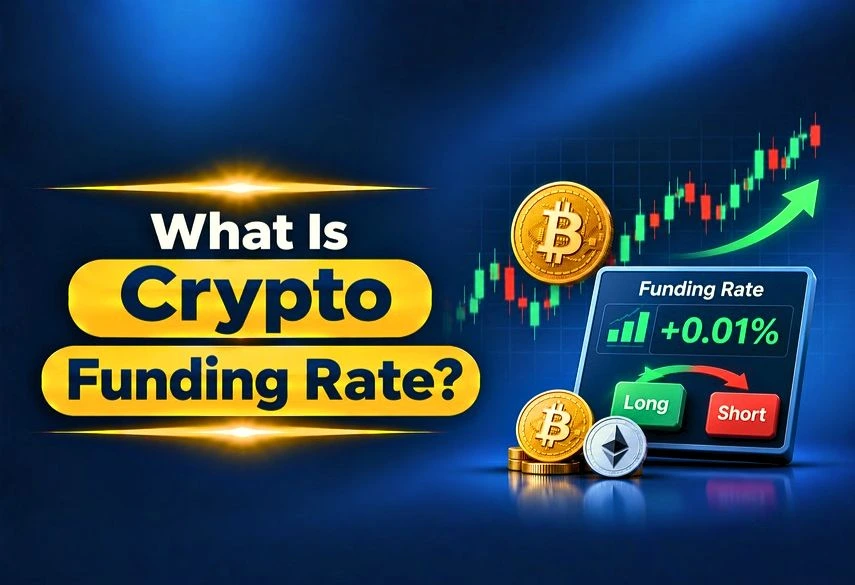
The crypto funding rate is a small periodic payment exchanged between long and short traders in perpetual futures contracts. It keeps the contract price close to the real spot price of the coin. When the rate is positive, longs pay shorts. When it is negative, shorts pay longs.
You can calculate the exact cost using a simple formula: Funding Payment = Position Value × Funding Rate.
This mechanism is one of the most important (and often misunderstood) parts of trading perpetual futures. In this complete guide, we will explain the funding rate in simple words, show you exactly how to calculate funding rate, and help you understand what a positive funding rate or negative funding rate really means for your trades.
What Is Funding Rate in Crypto?
A perpetual futures contract never expires. Unlike traditional futures that settle on a fixed date, you can hold a perpetual position for as long as you want. Because there is no expiry date, nothing forces the futures price to match the spot price of Bitcoin, Ethereum, or any other coin.
That is where the crypto funding rate comes in. The funding rate acts like a balancing force. It creates a financial incentive for traders to push the perpetual price back toward the spot price.
According to clear explanations from trading education platforms, the funding rate is paid every few hours (usually every 8 hours on major exchanges) and is calculated as a percentage of your full position size, not just your margin.

Why Do We Need a Perpetual Futures Funding Rate?
Without the perpetual futures funding rate, the futures price could drift far away from the real market price. If too many traders want to go long, the perpetual could trade much higher than the spot price. If too many want to short, it could trade much lower.
The funding rate solves this problem:
When the perpetual is trading above the spot price → Positive funding rate→ Longs pay Shorts.
When the perpetual is trading below the spot price → Negative funding rate→ Shorts pay Longs.
This simple system keeps the market balanced.
Positive Funding Rate vs Negative Funding Rate
Understanding the difference is crucial.
|
Situation |
Funding Rate |
Who Pays Whom |
Market Meaning |
|
Perpetual price > Spot price |
Positive |
Longs pay Shorts |
Market is bullish / crowded longs |
|
Perpetual price < Spot price |
Negative |
Shorts pay Longs |
Market is bearish / crowded shorts |
|
Perpetual price ≈ Spot price |
Near zero |
Almost nothing |
Market is balanced |
A strong positive funding rate means many traders are long and willing to pay to stay long. A strong negative funding rate means the opposite. Traders often watch the bitcoin funding rate and ETH funding rate as a quick sentiment indicator.
How to Calculate Funding Rate - Simple Formula
Most traders ask: how to calculate funding rate? The calculation is straightforward.
Basic Formula:
Funding Payment = Position Notional Value × Funding Rate
Position Notional Value = Size of your position × Current mark price
Funding Rate is usually shown as a percentage (for example 0.01%)
Example 1 – Positive Funding Rate
You hold a $20,000 long Bitcoin position.
Current BTC funding rate= +0.01% (per 8 hours)
Payment = 20,000×0.0001=2
You pay $2 to the short traders every 8 hours.
Example 2 – Negative Funding Rate
You hold the same $20,000 long position.
Current rate = –0.02%
Payment = 20,000×(–0.0002)=–4
This means you receive$4 from the short traders.
You can use any simple funding rate calculator (many free tools exist online) or just do the math yourself. Remember that the rate is applied to the full position size, not the margin you put up.
How Exchanges Calculate the Actual Rate
Most major exchanges use a combination of two parts:
1. Interest Rate Component– Usually a small fixed amount (often 0.01% every 8 hours).
2. Premium Component– How far the perpetual is trading from the spot index price.
A common formula looks like this:
Funding Rate = Premium Index + clamp (Interest Rate – Premium Index, –0.05%, +0.05%)
This formula prevents extreme swings while still responding to market pressure. Details can vary slightly between Binance, Bybit, OKX, and other platforms.
Real-World Impact: Bitcoin Funding Rate and ETH Funding Rate
Let’s look at practical numbers.
If the Bitcoin funding rate stays at +0.01% for a full day (three payments):
Daily cost on a $10,000 position = $3
Yearly cost if the rate never changes ≈ 10.95%of the position size.
When the market gets very bullish, the BTC funding rate or ETH funding rate can jump to 0.05% or even higher for short periods. At 0.05% every 8 hours, the annualized cost becomes roughly 55%. Holding a large leveraged long position becomes expensive very quickly.
This is why experienced traders always check the current funding rate before opening a big position, especially when planning to hold for days or weeks.
You can estimate your potential position size and manage risk more effectively using our Crypto Position Size Calculator before opening a leveraged trade.
Why Funding Rate Matters for Traders
1. It is a real cost– Even if the price does not move, funding can slowly eat your profits.
2. It shows market sentiment– Extreme positive rates often appear near market tops. Extreme negative rates can appear near bottoms.
3. It creates opportunities– Some traders specially look for high positive or high negative rates to run funding rate arbitrage strategies.
4. It affects leverage decisions– High funding makes high leverage more dangerous for long-term holds.
Practical Tips for Beginners
-
Always check the current funding rate and the next funding time before entering a trade.
-
Prefer shorter holding periods when the rate is high and against your position.
-
Use a funding rate calculator to estimate daily and monthly costs.
-
Remember that funding is paid only if you hold the position at the exact funding time.
-
Compare rates across exchanges - the bitcoin funding rate can be different on Binance, Bybit, and OKX at the same moment.

Conclusion
The funding rate is the hidden cost (or income) of every perpetual futures trade. Once you understand what the funding rate is in crypto and how the perpetual futures funding rate works, you gain a clearer picture of the true cost of holding a position.
Whether the rate is positive or negative, it always serves the same purpose: keeping the perpetual market honest and close to the real spot price. By learning how to calculate funding rates and watching key numbers like the BTC funding rate and ETH funding rate, you can make smarter decisions and avoid unexpected costs.
Mastering this simple concept separates beginners from more professional crypto futures traders.
Related Tools
- Crypto Tax Calculator (India)
- Risk Reward Ratio Calculator
- Position Size Calculator (INR)
- Crypto Liquidation Price Calculator
- Crypto DCA Calculator
(Sources:ChartThread ,CoinLab ,Coinbase)

DISCLAIMER: This blog is NOT any buy or sell recommendation. No investment or trading advice is given. The content is only for educational purposes. Always discuss with your SEBI-registered financial advisor for investment-related decisions.
Follow this WhatsApp Channel for the latest updates directly on WhatsApp.