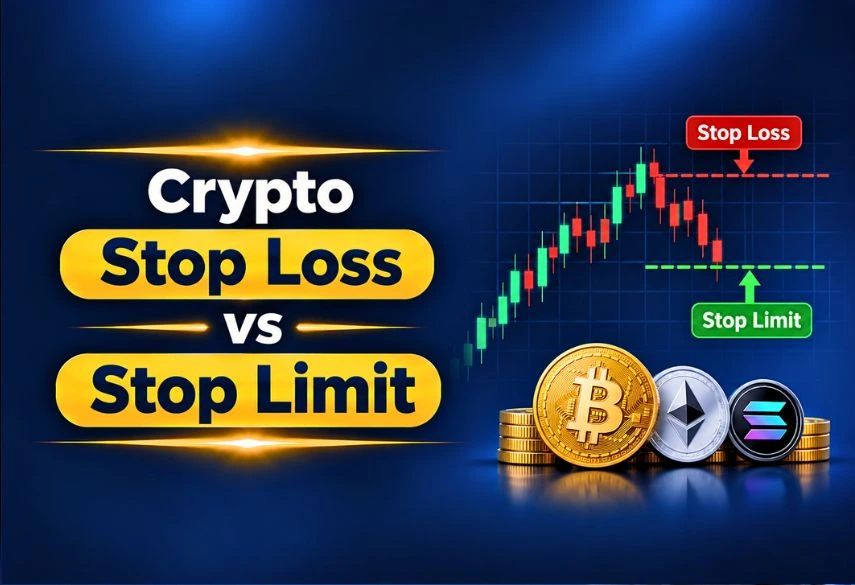
When trading cryptocurrencies, protecting your capital is just as important as making profits. The main difference between stop loss vs stop limit is that a stop-loss market order prioritises exiting a trade, while a stop-limit order gives you greater control over the execution price. For example, if Bitcoin starts falling sharply, a stop-loss market order attempts to sell at the best available price after reaching your trigger level.
A stop-limit order, on the other hand, sells only at your specified limit price or better, which means it may not execute during a sudden market crash. Understanding both orders can help you make better trading decisions and manage risk more effectively.
In this guide, we will explain stop-loss and stop-limit orders in simple language, compare their differences, explore practical Bitcoin examples, and understand which order type is more suitable for different crypto trading situations.
What Is a Stop Loss Order in Crypto?
A stop-loss order is a trading instruction that helps traders limit potential losses when the market moves against their position. It allows you to decide in advance at which price you want to exit a trade instead of waiting for the market to fall further.
In cryptocurrency markets, prices can change rapidly because of market news, investor sentiment, economic developments, and sudden changes in buying or selling pressure. A stop loss order crypto traders use can help manage these unexpected movements without constantly monitoring the market.
Let's understand this with an example.
Suppose you purchase Bitcoin at $90,000. After analysing the market, you decide that you do not want to hold the position if Bitcoin falls below $87,000. You place a stop-loss market order at $87,000.
If Bitcoin reaches that level, the order is triggered and becomes a market sell order. It attempts to sell your Bitcoin at the best available price. However, if the market is moving quickly, your actual selling price could be $86,800 or even lower.
This difference between the trigger price and actual execution price is known as slippage.

What Is a Stop Limit Order in Crypto?
A stop-limit order is another type of conditional trading order that allows you to control the price at which you are willing to buy or sell cryptocurrency. Unlike a regular stop-loss market order, a stop-limit order uses two prices: the stop price and the limit price.
The stop price is the level that activates your order. Once the market reaches this price, the exchange places a limit order at your specified limit price. The order will execute only at that price or a better price.
For example, suppose you purchased Bitcoin at $90,000 and want to exit if its price starts falling. You can set a stop price of $87,000 and a limit price of $86,500.
When Bitcoin reaches $87,000, your stop-limit order becomes active and places a sell limit order at $86,500. If buyers are available at $86,500 or higher, your order can execute.
However, imagine Bitcoin suddenly crashes from $87,000 to $84,000. Your sell order may remain unfilled because the market is trading below your minimum acceptable selling price.
This is the biggest limitation of a stop-limit order. It provides price control but does not guarantee execution.
Stop Loss vs Stop Limit: Key Differences
Although both orders are used for risk management, their execution mechanisms are different. Understanding these differences is important before choosing an order type for your crypto trades.
|
Comparison |
Stop Loss (Market) |
Stop Limit |
|
Meaning |
Triggers a market order |
Triggers a limit order |
|
Price Levels |
One stop price |
Stop price and limit price |
|
Execution |
Attempts immediate execution |
Executes at limit price or better |
|
Price Control |
Limited |
Greater |
|
Slippage |
Possible |
Restricted by limit price |
|
Execution Guarantee |
Not guaranteed |
Not guaranteed |
|
Risk of Unfilled Order |
Generally lower |
Higher during fast movements |
|
Best Suited For |
Quick exits |
Price-controlled exits |
The most important point in the stop loss vs stop limit order comparison is that a stop-loss market order focuses on exiting the position, whereas a stop-limit order focuses on maintaining a specified price boundary.
Neither order can guarantee protection against extreme market conditions, exchange disruptions, or insufficient liquidity.
Stop Market vs Stop Limit: Understanding the Execution Process
Many crypto traders also use the terms stop market and stop limit. These terms describe how an order behaves after its trigger price is reached. A stop-market order becomes a market order once the stop price is triggered. It attempts to execute against available buyers or sellers, depending on the direction of the trade. Since the order prioritises execution, the final price may be different from the trigger price.
A stop-limit order works differently. Once the stop price is reached, the exchange places a limit order in the order book. This order remains active according to its time-in-force settings until it is filled, cancelled, or expires.
One important thing to remember is that the exact order behaviour, trigger reference price, and execution rules can vary between cryptocurrency exchanges. Always check the exchange's order specifications before placing a trade.
Practical Example: Stop Loss vs Stop Limit Crypto
Let's understand the difference through a realistic Bitcoin trading situation. Suppose you purchase 1 BTC at $90,000. You want to protect your investment and decide to exit if Bitcoin falls towards $87,000.
Scenario A: Using a Stop-Loss Market Order
You place a stop-loss market order with a trigger price of $87,000. When Bitcoin reaches this level, your order is triggered. However, due to sudden selling pressure, the available execution price is $86,800.
|
Details |
Stop Loss Market |
Stop Limit |
|
Bitcoin Purchase Price |
$90,000 |
$90,000 |
|
Stop Trigger |
$87,000 |
$87,000 |
|
Limit Price |
Not Applicable |
$86,500 |
|
Actual Selling Price |
$86,800 |
$86,500 or better, if filled |
|
Total Loss |
$3,200 |
$3,500, if filled at $86,500 |
|
Execution |
Attempts market execution |
May remain unfilled |
Your order successfully attempts to exit the position, but you receive a slightly lower price than expected because of slippage.
Scenario B: Using a Stop-Limit Order
Now suppose you use a stop-limit order with a stop price of $87,000 and a limit price of $86,500.
When Bitcoin reaches $87,000, your sell limit order becomes active at $86,500. If the market has enough buying interest at this price or higher, the order can execute.
But if Bitcoin suddenly falls to $84,000, your order may not execute because buyers may not be available at your limit price.
This example highlights an important difference: a stop-loss market order can provide a better chance of exiting, while a stop-limit order may leave you holding the cryptocurrency during a sharp decline.
Advantages and Disadvantages of Stop Loss and Stop Limit Orders
Both order types have advantages, but neither is perfect for every trading situation. A stop-loss market order is useful when your main objective is to exit a losing position. You do not need to decide a separate limit price, and the order attempts to execute using available market liquidity. This can be particularly useful when trading volatile cryptocurrencies, where prices can move rapidly.
However, the biggest disadvantage is slippage. If Bitcoin experiences a sudden price drop, your order may execute significantly below your stop price. Therefore, the actual loss can be higher than your initial calculation.
A stop-limit order offers more control because you decide the minimum price at which you are willing to sell. It can be useful when you want to avoid selling at an unexpectedly low price. However, this control comes with a trade-off: if the market moves beyond your limit price, your order may remain unfilled.
|
Order Type |
Advantages |
Disadvantages |
|
Stop Loss Market |
Prioritises execution; Simple to use; Useful for quick exits |
Slippage; Uncertain execution price |
|
Stop Limit |
Better price control; Predefined execution boundary |
May remain unfilled; Continued market exposure |
Therefore, the right choice depends on what matters more to you: exiting the trade or controlling the execution price.
How to Use Stop Loss in Crypto: Step-by-Step Guide
If you are new to cryptocurrency trading, learning how to set stop loss crypto orders is an important part of building a disciplined trading approach. Although the interface may differ across exchanges, the general process is similar.
First, select the cryptocurrency trading pair you want to trade, such as BTC/USDT or ETH/USDT. After analysing the market, decide your entry price and identify a level where your trading idea would become invalid.
For example, suppose you purchase Ethereum at $3,000. Based on your technical analysis, you identify $2,850 as an important support or invalidation level. You can consider placing a stop-loss order around that level.
Next, open the order panel and select the appropriate stop order. If you choose a stop-market order, enter your trigger price of $2,850. If you choose a stop-limit order, enter both the stop price and limit price. For example, your stop price could be $2,850 and your limit price could be $2,830.
Before confirming the order, carefully check the cryptocurrency quantity, order direction, trigger settings, and execution conditions. If you are trading futures or perpetual contracts, also check whether the order is reduce-only, so that an exit order does not unintentionally open or increase another position.
Finally, monitor your open orders and check whether they are active, triggered, partially filled, or completed.
Best Stop Loss Strategy Crypto Traders Should Follow
A good stop loss strategy crypto traders follow should be based on market conditions and risk management rather than random price selection. One common mistake beginners make is placing their stop loss at a fixed percentage for every trade. For example, they may always use a 2% stop loss, regardless of whether they are trading Bitcoin, Ethereum, or a small-cap cryptocurrency.
A better approach is to consider market structure. Support and resistance levels, previous swing highs and lows, breakout zones, and volatility can help identify potential stop-loss areas. If you enter a trade after a breakout, your stop-loss level could be placed below the relevant breakout structure, provided the resulting risk is acceptable.
Position sizing is equally important. Suppose your trading capital is $5,000 and you decide to risk 1% on a trade. Your maximum planned risk would be $50. Your position size should be calculated according to the distance between your entry price and stop-loss price.
For example, if you buy Bitcoin at $90,000 and place your stop loss at $88,000, the price difference is $2,000 per BTC. To keep your planned loss near $50, your position size would be approximately 0.025 BTC, excluding trading fees and slippage.
Another important consideration is market volatility. If your stop loss is too close to the current market price, normal price fluctuations may trigger it before your trading setup has had enough time to develop. At the same time, placing your stop too far away increases the potential loss. The objective is to find a reasonable balance between market structure and acceptable financial risk.
What Is a Trailing Stop Loss in Crypto?
A trailing stop loss crypto traders use is a dynamic stop-loss mechanism that automatically adjusts when the market moves in their favour. Unlike a regular stop loss, which generally remains at a fixed price, a trailing stop follows the market according to a predefined percentage or price distance.
For example, suppose you purchase Bitcoin at $90,000 and set a 5% trailing stop. Initially, your trailing stop is placed at $85,500.
If Bitcoin rises to $95,000, the trailing stop moves to $90,250. If the price increases further to $100,000, the trailing stop adjusts to $95,000.
However, if Bitcoin subsequently falls, the trailing stop generally stays at its highest adjusted level instead of moving downward.
|
Bitcoin Price |
Trailing Stop Price (5%) |
|
$90,000 |
$85,500 |
|
$95,000 |
$90,250 |
|
$100,000 |
$95,000 |
|
$105,000 |
$99,750 |
This approach can help traders protect unrealised profits without manually adjusting their stop-loss levels after every price increase.
However, trailing stops are not suitable for every trading strategy. A normal market correction can trigger the order, and the final execution price may still differ from the trailing trigger. Availability and calculation methods also depend on the exchange.
Stop Loss vs Stop Limit: Which Is Better?
There is no universally correct answer to the question of stop loss vs stop limit which is better. Both orders serve different purposes, and the right choice depends on your trading style, risk tolerance, market liquidity, and execution priorities.
A stop-loss market order may be more suitable if you are trading a volatile cryptocurrency and your priority is to exit a losing position. It attempts to execute the trade at available market prices once the trigger is reached.
On the other hand, a stop-limit order may be more suitable if you want greater control over the selling price and are comfortable with the possibility that your order may not execute.
For beginners, understanding stop-market orders is a good starting point because they prioritise execution rather than waiting for a specific limit price. However, traders should also understand slippage and the possibility of poor execution.
Experienced traders may prefer stop-limit orders in situations where price control is more important than immediate execution.
The important thing is not to choose an order simply because it sounds safer. Understand its limitations and select the one that matches your trading plan.
Common Mistakes to Avoid While Using Crypto Stop Loss Orders
Even experienced traders can make mistakes while placing stop orders. One common mistake is setting stop-loss prices randomly without considering market structure. A stop loss should be connected to your trading setup and the level where your original trading idea becomes invalid.
Another mistake is ignoring slippage. Traders often calculate their maximum loss using the stop price, but the actual execution price may be different. This is especially important when trading low-liquidity cryptocurrencies.
Similarly, placing a stop-limit order with a very narrow price difference between the stop and limit prices can increase the chances of non-execution during volatile market conditions.
Leverage is another important factor. When trading crypto futures, excessive leverage can increase liquidation risk. Your position may be liquidated before your intended stop-loss order executes, depending on the exchange's liquidation mechanism and margin requirements.
Finally, always check your open orders after manually closing a position. Some stop orders are independent of the original position. If they are not cancelled, they could trigger later and create an unintended trade.

Conclusion
Understanding crypto stop loss vs stop limit is essential for anyone trading cryptocurrencies. Both order types help manage trading risk, but they work differently.
A stop-loss market order prioritises exiting a position, while a stop-limit order provides greater control over the execution price. A trailing stop loss offers another approach by adjusting your exit level as the market moves in your favour.
Before choosing an order type, understand its execution rules, consider market liquidity, calculate your position size, and always have a risk management plan.
(Sources: Coinbase ,Binance,Kraken)

DISCLAIMER: This blog is NOT any buy or sell recommendation. No investment or trading advice is given. The content is only for educational purposes. Always discuss with your SEBI-registered financial advisor for investment-related decisions.
Follow this WhatsApp Channel for the latest updates directly on WhatsApp.