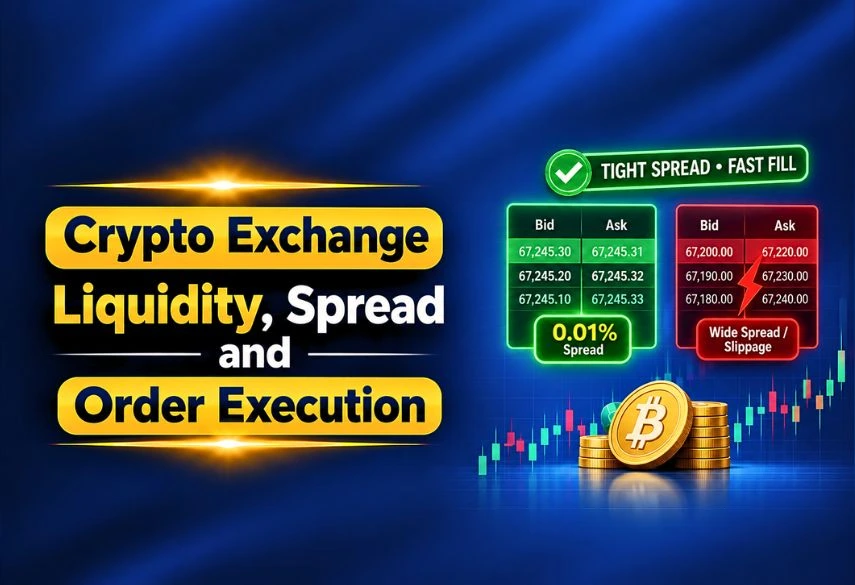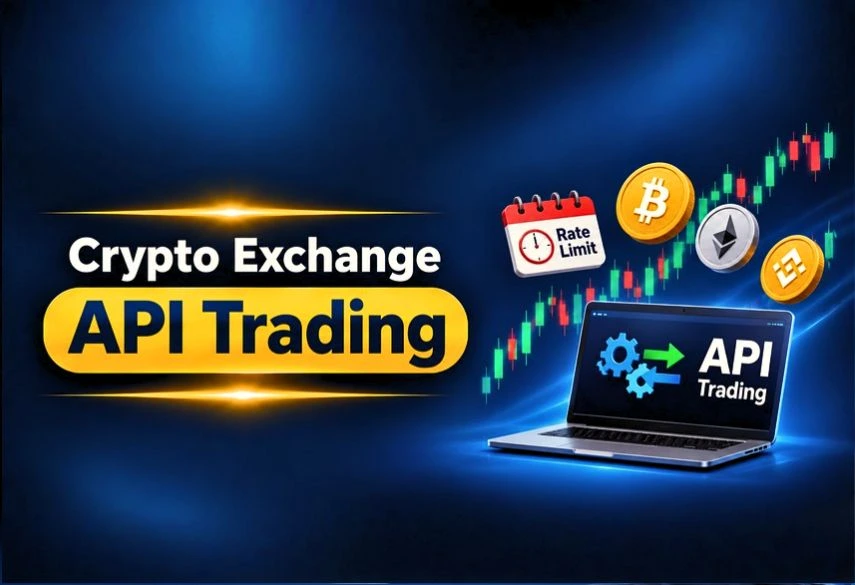
Crypto trading through APIs can make trading faster, more systematic, and easier to automate, but understanding fees, rate limits, and execution risks is essential before connecting a trading bot to an exchange. The best way to avoid unnecessary losses is to choose a reliable Crypto exchange API, understand its maker-taker fee structure, calculate trading costs before placing orders, respect API rate limits, and use proper risk controls.
Whether you are using the Binance API, Bybit API, or another Crypto trading API, this guide explains how everything works in simple language, including practical examples, comparison tables, and common mistakes beginners should avoid.
What Is a Crypto Exchange API?
A Crypto exchange API (Application Programming Interface) is a technology that allows traders, applications, and automated trading bots to communicate directly with a cryptocurrency exchange. Instead of manually opening an exchange website and placing orders, an API allows software to perform trading activities automatically.
For example, a trader can connect a trading bot to Binance using the Binance API. The bot can:
-
Fetch live cryptocurrency prices.
-
Monitor market movements.
-
Identify trading opportunities using predefined strategies.
-
Place buy and sell orders.
-
Check account balances and open positions.
-
Monitor order execution and trading history.
Similarly, the Bybit API provides access to market data, account information, and trading operations.
However, API trading is not completely free or risk-free. Exchanges charge trading fees, enforce API request limits, and may experience delays or execution problems during volatile market conditions.
How Does Crypto API Trading Work?
Crypto API trading works through communication between your trading software and the exchange's servers.
Here is a simple explanation of the process:
1. Create an API key: Generate an API key and secret from your cryptocurrency exchange account.
2. Connect your trading software: Enter the API credentials into your trading bot or application.
3. Access market data: Your software receives cryptocurrency prices, order book information, and trading data.
4. Generate trading signals: The bot analyses market conditions using your predefined strategy.
5. Place orders: The API sends buy or sell instructions to the exchange.
6. Track execution: Your application checks whether orders are completed, partially filled, or rejected.
For example, suppose Bitcoin is trading at $90,000. You configure a trading bot to buy Bitcoin whenever its price falls below $88,000.
When the price reaches your specified level, the Trading bot API sends an order request to the exchange. The exchange processes the request according to its trading rules and available liquidity.
Important: An API does not guarantee that an order will execute at your expected price. Actual execution depends on liquidity, market conditions, order type, and exchange response time.
Understanding Crypto Exchange API Fees
One of the most important factors in automated trading is understanding the Crypto exchange API fees. Many beginners assume that API trading has separate charges simply because they are using automated software.
In most cases, exchanges apply their normal trading fee structure to API orders. The fee depends on the trading product, account level, order execution type, and applicable promotions.
Let's understand the major fee categories:-
1. Maker and Taker Fees
Most cryptocurrency exchanges use a maker-taker fee structure.
Maker Fee: A maker order adds liquidity to the exchange's order book. For example, you place a limit buy order below the current market price, and it waits for another trader to match it.
Taker Fee: A taker order removes liquidity from the existing order book. Market orders generally fall into this category because they execute against available orders.
The difference between maker taker fees and crypto can directly affect your trading profitability.
For example, if you frequently use market orders, you may pay higher fees than a trader whose limit orders execute as maker orders. However, a limit order is not automatically a maker order. If it executes immediately, it can be classified as a taker order.
2. Binance Maker Taker Fees
Binance charges trading fees based on the account's VIP level, trading volume, and applicable discounts. According to Binance's published Spot fee schedule, the regular-user base rate is 0.10% for both maker and taker orders.
Using BNB for eligible fee payments can provide a discount.
3. Bybit Trading Fees
Bybit also follows a maker-taker fee structure. Its published standard VIP 0 rates for crypto-to-crypto Spot trading are 0.10% for both maker and taker orders. For perpetual and futures contracts, the published VIP 0 rates are different:
Maker fee: 0.020%
Taker fee: 0.055%
These rates may vary according to account level, region, and product.
Crypto Trading Fees Comparison
The following table compares published standard fee rates for selected trading products.
|
Exchange |
Trading Product |
Maker Fee |
Taker Fee |
|
Binance |
Spot |
0.10% |
0.10% |
|
Bybit |
Spot |
0.10% |
0.10% |
|
Bybit |
Perpetual/Futures |
0.020% |
0.055% |
4. How to Calculate Crypto API Trading Fees
Understanding API order fees crypto is important because even small charges can become significant when a bot executes hundreds of trades.
The basic formula is:
Trading Fee = Executed Order Value × Trading Fee Rate
Let's understand with an example.
Suppose:
- Trading capital used: $10,000
- Trading fee: 0.10%
- Order type: Market order
Calculation:
$10,000 × 0.10% = $10
You pay $10 when the order is executed.
If you later sell the same $10,000 position at the same value with another 0.10% fee, you pay another $10. Your total crypto trading fee becomes $20, excluding spread, slippage, and other applicable charges. This is why traders must calculate both entry and exit costs before evaluating a strategy.
Understanding Exchange API Rate Limits
Exchange API rate limits define how many requests your application can send to an exchange within a specific time period. These restrictions help exchanges maintain server stability and prevent excessive API traffic.
For example, your trading bot may continuously request Bitcoin prices, account balances, and order book updates.
If the application sends too many requests within a short period, the exchange may temporarily reject further requests. This is where Exchange API rate limits become important.
Binance API Rate Limit
Binance uses different limits for API requests, order placement, and other trading operations. According to its official Spot API documentation, request limits depend on endpoint weight and the applicable time interval.
For example:
-
API requests consume request weight.
-
Different endpoints may have different request weights.
-
Exceeding a limit can result in HTTP 429 errors.
-
Repeated violations without proper backoff can result in HTTP 418 IP bans.
The Binance API rate limit is not simply a fixed number of requests for every endpoint. You should check the current limits through the exchange information endpoint before deploying a trading application.
Bybit API Rate Limits
Bybit also applies rate limits based on the API endpoint and account UID. Its official documentation specifies a default HTTP IP limit of 600 requests within a five-second window. However, individual API endpoints have their own limits.
For example, its documented order-creation endpoint has different request limits depending on the product category and account type. If you exceed the permitted limit, you may receive the error code 10006, which indicates too many requests.
Bybit also provides response headers showing remaining request capacity and reset information.
Binance vs Bybit API Rate Limits
|
Parameter |
Binance |
Bybit |
|
Rate-limit method |
Request weight and order limits |
Endpoint and UID-based limits |
|
IP restrictions |
Yes |
Yes |
|
Order limits |
Yes |
Yes |
|
Error handling |
HTTP 429 and 418 |
Rate-limit error codes |
|
Monitoring |
Response headers |
Response headers |
|
Documentation |
Official Spot API Docs |
Official V5 API Docs |
Remember that rate limits can change. Never build a Trading bot API around assumed limits without checking the latest exchange documentation.
Major Execution Risks in Crypto API Trading
Even when your API connection works perfectly, your trading strategy can still lose money because of execution-related problems.
Here are five important risks:-
1. Slippage
Slippage occurs when your order executes at a different price than expected. Suppose Bitcoin is trading at $90,000, and your bot sends a market buy order. Due to limited liquidity or sudden market movement, the order may execute at $90,050. This difference increases your actual purchase cost. Slippage can become particularly high during major news events and sudden market movements.
2. API Latency
Latency refers to the delay between sending an API request and receiving a response or execution update.
For example, your bot identifies a buying opportunity at $90,000, but network delays cause the order to reach the exchange when Bitcoin is trading at $90,100.
Even a small delay can affect strategies that depend on precise entry and exit prices.
3. Partial Order Execution
Sometimes an exchange cannot immediately execute your entire order at one price.
For example, you place a market buy order for 5 BTC, but only 3 BTC are available at your preferred price.
The remaining quantity may execute at different prices. This can change your average entry price and increase trading costs.
4. API Connection Failure
A trading bot may lose connection because of network problems, server maintenance, or exchange downtime. This creates a serious risk if the application cannot monitor open positions or send exit orders. Your software should maintain connection monitoring and have a recovery mechanism.
5. Duplicate Orders
Suppose your bot sends an order request, but the exchange response gets delayed. The application assumes the request failed and sends another order. Both orders may eventually reach the exchange, creating an unwanted position. Use unique client order IDs, order-status verification, and reconciliation systems to reduce this risk.
Best Practices for Safe Crypto API Trading
Before using Crypto API trading with real money, follow these important precautions:
1. Use API permissions carefully: Enable only the permissions required for your trading activity. Avoid enabling withdrawals unless absolutely necessary.
2. Start with a test environment: Use supported testnet or demo environments to test your strategy before risking real capital.
3. Monitor trading fees: Include maker fees, taker fees, and other applicable costs in your strategy calculations.
4. Respect API limits: Use request queues, rate-limit monitoring, and exponential backoff when requests are rejected.
5. Use WebSocket connections: Where supported, WebSocket streams can provide real-time market updates without repeatedly polling REST endpoints.
6. Implement stop-loss controls: Your software should have a reliable risk-management process for open positions.
7. Secure API credentials: Never share your API secret or store credentials in publicly accessible code repositories.
A good trading system should also maintain logs of every order, execution, error, and account update.
How to Check Trading Fees Through an Exchange API
An interesting feature of modern exchanges is that developers can retrieve account-specific trading fee information programmatically. This is useful when you are building a trading bot that needs to calculate the actual cost of each trade.
For example, Bybit provides a V5 endpoint called ‘GET /v5/account/fee-rate’.
It allows supported applications to retrieve maker and taker fee rates for products such as Spot, Linear, Inverse, and Options.
Binance also provides account-related commission information through its API. This is useful for creating an Exchange fee structure API integration that calculates trading costs using the actual commission applicable to an account. Instead of hardcoding fee percentages into your software, retrieving current account-specific information can make your trading calculations more accurate.

Conclusion
Crypto exchange API trading offers an efficient way to automate cryptocurrency trading, access real-time market data, and execute strategies without manually placing every order. However, successful automation requires more than connecting a trading bot to Binance or Bybit.
You must understand Crypto exchange API fees, maker-taker charges, Exchange API rate limits, latency, slippage, and order execution risks. The most important lesson is simple: A profitable trading strategy must remain profitable even after accounting for trading fees and execution costs.
Start with small positions, test your application, monitor API activity, and establish proper risk-management rules before moving to live trading. Automation can improve execution discipline, but it cannot eliminate market risk.
(Sources:Binance Spot Trading Fees , Binance API Documentation, Binance API Rate Limits ,Binance API Commission Rates)

DISCLAIMER: This blog is NOT any buy or sell recommendation. No investment or trading advice is given. The content is only for educational purposes. Always discuss with your SEBI-registered financial advisor for investment-related decisions.
Follow this WhatsApp Channel for the latest updates directly on WhatsApp.