The simplest and most effective way to avoid the costly mistake of paying exit load in mutual funds is this: Always check the Scheme Information Document (SID) or Key Information Memorandum before investing, understand the exact exit load percentage and holding period, and stay invested beyond that period.
If your goal is short-term, choose funds with zero or very low exit load such as overnight funds or many liquid funds. This single habit can save you thousands of rupees and protect your returns over time.
Most beginner investors carefully look at past returns, expense ratios, and fund manager names. Very few pay attention to exit load. Yet this small-looking charge can quietly reduce the money you finally receive when you redeem units early. Exit load in mutual funds is one of the most common and expensive mistakes new investors make, especially when markets fall and panic sets in.
What is Exit Load in Mutual Funds?
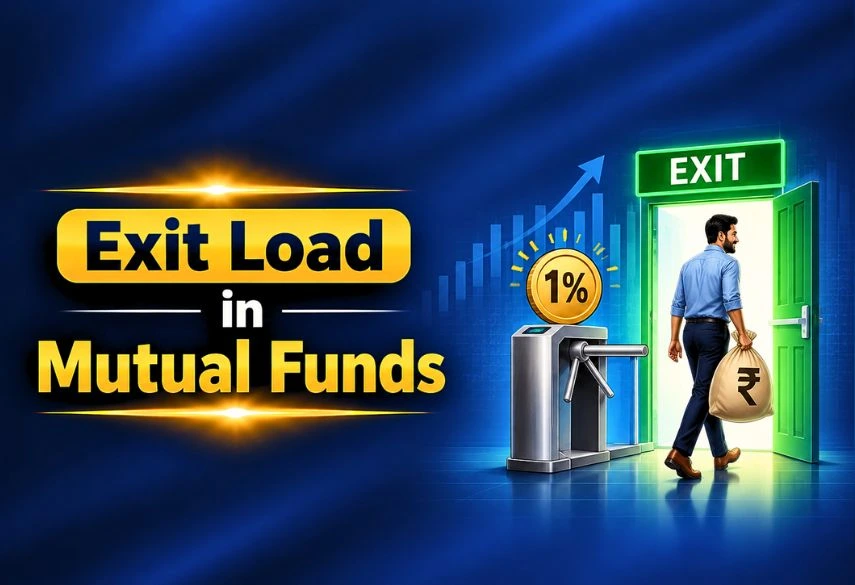
Exit load is a fee charged by the mutual fund house when an investor redeems (sells) units before a specified minimum holding period ends. It is usually shown as a percentage of the current redemption value.
For example, a fund may say: “1% exit load if redeemed within 12 months.” This means if you sell your units before completing one year, 1% of the amount you are withdrawing will be deducted.
The main purpose of exit load is to discourage short-term trading. Mutual funds pool money from many investors and invest it according to a specific strategy. When large numbers of people enter and exit frequently, the fund manager is forced to buy or sell securities at inconvenient times. This creates extra costs and can hurt the returns of investors who stay invested for the long term. Exit load acts as a gentle barrier against such frequent churning.
It is important to note that the money collected as exit load does not go into the pocket of the Asset Management Company (AMC). It is credited back to the scheme itself. This protects the remaining unitholders.

How is Exit Load Calculated?
The formula is simple:
Exit Load Amount = Redemption Value × Exit Load %
Net Amount Received = Redemption Value − Exit Load Amount
Redemption Value = Number of units sold × Applicable NAV on the redemption date.
Example 1: Lump Sum Investment
Suppose you invested ₹1,00,000 and received 1,000 units at a NAV of ₹100. After 8 months, the NAV rises to ₹120. You decide to redeem all units. The fund has a 1% exit load if redeemed within 1 year.
|
Fund Category |
Typical Exit Load |
Common Holding Period |
Remarks |
|
Equity Funds |
0.5% - 1% (sometimes up to 2%) |
6-12 months |
Most common structure |
|
Hybrid / Balanced Funds |
0.5% - 1% |
6-12 months |
Similar to equity |
|
Debt Funds |
0% - 1% |
7 days to 6-12 months |
Varies widely |
|
Liquid Funds |
Graded (0.0070% to 0.0045%) |
First 6-7 days only |
Very small charge |
|
Overnight Funds |
Nil |
No exit load |
Ideal for ultra-short term |
|
Index Funds & ETFs |
Usually Nil |
Often none |
Growing category with zero load |
|
ELSS (Tax Saver) Funds |
Nil |
3-year mandatory lock-in |
Cannot redeem early |
Even though your investment grew by ₹20,000, you still pay exit load on the full current value.
Example 2: SIP and the FIFO Rule
In Systematic Investment Plans (SIPs), each monthly instalment is treated as a separate investment. Each has its own holding period. When you redeem, mutual funds follow the First-In, First-Out (FIFO) method - older units are sold first.
Suppose you have been doing a monthly SIP for 14 months in a fund with 1% exit load within 12 months. If you redeem now:
Units bought more than 12 months ago → No exit load
Units bought within the last 12 months → 1% exit load applies
This is why partial redemptions in long-running SIPs can sometimes attract very little or no exit load.
Why Paying Exit Load Is a Costly Mistake
Paying exit load hurts investors in multiple ways:
1. Direct reduction in proceeds: You receive less money than the current value of your investment.
2. Charged on current value: If your investment has grown, the absolute rupee amount of exit load becomes larger.
3. Often paid at the wrong time: Many investors exit during market falls out of fear. Paying exit load at that moment makes the loss even bigger.
4. Compounding damage: Repeated early exits across different funds can cost a significant portion of long-term wealth.
SEBI has reduced the maximum permissible exit load from 5% to 3% under the Mutual Funds Regulations, 2026. This is a positive step for investors. However, most schemes already charged much lower rates (usually around 1%). The regulatory cap simply sets an upper limit.
How to Completely Avoid or Minimise Exit Load
Here are practical steps every investor can follow:
-
Read the SID carefully before investing. Look for the exact exit load percentage and the applicable period.
-
Match the fund with your time horizon. If you may need the money within 1 year, avoid equity funds that charge exit load for 12 months.
-
Prefer zero-exit-load options for short-term goals: Overnight funds, many liquid funds, and a large number of index funds.
Stay invested beyond the exit load period. Discipline is the cheapest way to avoid this charge.
Use FIFO wisely in SIPs. When redeeming partially, older units come out first and may already be free of exit load.
-
Avoid panic selling. Market corrections are normal. Selling early often means paying exit load + booking losses at the same time.
-
Check for free redemption limits. Some schemes allow a small percentage of units (for example 10%) to be redeemed without exit load even within the period.
Exit Load vs Lock-in Period - Clear Difference
Many beginners confuse the two terms:-
-
Lock-in period (example: ELSS funds) means you cannot redeem at all for a fixed number of years (usually 3 years).
-
Exit load means you can redeem, but you will pay a fee if you do so before the specified period.
One restricts your ability to exit; the other allows exit but at a cost.
Practical Tips Before You Redeem
Before clicking the redeem button, ask yourself these questions:
1. Have I completed the exit load period for the units I am selling?
2. Is there a better way to meet my cash needs without redeeming this fund?
3. Am I selling because of a genuine need or because of temporary market fear?
4. Have I checked the latest exit load structure of this specific scheme?
Taking two minutes to answer these questions can save real money.

Conclusion
Exit load in mutual funds is not designed to punish investors. It is a tool to encourage long-term behaviour and protect the interests of those who stay invested. However, for investors who do not understand it or ignore it, exit load becomes a costly and completely avoidable mistake.
The solution is straightforward: Know the rules before you invest, choose funds that match your time horizon, and stay invested beyond the exit load window whenever possible. When treating exit load with the same seriousness as returns and expense ratio, you keep more of money working and allow the power of compounding to do its job properly.
(Sources: Financialexpress, Kotakneo ,Moneycontrol , Indmoney)

DISCLAIMER: This blog is NOT any buy or sell recommendation. No investment or trading advice is given. The content is only for educational purposes. Always discuss with your SEBI-registered financial advisor for investment-related decisions.
Follow this WhatsApp Channel for the latest updates directly on WhatsApp.