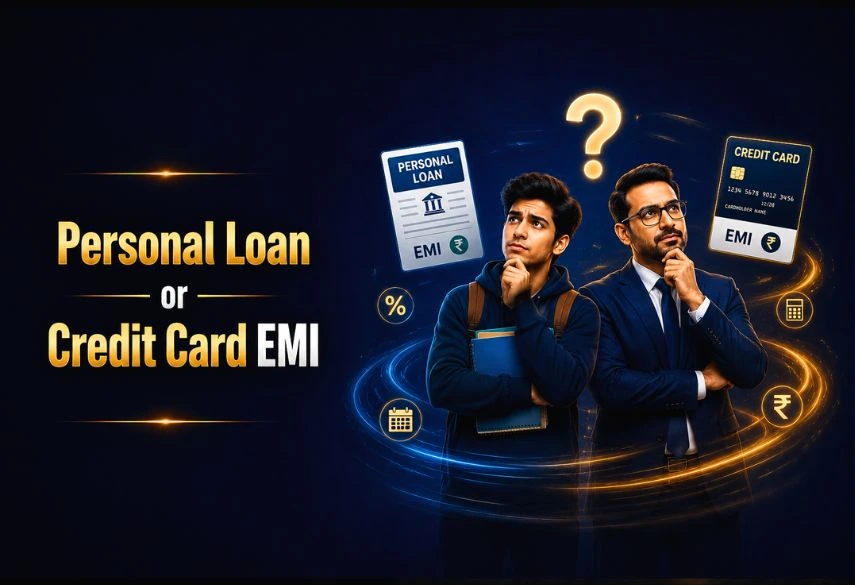
A personal loan is almost always cheaper than a credit card EMI for amounts above ₹50,000 or tenures longer than 6 months. Personal loan interest rates typically range from 10–16% for good credit scores, while credit card EMI conversion rates usually sit at 12–24% (and higher effective costs after fees and GST). Only genuine no-cost EMI offers, or very small, short-term needs, make credit card EMI the better pick.
Ravi's ₹1.2 Lakh Lesson
Ravi needed a new laptop and some home repairs. The total came to about ₹1.2 lakh. At the store and online, the "Convert to EMI" button glowed invitingly. He almost clicked it. Then a friend asked a simple question: "Have you checked how much extra interest you'll actually pay?"
That question changed everything. Ravi compared a personal loan offer against the credit card EMI option, and the difference shocked him. Over 12 months, the personal loan saved him several thousand rupees — and kept his credit card free for everyday use and emergencies.
This is the exact choice thousands of people face when deciding between a personal loan and credit card EMI. But Ravi is a salaried professional with a stable income and a decent credit score — the calculation looks quite different if you're a student without income proof, or a business owner whose income moves in cycles. That's what the rest of this guide covers.
Personal Loan or Credit Card EMI Confusion
Both options let you pay in monthly instalments. Both feel convenient. But the cost structure is very different. Credit card EMI is instant and needs almost no paperwork if you already hold a card. A personal loan needs a short application and verification, yet it usually costs less overall.
Most comparisons stop at the math. What they miss is that a student, a salaried employee, and a business owner don't have the same access to these products, the same paperwork, or the same risks — so "which is cheaper" really needs a "cheaper for whom" attached to it.
Personal Loan or Credit Card EMI: Key Differences
|
Factor |
Personal Loan |
Credit Card EMI |
|
Interest Rate |
10.5%–16% p.a. (banks) |
12%–24% p.a. (often higher effective, after fees) |
|
Typical Tenure |
12–60 months |
3–24 months |
|
Loan Amount |
Based on income & eligibility |
Limited to your available card limit |
|
Who Qualifies |
Salaried or self-employed with income proof; students usually need a co-applicant |
Anyone with an active card and enough limit — including student/add-on cards |
|
Documents Needed |
ID/address proof, income proof, bank statements, ITR (self-employed) |
Usually none — you're already a cardholder |
|
Credit Score Needed |
700+ for the best rates |
Not separately checked for EMI conversion; your card's existing limit is the real gate |
|
Fresh Credit Enquiry |
Yes, a hard enquiry (can dip your score slightly) |
No, for converting an existing card transaction |
|
Processing Fee |
0.5%–3% of loan amount |
₹199–₹999 flat, or 1–2%, plus GST |
|
Credit Limit Impact |
None |
Blocks that amount from your available limit |
|
Disbursement |
1–3 days (instant for pre-approved offers) |
Instant |
|
Best Suited For |
Larger amounts, longer tenures, salaried/self-employed borrowers |
Small purchases, short tenures, genuine 0% offers, urgent needs |
The Real Cost — A Worked Example
Take a practical example: ₹1,00,000 needed for 12 months.
- Personal loan at ~12.5%: total interest around ₹6,700–₹7,000, plus a processing fee. Overall cost stays lower.
- Credit card EMI at ~16%: total interest around ₹8,700, plus a processing fee and GST on the interest. The gap widens further with higher amounts or longer tenures.
For ₹2 lakh over 12–24 months, the savings with a personal loan often reach ₹10,000–₹17,000 or more, depending on the exact rates quoted to you.
For Students: Personal Loan or Credit Card EMI?
Priya is in her second year of college. Her laptop died right before a project deadline, and a replacement costs ₹45,000. She doesn't have a salary — so what are her real options?
Personal loan as a student: most banks want proof of regular income before approving a personal loan, and a full-time student usually doesn't have that. A few NBFCs and fintech lenders do offer small-ticket "student loans," but they almost always need a parent or guardian to co-sign as a guarantor, and the rate tends to run higher because the lender is taking on more risk. If the expense is course-related — tuition, certification, a laptop required for the program — it's also worth checking whether an actual education loan fits better. That's a different product, with its own rules and often a repayment moratorium until after graduation.
Credit card EMI as a student: if Priya has a student credit card, or is an add-on/supplementary cardholder on a parent's account, EMI conversion is usually more accessible — no fresh paperwork, no guarantor, and it's instant. The catch is that student cards typically have lower limits, so this only works for smaller amounts, and the effective interest rate is still higher than that of a personal loan.
The upside worth knowing: used carefully — small amounts, paid on time — credit card EMI can be one of the first ways a student builds a credit history. That history matters later, when Priya applies for her first personal loan, car loan, or a credit card with a real limit after she starts earning.
Rule of thumb for students: for a small, one-off expense like Priya's laptop, a credit card EMI (ideally a genuine no-cost offer) is usually the practical choice. For anything larger or education-related, it's worth asking a parent to either co-apply for a personal loan or look into an education loan before defaulting to EMI.
For Business Owners & Self-Employed: Personal Loan or Credit Card EMI?
Arjun runs a small design studio. He needs ₹1.5 lakh for new equipment, and separately, he sometimes has a 45–60 day gap between paying vendors and getting paid by clients. Two different problems — and they don't necessarily have the same answer.
Personal loan as a self-employed borrower: banks will ask for more than they'd ask a salaried applicant — typically 2–3 years of ITR, bank statements (business and personal), and proof the business exists (registration, GST filings, and so on). Approval can take a little longer, and rates are sometimes marginally higher than for salaried borrowers, since self-employed income is seen as less predictable. Still, for a one-time, larger expense like Arjun's equipment purchase, a personal loan usually beats credit card EMI on total cost — exactly as it would for a salaried borrower.
Credit card EMI as a business owner: for the equipment purchase, EMI is tempting because it's instant — but it permanently ties up part of Arjun's credit limit until the EMI is paid off. If he also relies on that card for routine business expenses or as a buffer during slow-paying months, blocking a chunk of it can hurt more than the extra interest does. For the short-term cash-flow gap, EMI (or simply carrying a balance) feels convenient, but the interest adds up fast if it turns into a recurring pattern instead of a one-time bridge.
Worth comparing before either option: business owners often have access to products this comparison doesn't cover — a business loan, an overdraft (OD) facility against current account balances, or a loan against property. For working-capital gaps specifically, these can work out cheaper than either a personal loan or credit card EMI, so it's worth asking your bank what's available before assuming the choice is only between these two.
A quick note on tax: interest on funds genuinely used for business purposes may be treated differently for tax purposes than interest on a personal loan used for personal expenses, but the specifics depend on how the loan is structured and documented. This isn't tax advice — check with a chartered accountant before assuming any interest is deductible.
Rule of thumb for business owners: one-time, larger business expenses usually favour a personal or business loan. Short, recurring cash-flow gaps are worth solving with an overdraft or working-capital line if you can get one, rather than defaulting to card EMI every time.

When Credit Card EMI Can Be the Better Choice
Credit card EMI wins in specific cases, whoever you are:
- Genuine no-cost EMI (0% interest) on partner merchants, where no major discount is sacrificed and processing fees are low or waived.
- Very small amounts (under ₹30,000–₹50,000) for 3–6 months.
- You need the money immediately and can't wait even a day or two.
- Your credit score isn't strong enough yet for a competitive personal loan rate.
Even then, check the fine print. Many "no-cost" offers hide the interest in the product price, or still charge GST and processing fees.
When a Personal Loan Is Clearly Cheaper
Choose a personal loan if:
- The amount is ₹50,000 or more.
- You need 12 months or longer to repay.
- You want lower total interest and fixed, predictable EMIs.
- You'd rather keep your credit card limit free (high utilisation can hurt your credit score).
- You're consolidating existing high-interest debt.
Personal loans also offer longer tenure options, which lowers the monthly EMI and makes budgeting easier.
Other Important Factors
Credit utilisation: converting a large purchase to credit card EMI blocks that amount from your available limit. If you use the card for daily spends too, utilisation rises and can temporarily lower your credit score.
Flexibility: personal loans often allow prepayment (sometimes with a small charge). Credit card EMIs may have foreclosure fees too, but rules vary by bank.
Speed vs cost: credit card EMI is faster. Personal loans from banks or NBFCs with pre-approved offers can also be quick now, often within a day — though instant-approval loan apps aren't automatically cheap. Some charge rates close to, or higher than, credit card EMI, so compare the actual rate, not just the speed.
Hidden costs: always calculate total interest + processing fee + GST. Don't look only at the monthly EMI figure. Use free EMI calculators from bank websites for accurate numbers.
Documents & Eligibility Checklist
Salaried applicant (personal loan):
- PAN, Aadhaar
- Last 3 months' salary slips
- Last 6 months' bank statement
- Form 16 or latest ITR
Self-employed / business owner (personal loan):
- PAN, Aadhaar
- last 2–3 years' ITR
- Business proof (registration/GST)
- last 6–12 months' bank statements (business and personal)
Student (personal loan):
- Co-applicant (parent/guardian) with their own income proof
- Some lenders offer small-ticket loans
- An education-specific loan product may fit better.
Anyone (credit card EMI):
Typically no fresh documents — your existing card and available limit are what matter.
How to Decide, Step by Step
- Calculate the total amount you need and how long you can comfortably repay it.
- Identify which category you fall into — salaried, self-employed, or student without income — since that decides which products you can even apply for.
- Check current personal loan offers, especially pre-approved ones from your own bank.
- Check the exact interest rate, processing fee, and GST on your credit card EMI conversion.
- Compare the total amount you'll pay in both cases, not just the monthly figure.
- Pick the lower total-cost option that fits your cash flow and that you actually qualify for.

Conclusion
Borrowing is sometimes necessary. Paying more interest than required isn't. The next time you're facing a big expense — whether you're a student like Priya, a business owner like Arjun, or a salaried professional like Ravi — pause before hitting "Convert to EMI." Run the numbers for a personal loan first, and check what you actually qualify for. You may find, like Ravi did, that the slightly longer process saves real money and keeps your finances healthier.
Sources: (Livemintmoney, IDFC First Bank, GoodReturns, Bajaj Finserv Market)

DISCLAIMER: This blog is NOT any buy or sell recommendation. No investment or trading advice is given. The content is only for educational purposes. Always discuss with your SEBI-registered financial advisor for investment-related decisions.