An equity mutual fund is an investment scheme that pools money from multiple investors and primarily invests it in shares of companies. The portfolio is managed by a professional fund manager, allowing investors to participate in the stock market without selecting and monitoring individual stocks themselves.
These funds are commonly used for long-term financial goals such as retirement planning, children’s education, buying a home, or building wealth. However, because their value depends on stock-market performance, they can rise or fall and do not provide guaranteed returns.
In this blog, we will cover the equity fund meaning, its different categories, costs, taxation, and risks to help you decide whether it fits your investment objectives.
What Is an Equity Mutual Fund?
An equity mutual fund collects money from many investors and invests that pooled amount across shares of different companies.
When you invest in the fund, you receive units. The value of each unit is represented by the fund’s Net Asset Value, commonly known as NAV. The NAV changes according to the market value of the investments held by the scheme.
For example, imagine that a mutual fund invests in 40 companies across banking, technology, healthcare, manufacturing and consumer goods. Instead of buying shares in all 40 companies individually, you can invest in the fund and receive exposure to the entire portfolio.

A professional fund manager and research team decide:
- Which companies to invest in
- How much to allocate to each company
- When to buy or sell a stock
- How to manage the portfolio’s risk
- Whether the portfolio needs rebalancing.
This professional management makes equity schemes accessible to people who may not have the time, knowledge, or resources to research individual companies.
However, professional management does not remove market risk. The value of your investment may still decline when stock prices fall.
How Does an Equity Mutual Fund Work?
The process begins when an asset management company launches a mutual fund scheme. Investors contribute money to the scheme, and the fund manager invests the collected amount according to the investment objective mentioned in the scheme documents.
Here is how the process generally works:
1. You choose a mutual fund scheme
You select a fund based on your goal, investment horizon, and ability to tolerate market fluctuations. The scheme may focus on large companies, smaller businesses, a particular sector, or a broad market index.
2. You invest through SIP or lump sum
You can invest a fixed amount regularly through a Systematic Investment Plan or invest a larger amount at one time.
Minimum investment requirements vary across schemes and asset management companies.
3. You receive mutual fund units
Your investment purchases units based on the applicable NAV and cut-off rules. For instance, investing ₹10,000 at an applicable NAV of ₹50 would generally provide 200 units, excluding any applicable charges or adjustments.
4. The fund invests in securities
The fund manager allocates the pooled money to shares and other permitted instruments according to the scheme’s stated mandate.
5. Your investment value changes
If the portfolio’s market value increases, the NAV may rise. If the portfolio loses value, the NAV may decline.
Your current investment value can broadly be calculated as:
Number of units × Current NAV
6. You can redeem your investment
Most open-ended equity funds allow redemption on business days. However, an exit load may apply when units are redeemed within a specified period.
ELSS investments have a mandatory three-year lock-in, during which the units cannot normally be redeemed.
Equity Fund Meaning and Regulatory Classification
An equity fund primarily invests in equities and equity-related instruments. However, it is inaccurate to assume that every equity category follows the same minimum equity allocation.
SEBI’s February 2026 categorisation framework specifies different minimum allocations for different categories. For example, large-cap, focused, sectoral, thematic and ELSS funds require at least 80% allocation to their specified equity mandate, while mid-cap, small-cap and flexi-cap funds require at least 65%.
The regulatory classification of a scheme and its classification for taxation should not be treated as exactly the same concept.
For Indian tax purposes, an equity-oriented fund generally needs to meet the prescribed domestic equity exposure conditions under the Income-tax Act.
Main Types of Equity Funds
Equity mutual funds are divided into categories according to the size of companies they invest in, their investing style, and their portfolio strategy.
|
Fund category |
Main investment requirement |
Relative risk |
Suitable investment horizon |
|
Large-cap fund |
Minimum 80% in large-cap companies |
Lower than mid- and small-cap funds, but still market-linked |
Usually 5 years or longer |
|
Mid-cap fund |
Minimum 65% in mid-cap companies |
High |
Usually 7 years or longer |
|
Small-cap fund |
Minimum 65% in small-cap companies |
Very high |
Usually 7–10 years or longer |
|
Large and mid-cap fund |
Minimum 35% each in large- and mid-cap companies |
High |
Usually 5–7 years or longer |
|
Multi-cap fund |
Minimum 25% each in large-, mid- and small-cap companies |
High |
Usually 7 years or longer |
|
Flexi-cap fund |
Minimum 65% in equities, with flexibility across market caps |
Depends on portfolio allocation |
Usually 5–7 years or longer |
|
Focused fund |
At least 80% in equities, with a maximum of 30 stocks |
High concentration risk |
Usually 5–7 years or longer |
|
Sectoral fund |
Minimum 80% in a particular sector |
Very high |
Depends on the sector cycle |
|
Thematic fund |
Minimum 80% in a specified investment theme |
Very high |
Long-term, with high risk tolerance |
|
ELSS fund |
Minimum 80% in equities with a three-year lock-in |
High |
Usually 5 years or longer |
These allocations are based on SEBI’s February 2026 categorisation framework.
Large-Cap Funds
Large-cap funds invest mainly in established companies with relatively high market capitalisation.
These businesses may have stronger financial resources, established operations and better access to capital than smaller companies. Large-cap funds may therefore experience less volatility than mid- or small-cap schemes.
However, “less volatile” does not mean risk-free. Large companies can also experience business problems, valuation corrections and significant falls during weak market conditions.
Mid-Cap Funds
Mid-cap funds invest primarily in companies positioned between large and small businesses in terms of market capitalisation.
These companies may offer strong expansion potential, but they can also be more sensitive to economic slowdowns, funding pressures and changes in investor sentiment.
Mid-cap funds may suit investors who have a longer investment horizon and can tolerate significant short-term fluctuations.
Small-Cap Funds
Small-cap funds invest mainly in companies ranked below the large- and mid-cap segments.
Some small businesses may grow rapidly, but they may also have limited financial resources, lower liquidity, and less predictable earnings. Consequently, small-cap funds can experience sharp gains as well as deep declines.
They are generally unsuitable for short-term goals or investors who may panic during market corrections.
Multi-Cap Funds
Multi-cap funds maintain exposure across large-cap, mid-cap and small-cap companies.
Under the current categorisation framework, they must invest at least 25% each in large-, mid- and small-cap companies.
This structure offers diversification across company sizes but also creates meaningful exposure to the volatility of mid- and small-cap stocks.
Flexi-Cap Funds
A flexi-cap fund can dynamically allocate money across large-, mid- and small-cap companies.
The fund manager may increase large-cap exposure during uncertain conditions or allocate more to mid- and small-cap businesses when attractive opportunities are available.
This flexibility can be useful, but the results still depend on the fund manager’s investment decisions and portfolio strategy.
Sectoral and Thematic Funds
Sectoral funds invest in one industry, such as banking, healthcare, technology or infrastructure.
Thematic funds invest around a broader theme that may include companies from multiple sectors. Examples could include consumption, manufacturing or digital transformation.
These schemes have high concentration risk. A downturn in the selected sector or theme can affect much of the portfolio simultaneously.
ELSS Tax-Saver Funds
An Equity Linked Savings Scheme, or ELSS fund, is an equity scheme with a mandatory three-year lock-in.
Eligible investments may qualify for a deduction under Section 80C when an investor chooses and qualifies under the old tax regime. The combined Section 80C deduction limit is subject to the applicable tax provisions and includes other eligible investments as well.
The Section 80C deduction is generally not available under the new tax regime. An investor should therefore not select an ELSS fund solely because it is described as a tax-saving product.

Benefits of Investing in Equity Mutual Funds
Professional portfolio management
Fund managers and research teams study financial statements, business models, industries, valuations and economic conditions before making portfolio decisions.
This saves investors from researching and managing every stock individually.
Diversification
An equity scheme may hold shares of several companies across different sectors.
Diversification reduces dependence on the performance of a single company. It cannot eliminate market risk, but it may reduce the impact of one investment performing poorly.
Accessibility
Many schemes allow investors to begin with relatively small amounts through a SIP.
This makes stock-market participation accessible to people who may not have enough capital to build a diversified share portfolio independently.
Convenience
Investors can purchase, monitor and redeem mutual fund units through an asset management company, registrar or authorised investment platform.
Account statements, portfolio disclosures and transaction records are also generally available online.
Liquidity
Most open-ended schemes can be redeemed on business days, subject to applicable rules and exit loads.
ELSS funds are an important exception because each investment remains locked in for three years.
Potential for long-term capital growth
Equity investments provide participation in the growth of underlying businesses.
Over an appropriate period, successful companies may increase their revenue, earnings and market value. However, this growth is not guaranteed, and equity returns can remain weak or negative for extended periods.
Investment discipline through SIPs
A SIP allows you to invest a fixed amount at regular intervals.
Regular investing can reduce the pressure of selecting a perfect entry date. When NAV is lower, the same amount purchases more units; when NAV is higher, it purchases fewer units.
This is commonly called rupee-cost averaging. It does not guarantee profits or protect against losses, but it can support disciplined investing.
Risks of Equity Mutual Funds
Every investor should understand the risks before investing.
Market risk
The NAV may decline because of economic conditions, interest-rate changes, corporate earnings, geopolitical events or broader market corrections.
Volatility risk
Equity prices can move significantly over short periods. Mid-cap and small-cap portfolios may experience especially sharp fluctuations.
Concentration risk
Focused, sectoral and thematic funds may hold a concentrated portfolio. Poor performance in a few companies, one sector or one theme may have a major effect on returns.
Fund-manager risk
Actively managed funds depend partly on the fund manager’s decisions. Incorrect stock selection, market timing or portfolio allocation may lead to underperformance.
Liquidity risk
Some smaller-company stocks may have limited trading activity. During difficult market conditions, selling such positions at a reasonable price may become harder.
Behavioural risk
Investors often buy after markets have risen and sell after a fall. These emotional decisions may damage long-term returns.
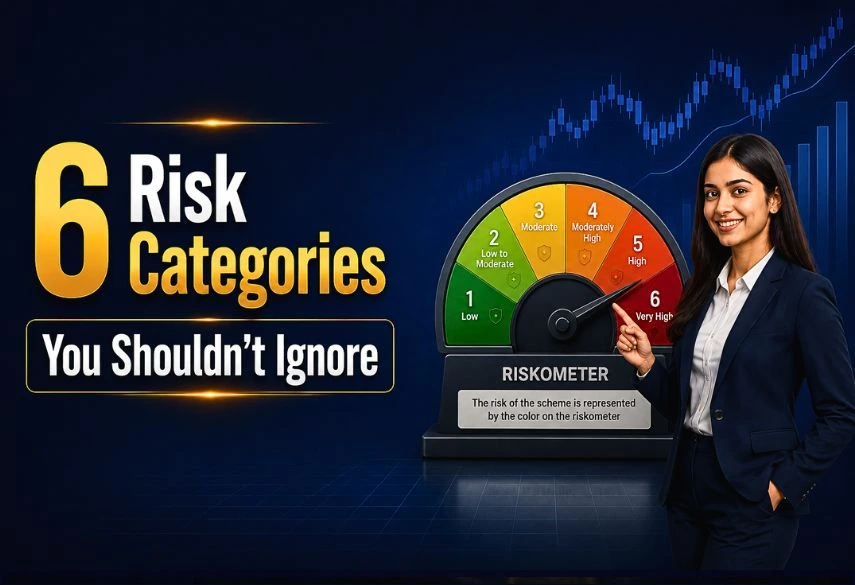
Risk should be evaluated through the scheme’s latest Riskometer, portfolio disclosures, investment mandate and your financial circumstances.
Costs Associated With Equity Mutual Funds
Expense ratio
The expense ratio represents the recurring expenses charged to a scheme for managing and operating the fund.
These expenses are reflected in the NAV. A higher expense ratio can reduce the investor’s net return over time, particularly when held for many years.
Compare expense ratios only among funds with similar objectives and strategies. A low-cost fund is not automatically suitable, and a higher-cost fund is not automatically better.
Exit load
An exit load is a charge that may apply when units are redeemed within a specified period.
The amount and applicable holding period vary from one scheme to another. Review the latest scheme information document before investing.
Securities Transaction Tax and other charges
Applicable taxes or transaction-related charges may be deducted when units are purchased or redeemed, depending on the product and transaction.
Check the latest account statement and scheme documents for the exact treatment.
Direct Plan vs Regular Plan
Most mutual fund schemes offer direct and regular plans.
Direct plan
A direct plan is purchased directly from the asset management company or through a platform offering direct mutual funds.
It generally has a lower expense ratio because distributor commission is not included.
Regular plan
A regular plan is purchased through a mutual fund distributor or intermediary.
Its expense ratio is generally higher because distribution-related expenses and commissions may be included.
AMFI states that the base expense ratio of a direct plan should be lower because it excludes distribution expenses and commissions.
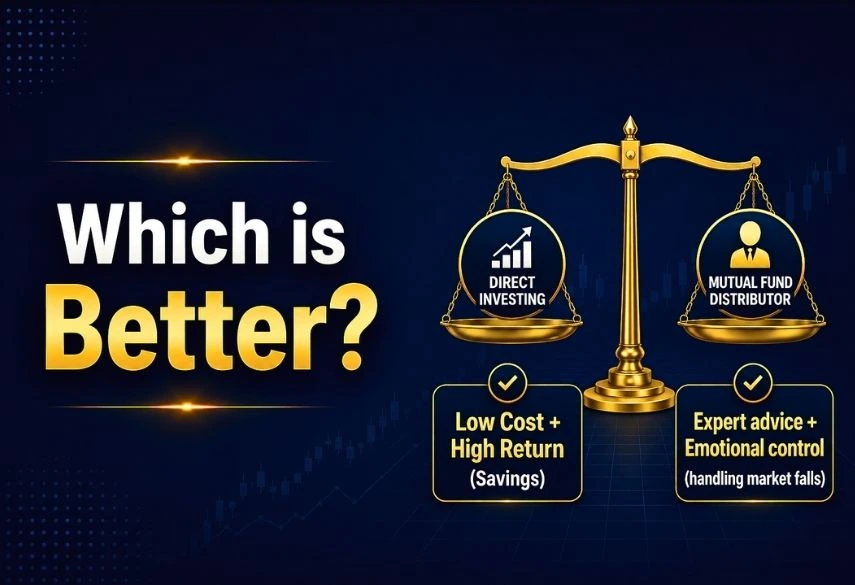
A direct plan may suit investors who can independently select, monitor, and rebalance their investments. A regular plan may be more appropriate for investors who need professional assistance, provided they understand the associated costs and possible conflicts of interest.
Growth Option vs IDCW Option
Growth option
Under the growth option, profits remain invested in the scheme. They are reflected in the NAV and can contribute to compounding over time.
This option may be more suitable for long-term wealth accumulation.
IDCW option
Under the Income Distribution cum Capital Withdrawal option, the scheme may distribute an amount when declared.
Such a distribution is not assured. It may come from distributable surplus and can reduce the NAV by a corresponding amount.
IDCW should not be treated as guaranteed interest or additional return.
Equity Fund Taxation in India
Tax treatment depends on the type of scheme, holding period, transaction date, Securities Transaction Tax conditions and the investor’s circumstances.
For eligible equity-oriented mutual funds, units held for up to 12 months are generally treated as short-term capital assets. Units held for more than 12 months are generally treated as long-term capital assets.
|
Type of gain |
Holding period |
Applicable tax treatment |
|
Short-term capital gain |
12 months or less |
20%, plus applicable surcharge and cess |
|
Long-term capital gain |
More than 12 months |
Gains exceeding ₹1.25 lakh in a financial year are taxed at 12.5%, plus applicable surcharge and cess |
These rates apply to qualifying transfers on or after 23 July 2024. The ₹1.25 lakh threshold applies to eligible aggregate long-term gains covered by Section 112A, rather than separately to each mutual fund scheme.
Short-term capital gains example
Suppose you invest ₹1,00,000 in an eligible equity-oriented fund and redeem it after ten months for ₹1,20,000.
Your short-term capital gain would be:
₹1,20,000 − ₹1,00,000 = ₹20,000
The applicable tax at 20% would be ₹4,000, before surcharge and cess and subject to the applicable tax rules.
Long-term capital gains example
Suppose your total eligible long-term capital gains covered under Section 112A during a financial year are ₹2,00,000.
The first ₹1,25,000 would fall within the annual threshold.
The taxable amount would be:
₹2,00,000 − ₹1,25,000 = ₹75,000
Tax at 12.5% would be ₹9,375, before applicable surcharge and cess.
Taxation of IDCW
IDCW received from a mutual fund is generally added to the investor’s taxable income and taxed according to the applicable slab rate.
Tax provisions can change. Verify the latest rules and consult a qualified tax professional before acting on taxation information.
SIP vs Lump-Sum Investment
A SIP and lump-sum investment are methods of investing, not separate fund categories.
SIP may suit you when:
- You receive a regular monthly income
- You want to build investing discipline
- You do not want to time the market
- Your financial goal is several years away
- You prefer investing smaller amounts regularly.
Lump sum may suit you when:
- You already have a large amount available
- Your investment horizon is long
- You can tolerate short-term volatility
- The money is not required for an immediate goal
- The investment matches your overall asset allocation.
A lump-sum investment should not be made merely because the market has recently risen or fallen. Your decision should be based on your financial plan rather than a short-term prediction.
Choose the Right Equity Mutual Fund
Do not choose a scheme solely because it delivered the highest return in the previous year.
Use the following process:
Define your financial goal
Specify why you are investing and how much money you may need.
A retirement goal 20 years away requires a different approach from a house purchase planned in three years.
Confirm your investment horizon
Equity schemes are generally unsuitable for money required in the near future.
The more volatile the category, the longer the period you may need to remain invested.
Assess your risk capacity
Risk tolerance describes how comfortable you feel with losses. Risk capacity describes how much financial loss you can actually afford.
Both factors matter.
Select the appropriate category
A first-time investor may prefer a diversified category rather than immediately selecting a concentrated sectoral, thematic or small-cap fund.
The correct choice depends on the investor, not on which category is currently popular.
Compare the fund with the correct benchmark
Evaluate whether the scheme has performed consistently against its relevant benchmark and category peers across multiple market periods.
One-year returns provide limited information.
Review rolling returns
Rolling returns show performance across multiple overlapping periods. They may provide a broader view of consistency than a single point-to-point return.
Evaluate risk-adjusted performance
Do not compare funds based only on returns. Consider volatility, drawdowns and how the fund performed during weak markets.
Check portfolio quality and overlap
Review major holdings, sector allocation and overlap with other funds you already own.
Holding several funds with similar portfolios may create an illusion of diversification.
Check expense ratio and exit load
Higher costs can reduce long-term net returns. Compare costs within the same category and plan type.
Read the scheme documents
Review the Scheme Information Document, Key Information Memorandum, factsheet, portfolio disclosure and Riskometer before investing.
Who May Consider Equity Mutual Funds?
An equity mutual fund may be considered by investors who:
- Have a medium- or long-term financial goal
- Can tolerate temporary declines in value
- Want exposure to company shares
- Prefer professional portfolio management
- Are prepared to invest consistently
- Have an emergency fund and adequate insurance
- Understand that returns are not guaranteed.
Who Should Avoid or Delay Investing?
Equity schemes may not be suitable when:
- The money is needed within the next few years
- You cannot tolerate a temporary decline
- You do not have emergency savings
- You have high-interest debt that needs attention
- You expect fixed or guaranteed returns
- You are investing only because of recent market performance
- You do not understand the fund’s strategy or risks.
Common Mistakes to Avoid
Chasing recent returns
The previous year’s best-performing category may not remain the best performer.
Investing without a goal
Without a defined goal and timeline, it becomes difficult to choose the appropriate fund or know when to redeem.
Owning too many funds
More schemes do not always create better diversification. Several funds may hold the same companies.
Ignoring expenses
Small differences in annual expenses can have a meaningful long-term effect.
Stopping SIPs during market declines
Stopping solely because the market has fallen may turn a temporary decline into a poor investment decision.
Expecting guaranteed returns
Equity mutual funds are market-linked products. They cannot assure a fixed return or protection of capital.
Reviewing the portfolio too frequently
Checking the NAV every day may encourage emotional decisions. Review the investment periodically or when your goals and financial circumstances change.

Conclusion
Understanding what an equity mutual fund is the first step towards making an informed market-linked investment decision.
An equity scheme gives investors access to a professionally managed and diversified stock portfolio. Different types of equity funds serve different objectives, but all equity categories involve market risk.
Before investing, evaluate your financial goal, risk capacity and time horizon. Compare the scheme’s strategy, benchmark, expenses, portfolio, Riskometer and consistency instead of choosing it only because of recent returns.
Starting early and investing regularly can support long-term wealth creation, but discipline does not remove risk. Invest only after understanding the product and how it fits into your broader financial plan.
(Sources: Aditya Birla Capital, Business Insider, Canara HSBC Life, Value Search Online, Business Today)

DISCLAIMER: This blog is NOT any buy or sell recommendation. No investment or trading advice is given. The content is only for educational purposes. Always discuss with your SEBI-registered financial advisor for investment-related decisions.









.webp)