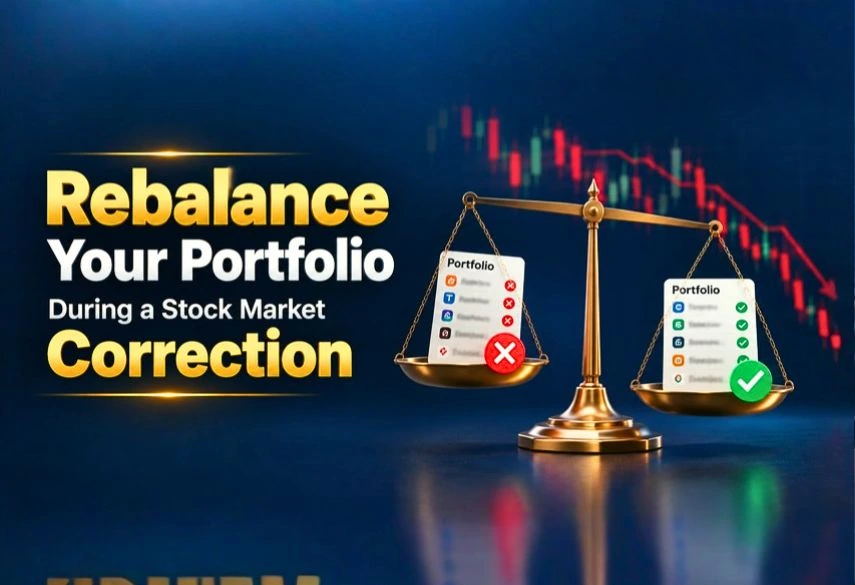
When the stock market falls sharply, your portfolio can move away from the asset allocation you originally chose. Rebalancing means bringing your investments back toward that target allocation by directing new contributions to underweight assets or, when appropriate, selling overweight assets and buying underweight ones.
For example, if your target is 60% stocks and 40% bonds but falling stock prices push your portfolio to roughly 52% stocks and 48% bonds, rebalancing can restore the risk level you originally intended.
The objective isn't to predict when the market will bottom. It's to follow a predetermined portfolio management process rather than making investment decisions based on short-term market movements.
What Is Portfolio Rebalancing?
Portfolio rebalancing is the process of adjusting your investments when their current weights move away from your target asset allocation.
Suppose your long-term target is:
- 60% stocks
- 40% bonds
Over time, market movements will change those percentages. If stocks decline while bonds remain relatively stable, stocks may represent a smaller percentage of your portfolio. Rebalancing brings the portfolio closer to its original target.

This matters because asset allocation determines a significant part of the risk you take. If your allocation drifts substantially, you may end up taking either more or less investment risk than you intended.
Should You Rebalance During a Market Correction?
A market correction is commonly defined as a decline of at least 10% from a recent market high. However, a correction itself does not automatically mean you should rebalance.
The better question is:
Has your portfolio moved far enough away from its target allocation to trigger your rebalancing rule?
For example, an investor using a threshold-based strategy might rebalance when a major asset class moves 5 percentage points away from its target.
If your target stock allocation is 60%, you might review the portfolio for rebalancing if stocks fall below 55% or rise above 65%.
The appropriate threshold depends on your investment strategy, taxes, transaction costs, portfolio complexity, and personal circumstances.
How to Rebalance Your Portfolio During a Market Correction
Here is a practical five-step process.
1. Confirm Your Target Asset Allocation
Start with the asset allocation established as part of your long-term investment plan.
For example:
- U.S. stocks: 40%
- International stocks: 20%
- Bonds: 35%
- Cash: 5%
Your target allocation should generally reflect factors such as your financial goals, investment horizon, liquidity needs, and ability and willingness to tolerate investment risk.
Don't automatically change your long-term target simply because markets have become volatile. A change in your financial circumstances may justify revisiting the allocation, but short-term market movements alone are a different issue.
2. Calculate Your Current Asset Allocation
Next, calculate what percentage of your total investment portfolio is currently held in each asset class.
Use:
Current asset weight = Value of asset class ÷ Total portfolio value × 100
For example, suppose your portfolio contains:
- Stocks: $48,000
- Bonds: $44,000
- Total portfolio: $92,000
Your current allocation is approximately:
- Stocks: 52.2%
- Bonds: 47.8%
If your target is 60% stocks and 40% bonds, your allocation has drifted substantially from the target.
3. Compare Current Allocation With Your Rebalancing Rule
There are several ways investors can decide when to rebalance.
Calendar-Based Rebalancing
You review the portfolio at predetermined intervals, such as every six or twelve months. The advantage is simplicity. The disadvantage is that a significant allocation drift could occur between review dates.
Threshold-Based Rebalancing
You rebalance when an asset class moves beyond a predetermined tolerance band.
For example:
- Stock target: 60%
- Lower threshold: 55%
- Upper threshold: 65%
This approach responds to allocation changes rather than arbitrary dates.
Hybrid Rebalancing
A hybrid strategy combines the two approaches. For example, you might review the portfolio every six months but only trade when an asset class has moved outside your predetermined threshold.
The important point is consistency. Establishing the rule before markets become volatile can reduce the temptation to make reactive decisions.
Portfolio Rebalancing Example: A 60/40 Portfolio
Suppose you originally had a $100,000 portfolio consisting of 60% stocks and 40% bonds. After a market decline, your investments are worth:
|
Asset Class |
Current Value |
Current Allocation |
Target Allocation |
Target Value (Example) |
Action Needed |
|
Stocks |
$48,000 |
52.2% |
60% |
$55,200 |
Buy $7,200 |
|
Bonds |
$44,000 |
47.8% |
40% |
$36,800 |
Reduce $7,200 |
|
Total |
$92,000 |
100% |
100% |
$92,000 |
Rebalance to 60/40 |
To return exactly to a 60/40 allocation, the portfolio would need approximately:
- $55,200 in stocks
- $36,800 in bonds
That represents a $7,200 difference for each asset class. One possible rebalancing transaction would therefore be to reduce bonds by $7,200 and add $7,200 to stocks. However, selling investments isn't always necessary.

How to Rebalance a Portfolio Without Selling
Using portfolio cash flows can be an efficient way to rebalance. Suppose stocks have become underweight. Instead of immediately selling bonds, you could direct:
- New retirement-plan contributions
- IRA contributions
- Brokerage deposits
- Dividends
- Interest payments
- Other available investment cash
toward the underweight stock allocation.
Over time, those contributions can move the portfolio closer to its target without requiring as many sales. This can be particularly useful in taxable accounts where selling appreciated investments may create capital gains.
Rebalancing in Taxable vs. Tax-Advantaged Accounts
Taxes should be considered before executing a rebalancing transaction.
Tax-Advantaged Accounts
Accounts such as traditional IRAs and 401(k)s generally allow investments to be bought and sold within the account without generating an immediate capital-gains tax from each trade.
That can make these accounts useful places to make allocation adjustments. However, the tax treatment of withdrawals and different account types varies, so account-specific rules still matter.
Taxable Brokerage Accounts
Selling an investment for more than its cost basis may create a taxable capital gain. Before selling an overweight asset in a taxable account, consider whether you can rebalance using new contributions, dividends, or adjustments elsewhere in the portfolio.
Tax consequences vary by jurisdiction and individual circumstances, so investors with significant taxable portfolios may want professional tax advice.
What Is the 5% Portfolio Rebalancing Rule?
One commonly discussed approach is to review an asset class after it moves approximately 5 percentage points away from its target allocation.
Suppose your target allocation is:
60% stocks / 40% bonds
Using a 5-percentage-point band, your stock allocation would have a range of approximately:
55% to 65%
If stocks fall below 55% or rise above 65%, that could trigger a portfolio review. Importantly, 5 percentage points is not the same as a 5% relative change. For example, moving from a 60% target to 55% is a five-percentage-point change.
There is no universal threshold appropriate for every investor. The right rebalancing policy depends on the portfolio, tax situation, investment costs and financial plan.
Rebalancing vs. Buying the Dip
Rebalancing and “buying the dip” may look similar, but they are not the same strategy. Buying the dip generally means purchasing an asset because its price has fallen and you expect it to offer an attractive opportunity.
Rebalancing is different.
You aren't necessarily buying stocks simply because they are cheaper. You are buying because your current stock allocation has fallen below the level specified by your investment plan.
Rebalancing is primarily an asset-allocation and risk-management process, not a prediction about where markets will move next.
What If Stocks and Bonds Are Both Falling?
Stocks and bonds can decline at the same time. In that situation, look at percentage allocations rather than price declines alone.
One asset class may still become underweight relative to another even when both have lost value. For example, if stocks decline 20% while bonds decline 5%, stocks could become substantially underweight.
New contributions can then be directed toward the underweight asset according to your predetermined rebalancing policy. The decision should be based on the portfolio's current allocation relative to its target, not simply on which investment has fallen the most.
When Should You Not Rebalance?
Not every market decline requires action. You may not need to rebalance when:
- Your allocation remains within your predetermined tolerance range.
- The tax consequences of trading outweigh the benefit of a small adjustment.
- New contributions will naturally restore the allocation.
- Your financial circumstances have changed, and your overall investment plan needs to be reviewed first.
- A trade would conflict with withdrawal, liquidity or near-term spending requirements.
Avoid rebalancing simply because financial headlines are negative. A rules-based approach gives you a clearer reason for acting or not acting.
Common Portfolio Rebalancing Mistakes
Rebalancing Too Frequently
Constantly adjusting a portfolio after small market movements can create unnecessary trading, taxes, and administrative work. Use a predetermined schedule, threshold, or combination of both.
Waiting for the “Perfect” Time
Rebalancing or a well-balanced portfolio is not market timing. Trying to identify the exact market bottom introduces another prediction into a process designed to maintain your desired asset allocation.
Changing Your Target Because Markets Fell
A temporary decline does not necessarily mean your long-term risk profile has changed. If your goals, investment horizon, or financial circumstances have genuinely changed, reassessing your target allocation can make sense. That is different from changing it solely because markets are uncomfortable.
Ignoring Taxes
A rebalancing strategy that works inside a retirement account can have very different consequences in a taxable brokerage account. Always consider the account type before selling.
Looking at Accounts Separately
If you have a 401(k), IRA, and taxable brokerage account, consider evaluating your allocation across the overall portfolio when appropriate. Every individual account does not necessarily need to contain the exact same asset mix.
For example, one account may hold more bonds while another holds more equities, while the combined portfolio still meets your target allocation.
A Simple Portfolio Rebalancing Checklist
Before making a rebalancing decision, ask:
- What is my target asset allocation?
- What is my current asset allocation?
- Has an asset class crossed my predetermined threshold?
- Can I rebalance using new contributions or portfolio cash flows?
- Which account is most appropriate for the adjustment?
- Would selling create material tax consequences?
- Has my financial situation actually changed?
- Am I following my investment plan or reacting to market headlines?
If you cannot clearly answer these questions, review the overall investment plan before making significant changes.

Conclusion
Rebalancing during a market correction is not about predicting whether stocks will fall another 5%, 10%, or 20%. It is about maintaining the asset allocation established for your long-term financial plan.
Start by comparing your current portfolio with your target. If the difference exceeds your predetermined rebalancing threshold, consider using new contributions and portfolio cash flows first. When trades are required, consider account type and potential tax consequences before acting.
Most importantly, use a rule established in advance rather than making allocation decisions based solely on short-term market movements.
(Sources: Reuters, Livemint, ET, Schwab, Nber)

DISCLAIMER: This blog is NOT any buy or sell recommendation. No investment or trading advice is given. The content is only for educational purposes. Always discuss with your SEBI-registered financial advisor for investment-related decisions.